
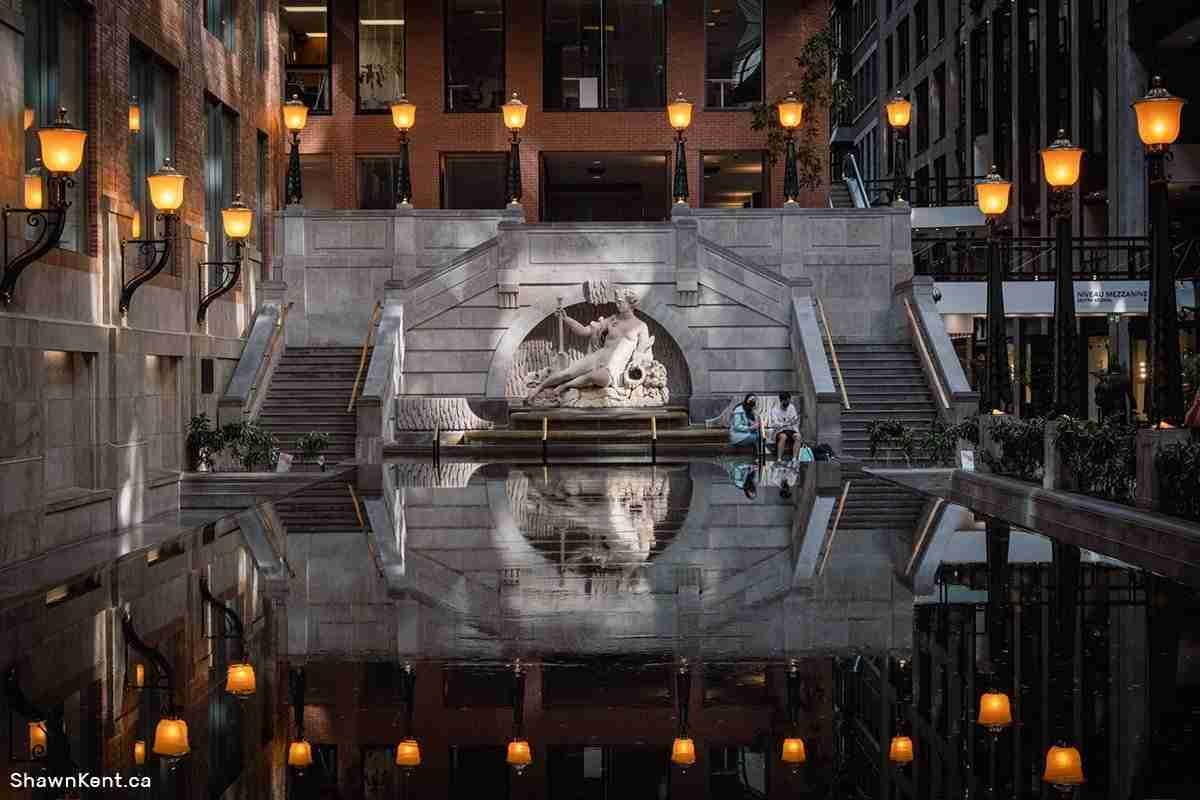
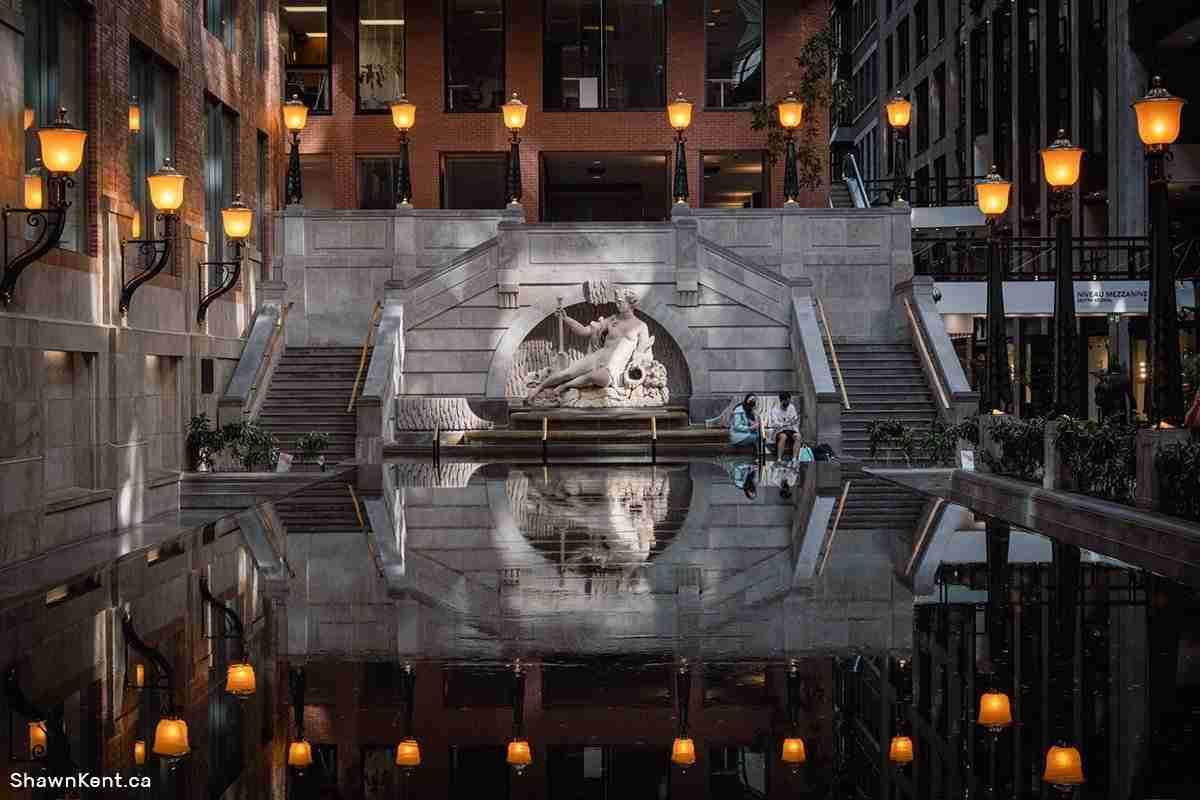
Set discreetly in the heart of downtown Montréal, the Centre de Commerce Mondial is an elegant blend of restored 19th-century architecture and contemporary design, unified under a soaring glass atrium. This indoor urban space—part business complex, part cultural passage—incorporates historic facades, iron balconies, and polished stone into a luminous, linear environment anchored by a central reflecting pool. Known to photographers for its clean geometry, moody reflections, and the surprising presence of a Berlin Wall fragment, it's a hidden gem for those who appreciate minimalist framing, symmetry, and the subtle drama of light. Regardless of the season outside, the Centre provides a weatherproof canvas for architectural compositions rich in rhythm and reflection.
Best Photography Opportunities
• Reflecting Pool and Berlin Wall Fragment
: The reflecting pool is the compositional centerpiece of the Centre. Its long, uninterrupted surface mirrors both the ornate facades and the rhythm of the overhead lighting, creating a perfect axis for symmetrical photography. Position your tripod low along the pool's edge and use a wide-angle lens to emphasize the vanishing lines created by the stone columns, metal lamps, and upper balconies. The Berlin Wall fragment at the far end introduces a dramatic historical contrast to the otherwise orderly architecture. Its graffiti-splashed concrete disrupts the clean aesthetic and provides a focal point with documentary significance. For best results, photograph this scene when the ambient lighting is soft—early in the morning or in late afternoon—so reflections remain crisp and unbroken.
• Architectural Symmetry and Interior Façades
: On both sides of the atrium are preserved 19th-century facades, once exterior walls now framed within a glass ceiling. Their archways, stone sills, and wrought-iron balconies repeat with satisfying precision, creating a visual rhythm that is ideal for centered, symmetrical compositions. From the main central walkway, frame shots that draw the eye down the spine of the space, incorporating ceiling beams and lamps for added dimensional layering. These compositions are particularly strong when shot with a tilt-shift lens to maintain clean verticals, or with a standard zoom and careful leveling. The symmetry isn't just horizontal—look upward to capture the vertical balance between roof, railings, and ground. Subtle differences in masonry tone and window shape offer variation within the symmetry, rewarding close observation.
• Second-Level Balcony Views and Overhead Geometry
: The upper walkway provides an elevated vantage point, perfect for photographing both across and down into the atrium. From here, you can compress the depth of the space using a medium telephoto lens, capturing the intricate repetition of arches, lamps, and reflective flooring. This bird's-eye angle reveals geometric layers that are harder to appreciate from ground level. Use the curve of the second-level railings as a foreground anchor to give your composition depth, or shoot straight down for more abstract, flattened interpretations. Late morning or mid-afternoon light streams in from the glass ceiling and strikes the upper facades directly, revealing texture and creating soft contrast across the masonry and balconies.
• Abstract Reflections and Detail Studies
: The Centre is a dream location for photographers who thrive on minimalism and abstraction. The interaction between polished floors, reflective pool water, ironwork, and glass surfaces creates constant opportunities for layered, interpretive imagery. Use a fast prime or standard zoom to isolate reflections of lamps or windows in the pool surface, focusing on how light bends and softens along the water's edge. You'll also find repeating textures in the walls—smooth limestone, weathered brick, and glossy tiles—that can be framed individually or used as graphic backdrops. For high-impact compositions, combine multiple layers—shoot a stone arch reflected in the pool, backlit by the atrium's ceiling grid. These images are most effective in indirect light, when contrast is lower and tonal range can be controlled without hard shadows.
• Human Scale and Environmental Portraits
: The space's clean lines and rhythmic structure make it ideal for placing people within frame to emphasize scale or solitude. A lone figure walking the length of the reflecting pool becomes a focal point within the ordered architecture, adding narrative without disrupting symmetry. Use a wide aperture for shallow depth of field portraits in front of textured backgrounds like the Berlin Wall segment or arched stone windows. Conversely, stop down to f/8 or higher to retain full environmental context. Whether capturing a candid passerby or a posed subject, the Centre lends itself to contemplative compositions—especially in early morning or evening when the space is quieter and the lighting more dramatic.
• Evening Mood and Blue Hour Exposures
: After sunset, the Centre de Commerce Mondial transforms into a more atmospheric space. Warm interior lighting reflects off the tile floors and calm water, while shadows deepen along the stonework and iron fixtures. This is the perfect time to shoot long exposures, particularly from the second level or along the pool, capturing the interplay between architectural light and ambient tone. Reflections become more subdued but still defined, and human silhouettes take on added drama when positioned against the softly glowing lamps or illuminated glass panels. Use a tripod to keep exposures sharp and experiment with framing both high and low for moody, cinematic compositions.
Best Time to Visit
Though enclosed and sheltered from weather, the Centre's photographic atmosphere shifts with the day's light. The best time to visit is mid-morning between 9:30 and 11:30, when the sun is high enough to illuminate the upper glass ceiling and cast soft, directional light across the stone facades and reflecting pool. This natural light adds warmth and dimensionality without overpowering the balanced interior exposure.
Late afternoon, after 3:00, brings more shadow into the lower levels while the upper balconies remain lit. This interplay of bright and shaded zones is ideal for detail work and layered compositions, especially when capturing contrast between textures or incorporating people into the scene.
Early morning, just after opening, offers the quietest experience, perfect for centered compositions, uninterrupted long exposures, and working with a tripod. Cloudy days produce a softbox effect from the overhead glass, minimizing harsh contrast and allowing more flexibility in exposure. Blue hour transforms the space into a glowing corridor of ambient warmth and soft reflections, best captured with longer exposures to bring out the architectural lighting without sacrificing detail.
During holidays, expect additional lights and decorations, which may enhance or complicate compositions depending on your style. For clean architectural shots, weekdays are generally better, while weekends are ideal for street photography and environmental portraits.
How to Get There
The Centre de Commerce Mondial is located at 747 Rue du Square-Victoria in downtown Montréal. The easiest access is via the Square-Victoria–OACI metro station on the Orange Line, which connects directly through Montréal's underground pedestrian network (RÉSO). Street-level entrances are available on Rue Saint-Antoine and Rue Saint-Pierre.
If approaching from Old Montréal, it's less than a ten-minute walk via Rue McGill or Rue Saint-Jacques. Underground parking is available on-site, though street parking is limited. The building is open to the public during standard business hours, with certain areas remaining accessible later into the evening due to connected restaurants and cafés.
Photography is permitted throughout the space for personal use. Tripods are generally tolerated if used respectfully and not during peak business hours. For commercial work, additional permissions may be required through the property's management.
Recommended Photography Gear
A wide-angle zoom (16–35mm) is the most essential lens for this space, allowing you to capture the length of the reflecting pool, the full height of interior façades, and the geometry of the ceiling from both ground and balcony levels. Pair it with a standard zoom (24–70mm) for framing architectural details, Berlin Wall close-ups, and portraits with surrounding context.
A fast prime lens (35mm or 50mm f/1.4–f/1.8) is perfect for handheld shooting in lower light and for abstract studies with shallow depth of field. This is especially useful when isolating reflections or details in the tile, glass, or wrought iron elements.
Bring a lightweight tripod for long exposures during early morning or evening shoots. It's especially useful along the reflecting pool or when photographing the upper floors in dimmer light. A circular polarizer helps control glare from the water and tile surfaces, particularly on brighter days. A microfiber cloth is necessary to keep optics clear in an environment with reflective surfaces and indoor humidity.
A compact camera bag that allows quiet, unobtrusive shooting is ideal for this professional setting. Avoid flash and bulky accessories unless shooting outside of peak hours or with explicit permission.
Nearby Photography Locations
• Notre-Dame Basilica of Montréal
: Just a ten-minute walk away, this cathedral offers an opulent Gothic Revival interior with blue ceilings, gold detailing, and radiant stained glass. Best photographed in the morning for controlled lighting and fewer visitors, it's a must for any architectural photographer visiting Montréal.
: Directly across the street, this convention center features a massive glass façade made up of multi-colored panels. When sunlight streams through, the resulting shadows and reflections cast onto the floor and walls are perfect for abstract and color-based compositions.
: Just southeast of the Centre, this historic district offers cobblestone streets, 18th-century buildings, and classic European-style façades. Early morning and golden hour are ideal here, especially for capturing storefront textures, street life, or ambient urban scenes.
: One of the few authentic Parisian Art Nouveau métro entrances outside France, this cast-iron structure stands at the corner of the square. It makes a unique foreground element or standalone subject, especially when framed with modern skyscrapers behind it.
: Located just north of the Centre, this open-air plaza features the dynamic fountain sculpture "La Joute" by Jean-Paul Riopelle. The sculpture's fire-and-mist performance at night offers a surreal photographic opportunity, particularly during long exposures.
The Centre de Commerce Mondial is more than a commercial hub—it's a sanctuary of shape, structure, and stillness in the middle of Montréal's vibrant core. For photographers, it provides a space where time seems to slow, lines converge, and the city's layers reveal themselves one reflection at a time.
Comments
Loading comments…