
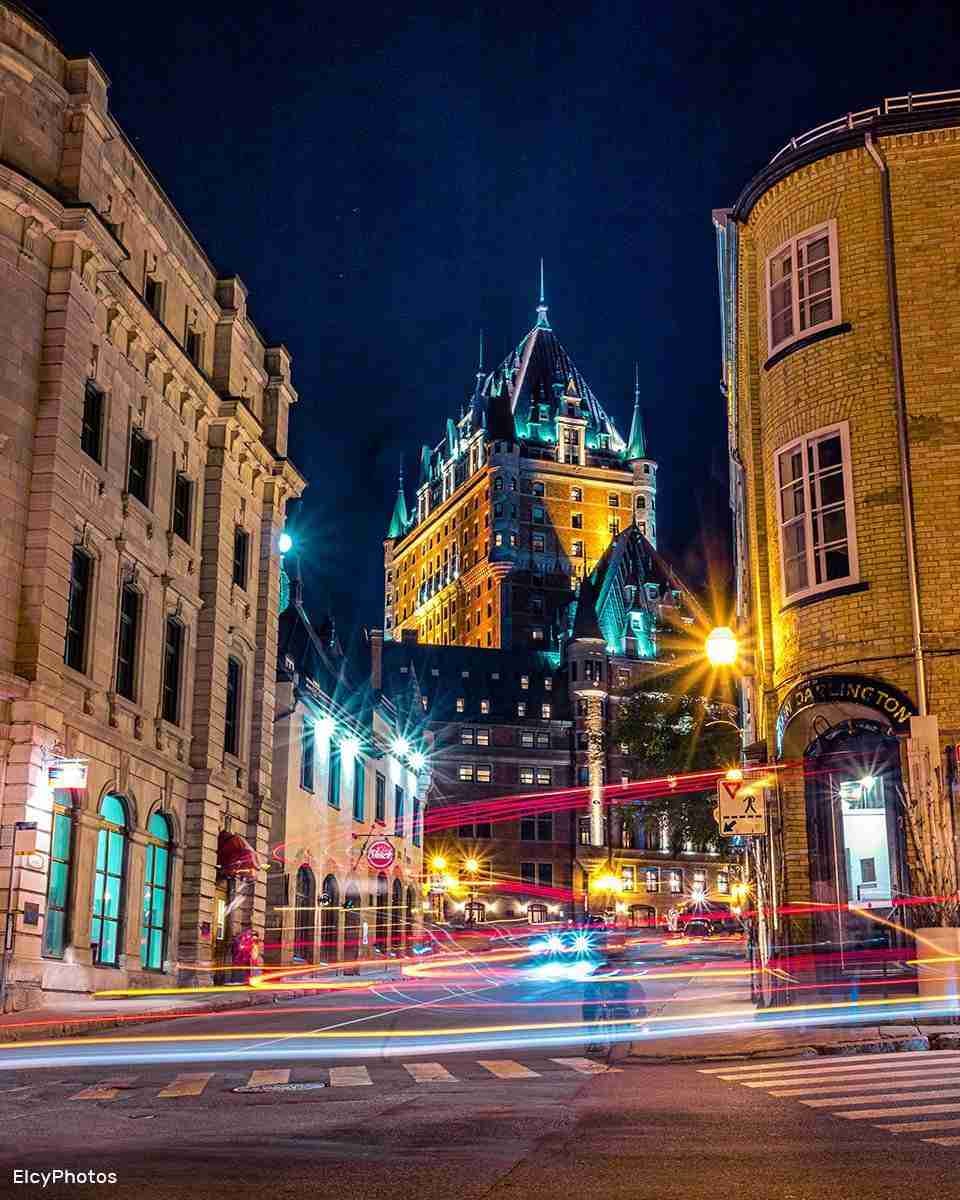
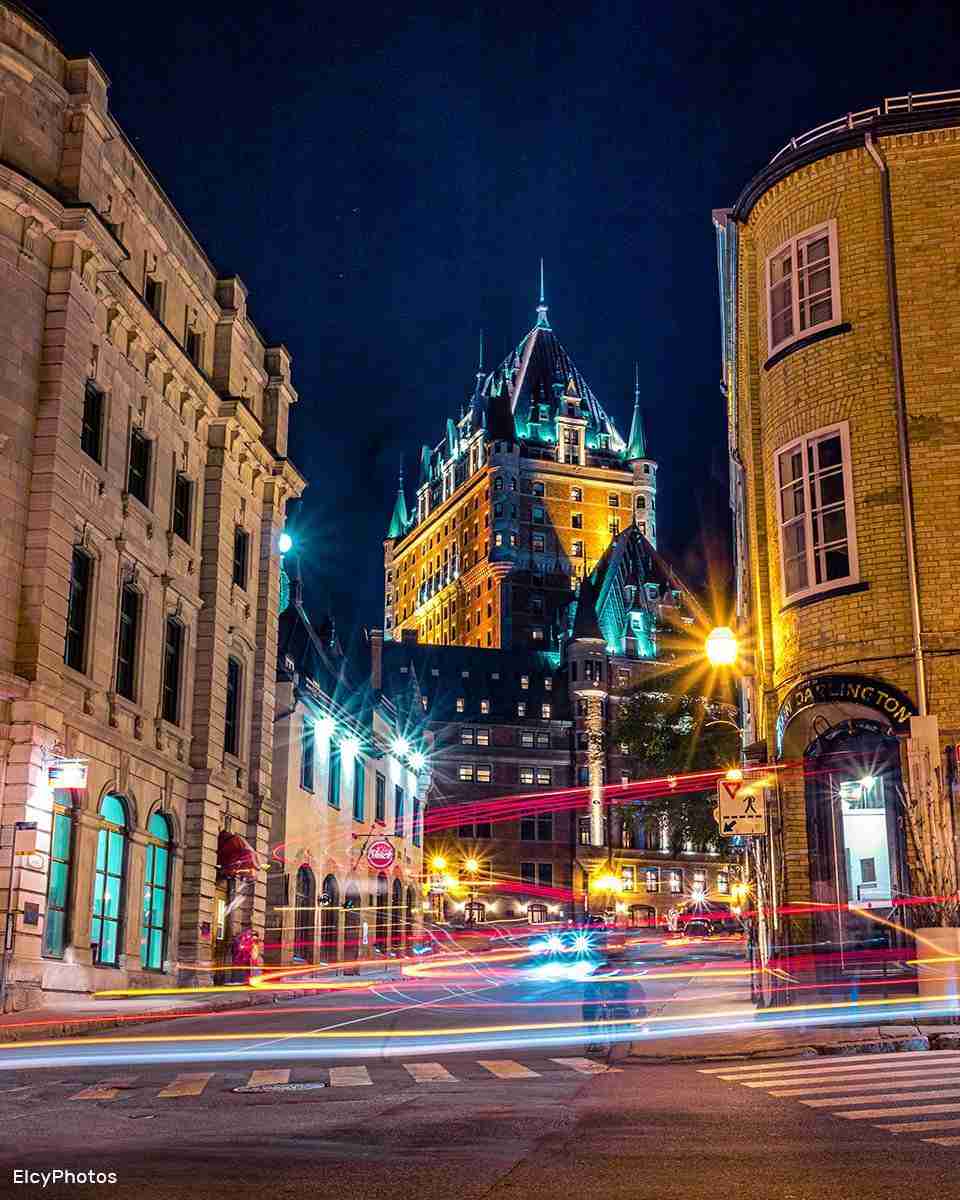
Tucked discreetly at the top of Old Quebec, Fort Street (Rue du Fort) is one of the city's most rewarding photographic vantage points—quiet, steep, and perfectly aligned with the majestic Château Frontenac. This short, unassuming street acts as a compositional funnel, drawing the eye straight up to the illuminated turrets and stone grandeur of the château perched above the old town. By day, it offers balanced urban frames filled with texture and architectural rhythm. But it's in the evening, as golden light fades and the city's glow emerges, that Fort Street becomes something rare: a natural lead-in to one of the most photographed hotels in the world, rendered anew with mood, geometry, and light.
Best Photography Opportunities
• Evening alignment with Château Frontenac
The defining shot from Fort Street is composed from the lower end of the hill, looking directly up toward the Château Frontenac. As twilight descends, the streetlights flicker on, casting warm pools of light on the cobblestones while the château's turrets glow softly against the darkening sky. A tripod and wide-angle lens are essential here—this is a shot that thrives on symmetry and edge-to-edge sharpness. Use a small aperture (f/8–f/11) for deep depth of field, and time exposures to balance residual sky color with the warm tones of the city's lighting. Blue hour, when the sky holds cobalt tones and windows begin to glow, is ideal.
• Side-angle compositions with layered architecture
Standing near the midpoint of Fort Street and pivoting slightly allows you to frame the château in the background with classic Old Quebec buildings in the foreground. These compositions benefit from using a mid-range zoom or standard prime to compress the perspective, creating a layering of textures—brick, copper roofs, balconies, and stonework. Side lighting during golden hour adds definition and shadow play, emphasizing the steep rise of the street and drawing attention to architectural features like wrought ironwork and wooden shutters.
• Window light and human elements at dusk
As night falls, the windows of the surrounding buildings reflect warm, ambient light that plays beautifully against the cool tones of stone walls. These small pockets of warmth can be used as leading elements or focal points. Including a passerby walking up or down Fort Street adds scale and narrative. A fast lens (35mm or 50mm) wide open can isolate a window, doorway, or streetlamp in softly diffused bokeh, perfect for storytelling images that focus on mood rather than broad context.
• Overcast detail studies and weather textures
On overcast or rainy days, Fort Street becomes a stage for texture: wet cobblestones, glistening bricks, mist hugging the rooftops. These conditions flatten contrast and emphasize tonality—ideal for black-and-white conversions or subdued color palettes. Get close to photograph reflections in puddles, or use a longer lens to isolate architectural fragments of the château peeking over rooftops. Even in poor weather, Fort Street retains its structure, giving photographers a dependable framework for minimalist, textural work.
• Early morning quiet and pastel skies
Although Fort Street's signature image is often an evening shot, early morning offers a peaceful alternative. Before the shops open and foot traffic returns, the street lies empty, bathed in soft light that filters over the rooftops and gently touches the upper façades. A pastel dawn sky behind the château can frame it in a cool, serene glow. This is the time for slower compositions—long exposures with no cars or pedestrians, carefully balanced white tones, and subtle detail.
Best Time to Visit
Evening and twilight are when Fort Street reaches its full potential. From sunset through blue hour, the balance of natural and artificial light creates depth and mood, and the glowing windows of the château add a fairy-tale ambiance to the frame. Arrive about 30 minutes before sunset to compose and wait for the optimal balance of light.
Winter adds another dimension, with snow softening surfaces and icicles framing rooftops. The château, lit warmly against the cold, becomes even more dramatic. Dress for freezing temperatures and prepare for low light—long exposures are a must.
Autumn offers crisp air, clean light, and occasional foliage that frames the buildings. In summer, early mornings and late evenings are the best times, as mid-day can flatten the street with overhead light and bring heavy tourist presence.
Spring's soft pastels and lingering blue hours after rain create reflective conditions ideal for moody, minimal compositions.
How to Get There
Fort Street is located in the heart of Old Quebec, just west of Terrasse Dufferin and directly below the Château Frontenac. From Rue Saint-Louis or Rue Sainte-Anne, walk uphill through the fortified gates of Old Quebec and continue toward the Château.
The nearest public transit stop is along Rue Saint-Jean, a few minutes' walk away. If arriving by car, limited paid parking is available in Old Quebec, particularly along Rue D'Auteuil and in nearby underground garages.
From the top of Fort Street, it's a short walk to Place d'Armes and the Upper Town promenade. The street is easily accessible by foot, though it is steep and cobbled—wearing stable shoes is advised, especially for dawn or evening shoots.
There are no photography restrictions, and the area is open to the public at all hours. Tripods are best used early or late in the day to avoid blocking the narrow sidewalk or drawing attention in busy periods.
Recommended Photography Gear
A wide-angle zoom (16–35mm) is essential for capturing the full upward alignment of Fort Street with the Château Frontenac framed between buildings. For tighter, layered perspectives or compressed street scenes, a mid-range zoom (24–70mm) provides versatility in quickly changing light.
A fast prime (35mm or 50mm f/1.4–f/1.8) is perfect for handheld twilight work, detail studies, or low-light moments when you want to shoot without a tripod. A compact travel tripod is useful for long exposures during blue hour, especially if you're capturing light trails or ambient window glow.
A circular polarizer helps cut glare off windows and wet cobblestones, especially after rain. A 3-stop ND filter can be useful for smoothing movement in passing clouds or creating slight motion blur in people walking through the scene.
In winter, bring extra batteries, as cold temperatures quickly drain power. In summer and autumn, pack a microfiber cloth—humidity and coastal mist can fog lenses quickly.
Nearby Photography Locations
• Château Frontenac and Terrasse Dufferin
Just above Fort Street, this broad boardwalk provides sweeping views over the St. Lawrence River and is perfect for wide vistas, architectural close-ups of the château, and golden hour skyline shots.
A narrow alley of art vendors and old-world charm. Ideal for street photography, intimate textures, and early morning quiet before the market stalls open.
Accessible via the nearby funicular or stairs, the Lower Town offers cobbled alleys, colorful storefronts, and reflective puddles. A great spot for twilight or holiday light shots in winter.
• Rue Saint-Louis
One of the most atmospheric streets in the Upper Town, it offers wrought-iron balconies, shopfronts, and lantern-lit scenes in the evening. Excellent for layering architecture and street life.
From this elevated area, capture sweeping views across Old Quebec, including aerial perspectives of Fort Street and the Château. Ideal for wide panoramas and sunrise work.
Fort Street is a subtle gem in a city rich with grandeur. It gives photographers a chance to frame the Château Frontenac in a way that feels personal and grounded—less postcard, more story. With light, patience, and the quiet rhythm of the old stones beneath your feet, this little street turns into a perfect stage for architectural poetry.
Comments
Loading comments…