
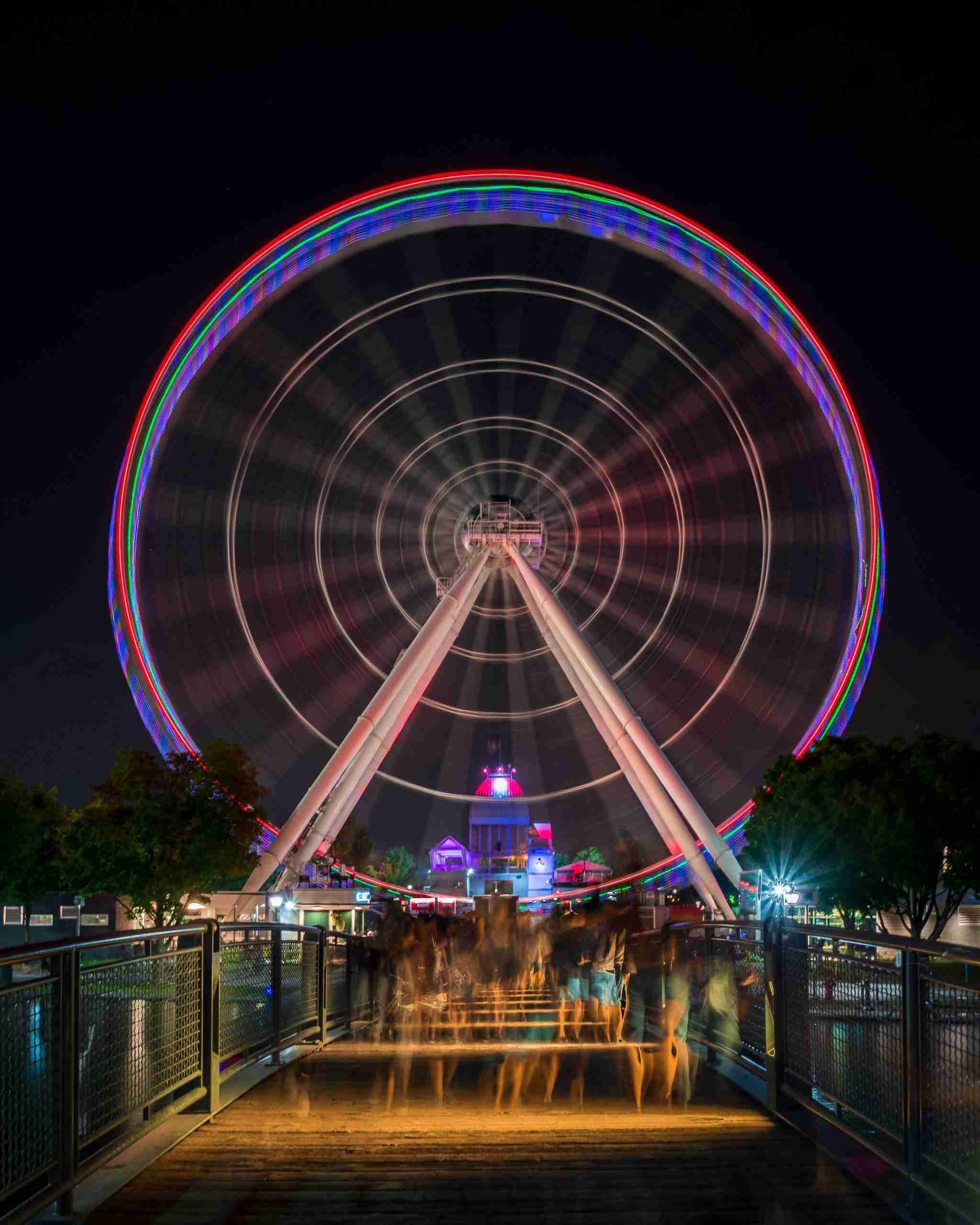
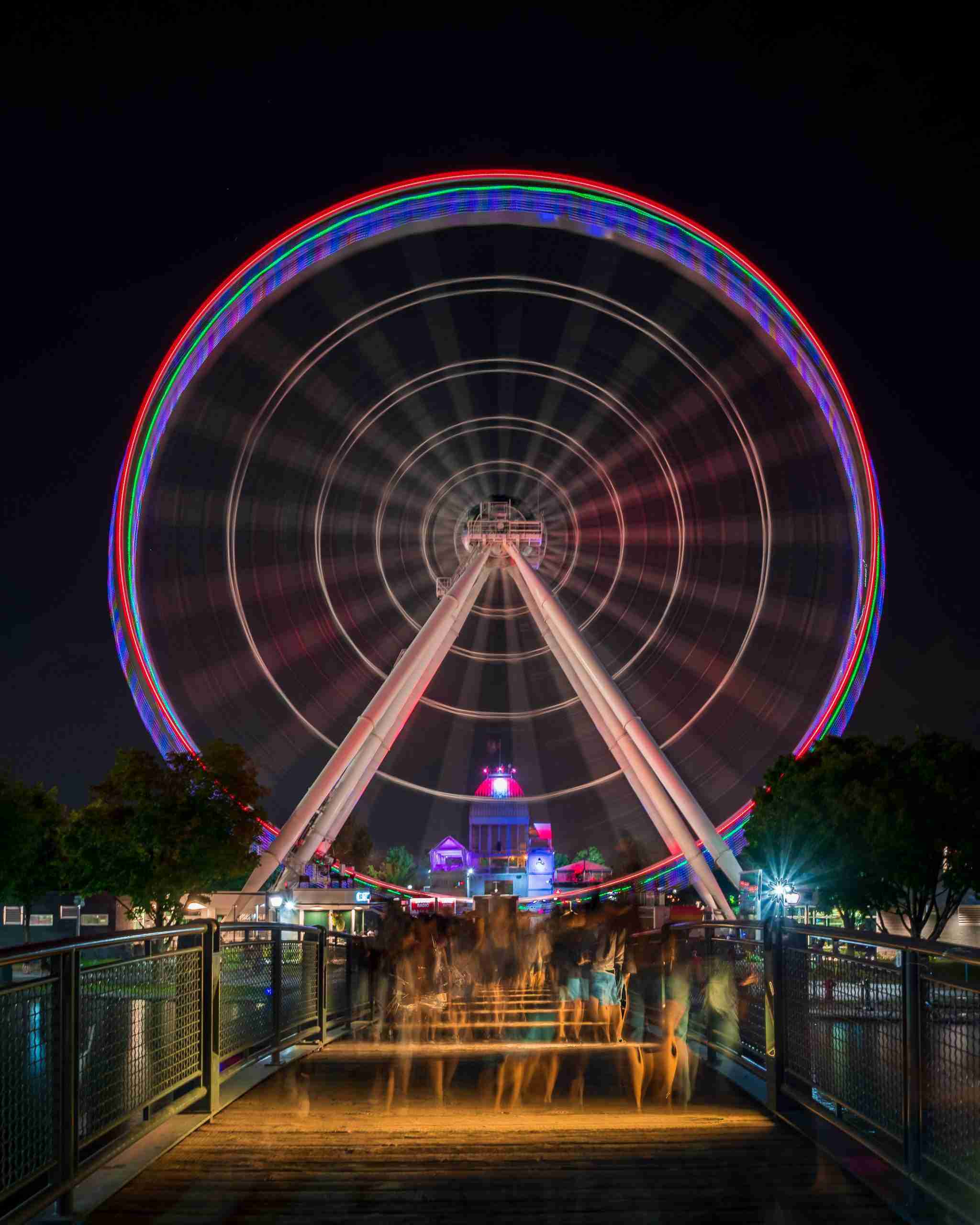
La Grande Roue de Montréal, located at the edge of the Old Port, is not only the tallest observation wheel in Canada but also one of the most visually commanding structures in the city's skyline. Standing 60 meters high, it offers photographers sweeping views of downtown Montréal, the St. Lawrence River, and the distant silhouette of Parc Jean-Drapeau. Whether viewed from a gondola or photographed from ground level, the wheel delivers both vertical scale and luminous presence—especially after sunset, when it becomes a glowing geometric beacon against the night.
Best Photography Opportunities
• Twilight Cityscapes from the Gondolas
Shooting from within one of the wheel's glass-enclosed cabins gives access to elevated panoramas over the Old Port and downtown skyline. Twilight is the ideal time to shoot from the top, as the fading ambient light balances with the city's artificial illumination. Use a fast lens and wide focal length to capture the curve of the river and the linear geometry of the city grid. Reflections on the glass can be minimized with a lens hood or polarizer. Shooting during twilight also reduces harsh contrast and allows the city's grid and skyline to glow evenly beneath the soft hues of the transitioning sky. Try framing the Biosphère or bridges in the distance to create layered urban depth.
• Long Exposures from the Waterfront Promenade
From ground level along the quays of the Old Port, La Grande Roue becomes a perfect subject for long-exposure work. Use a tripod and ND filter to smooth ripples on the river, blur pedestrian traffic, and turn the wheel's LED lighting into radiant, circular streaks. Frame the wheel against the water to capture reflections, or include the old port warehouses for added texture and architectural contrast. These compositions benefit from blue hour, when the balance of artificial and natural light creates a gentle gradient behind the wheel. Incorporating moving boats or reflections from nearby cafés enhances the sense of place.
• Framing the Wheel through Old Montreal's Architecture
Several narrow side streets and vantage points in Old Montreal allow for creative juxtapositions of the modern wheel with historic facades. These compositions work well in golden hour when sunlight warms the stone buildings, and the cooler tones of the wheel create color contrast. Look for arches, window frames, or alleyways to use as foreground elements that lead the eye toward the spinning centerpiece. Reflections in upper-story windows, wrought iron balconies, and climbing ivy add further texture to these scenes, grounding the ultramodern icon in the city's heritage.
• Nighttime Lightplay and Reflections
After dark, the ferris wheel becomes a brilliant focal point of the waterfront, cycling through programmable LED displays. This is the best time to work with reflections—either on wet pavement, standing water, or the glass surfaces of surrounding structures. Slow shutter speeds allow you to capture the dynamic movement of the lights as they wrap around the wheel's frame, creating layered, luminous effects. On rainy nights, the mirror-like quality of the cobblestones and puddles amplifies the wheel's presence, turning even short exposures into striking, graphic compositions.
• Seasonal Atmosphere and Event Integration
Throughout the year, La Grande Roue is integrated into the city's major events—from winter festivals and holiday markets to summer concerts and fireworks displays. Seasonal décor, weather conditions, and surrounding installations add ever-changing context. In winter, snow adds clarity and contrast, while foggy or rainy nights produce ethereal, high-atmosphere compositions that emphasize the wheel's illumination. During Montréal en Lumière or Canada Day celebrations, the surrounding area becomes a dynamic blend of light, performance, and color, with the wheel anchoring wide-angle or panoramic crowd scenes. Early spring offers melting snow, glowing reflections, and returning visitors that alter the tone of each shot.
Best Time to Visit
The most rewarding times to photograph La Grande Roue de Montréal are during late afternoon through blue hour and into the evening. Sunset provides ideal ambient light for cityscape work, while blue hour allows a perfect balance between the natural fading light and the illumination of the wheel itself. At night, its LED lights become a standalone subject, offering endless color variation and motion effects. These transitions between daylight and night allow photographers to produce distinctly different images from the same vantage point.
In summer, the golden hour casts warm light across the Old Port, creating strong contrast and vibrant reflections in the water. The long days allow for extended shooting sessions and capture the energy of peak tourist season. Autumn introduces a richer color palette with fewer crowds, and the low-angle sunlight brings out the textures of nearby buildings. In winter, the wheel takes on a minimalist appearance amid falling snow, and the contrast between its lights and a subdued landscape produces atmospheric, storybook-like compositions. Mornings can also offer moody fog or pink-toned skies that cast a dreamy quality over the entire scene.
It's also worth timing your visit with special event calendars. Fireworks displays, holiday markets, and festivals like Montréal en Lumière add additional layers of light and energy to the area. Arriving early helps with tripod placement and composition scouting, especially during busy periods. For those interested in timelapse or sequential shooting, the blue hour offers the most dynamic shift in conditions.
How to Get There
La Grande Roue de Montréal is located in the heart of the Old Port (Vieux-Port de Montréal), directly along the Rue de la Commune and near Bonsecours Basin. It is easily accessible by foot from Old Montreal, with several metro stations nearby, including Champ-de-Mars and Place-d'Armes. Parking is available in nearby public lots, though walking or biking is often more efficient, particularly on weekends and during festivals.
The observation wheel operates year-round, with heated gondolas available in winter and climate control in summer. Photographers can shoot both from within the wheel and from multiple exterior vantage points throughout the port area. Tripods are permitted on the grounds but are not allowed inside the gondolas. For best access to long-exposure spots, arrive before dusk to scout and set up before the crowds gather.
Recommended Photography Gear
A wide-angle lens (16–35mm) is ideal for capturing the scale and position of La Grande Roue from nearby walkways, especially when working with reflections, light trails, or sky transitions. When shooting from within the gondola, a wide lens will also help frame the panoramic skyline below. A mid-range zoom (24–70mm) is useful for context-rich compositions, allowing you to balance the wheel with surrounding architectural or waterfront elements. This lens also performs well in tight spaces or when integrating foreground details into the broader scene.
For detail shots, light displays, and compressed cityscapes, a telephoto lens (70–200mm) is indispensable. It lets you isolate the interplay of color and motion in the lights or frame architectural elements across the river. A macro lens may come in handy during winter to photograph frost patterns on glass or fine textures in nearby snow-covered structures.
A sturdy tripod is critical for evening and night photography, enabling long exposures and precise framing, particularly when working with reflections or light trails. A remote shutter or intervalometer helps reduce shake during long exposures and is useful for time-lapse sequences. ND filters are beneficial during the day to blur movement in clouds, crowds, or water, and a circular polarizer deepens color contrast while managing reflections. Always carry a lens cloth and rain cover, as weather can change quickly and waterfront conditions often produce mist or condensation.
Nearby Photography Locations
Just steps from the wheel, this calm body of water provides symmetrical reflections of La Grande Roue, especially at night. The nearby Bonsecours Market adds elegant domed architecture to frame or contrast with your shots.
A slightly elevated platform further into the river, this spot offers panoramic views of the wheel, Old Montreal, and city skyline. Excellent for wide cityscapes at sunset and during fireworks shows.
This historic square connects the port to Old Montreal's busiest tourist corridor. Street performers, horse-drawn carriages, and historic facades provide layers of street photography opportunities that complement architectural images of the wheel.
Located further down the port, this location provides a more distant view of the wheel and riverfront. Ideal for sunrise compositions, beach shots, and using the tower as a vertical anchor in skyline images.
• Parc Jean-Drapeau and the Biosphère
Across the river, this island park offers a full reverse view back toward the wheel and downtown. Particularly strong for twilight and blue hour skyline shots that include La Grande Roue in context.
La Grande Roue de Montréal offers more than just a ride—it's a rotating monument to the city's modern identity, providing photographers with endless perspectives, changing light, and dynamic urban contrasts. Whether you're seeking sweeping skyline views or detailed nighttime compositions, this luminous landmark brings elevation, rhythm, and color to the heart of the cityscape.
Comments
Loading comments…