
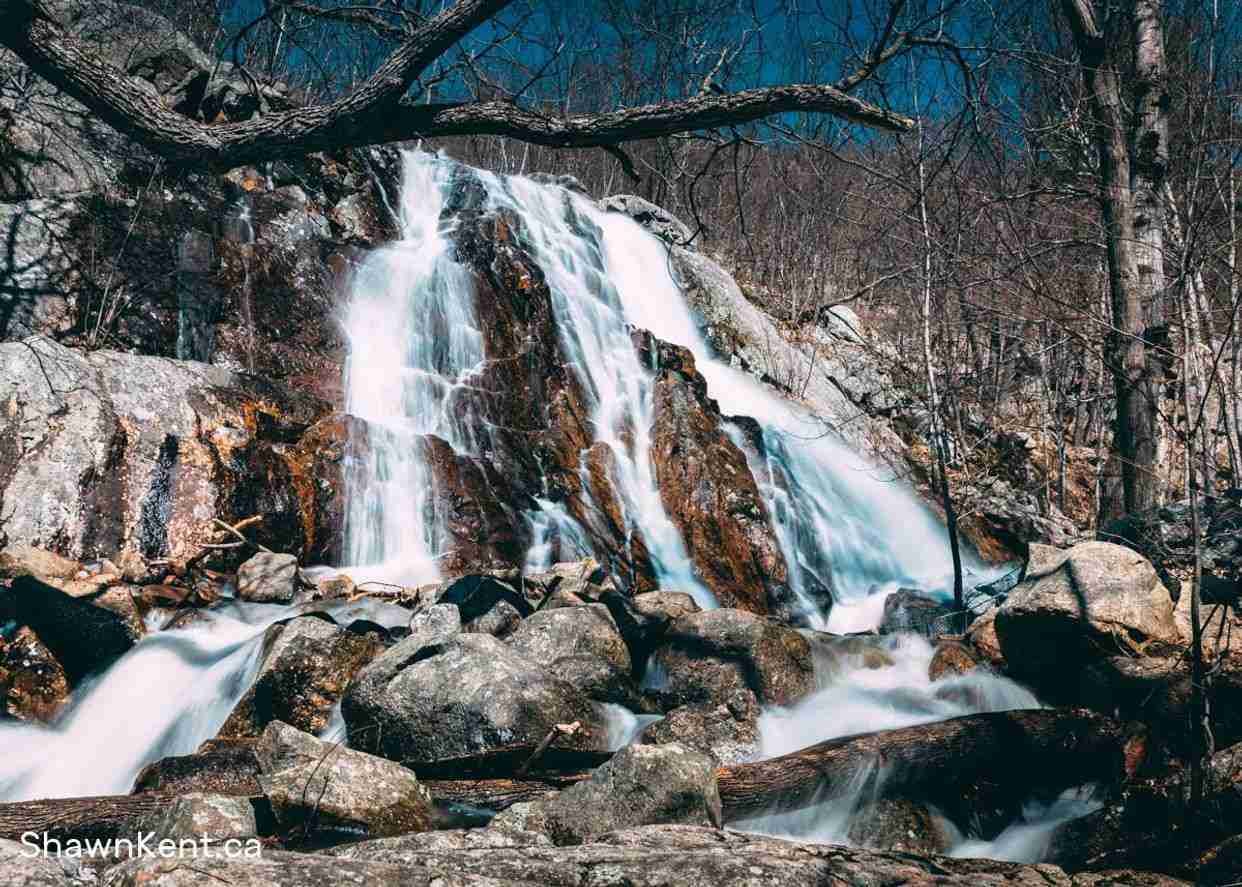
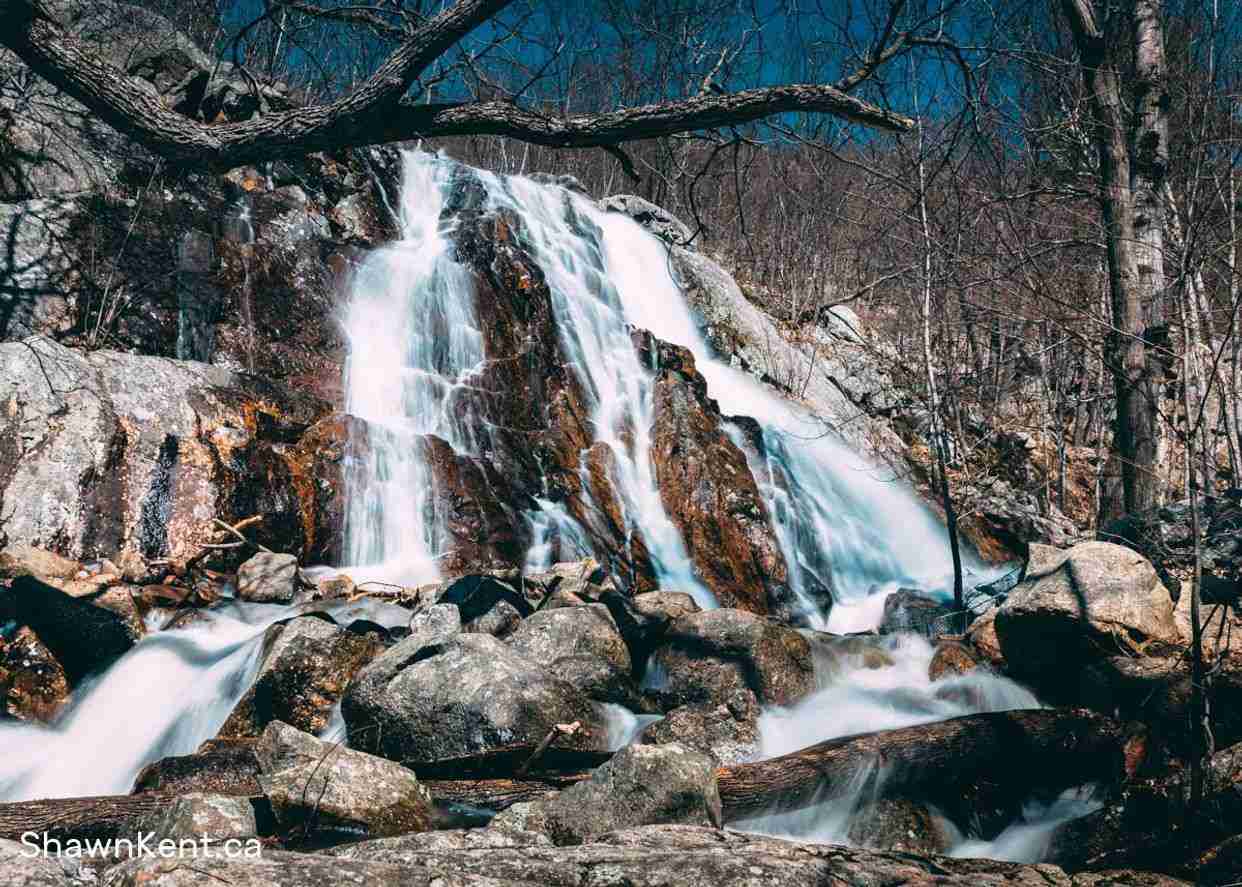
Luskville Falls Trail, tucked along the Eardley Escarpment on the western edge of Gatineau Park, is a favorite among local hikers—and a rewarding challenge for photographers seeking natural spectacle and elevation in the National Capital Region. The trail leads first to the namesake waterfall, which cascades down jagged rock faces in a series of sharp drops and angular ledges. During the spring melt, it's a striking vertical feature surrounded by newly green forest and steep geological forms. Continue past the falls, and the trail rises sharply to one of the region's most panoramic vistas: the Luskville Lookout. The route is steep and rocky, but every stage offers layered compositions of cliffs, trees, and water, making this one of Gatineau Park's most dynamic locations for nature photography.
Best Photography Opportunities
• Lower waterfall views framed by cliffs and vegetation
The base of Luskville Falls presents the most accessible and visually concentrated subject on the trail. Here, water flows down a jagged rock face surrounded by moss, exposed roots, and clusters of seasonal foliage. The fall's layered descent over the uneven stone allows photographers to experiment with both wide and tight compositions. Use a wide-angle lens to capture the water in the context of the surrounding cliffside, or a mid-range zoom to focus on segments of the cascade where water interacts with light, shadow, or plant life. In early spring, meltwater amplifies the force and volume of the falls, making long exposures especially effective. Positioning yourself off to the side allows foreground rocks or ferns to lead the eye upward toward the flowing water.
• Trail ascent perspectives with elevation and texture
As the trail climbs, its steep, rocky switchbacks offer opportunities to photograph the drama of ascent. These compositions work well when framed with hikers, twisted tree roots, or stone outcrops to emphasize the vertical terrain. Use a narrow aperture to maintain depth across foreground and background, and look for side-lighting in the early morning or late afternoon that enhances the texture of the rock and defines the trail contours. In spring and early summer, the contrast between new vegetation and exposed bedrock adds complexity to otherwise monochromatic cliff scenes.
• Top-down shots of the waterfall from the upper trail
Past the main viewpoint, the trail crosses above the falls, providing a more abstract opportunity to photograph the water as it breaks over the ledges below. From above, the falls appear less dramatic in volume but reveal intricate patterns in water flow and rock shape. This perspective benefits from a mid-range zoom or telephoto lens, allowing you to compress distance and focus on the geometry of stone and stream. Polarizers help manage reflection and water clarity, particularly when shooting in high sunlight.
• Expansive ridge views from Luskville Lookout
The ultimate reward for continuing the climb beyond the falls is the Luskville Lookout, a rocky ridge offering broad views across the Ottawa Valley. The treeline parts here to reveal an unobstructed horizon—ideal for wide panoramic landscape compositions. Sunrise and late golden hour deliver the best conditions, as the low sun angles cast warm light across the valley and create long shadows over the cliff face. Foreground interest comes from lichen-covered rock, low-growing evergreens, and trail markers that can guide visual structure. Use a tripod and graduated ND filter to manage dynamic range between sky and ground, especially on clear days when the contrast can be severe.
• Seasonal trail details and changing atmospheric conditions
While the primary draw is the waterfall and lookout, the trail itself transforms dramatically throughout the year. In spring, ephemeral wildflowers bloom along the trail's edge, and streams of water trickle over rock faces from snowmelt higher up. In summer, the vegetation becomes dense and light filters through leaves, creating patterned shadows along the trail. Autumn colors ignite the hardwood trees below the escarpment, adding a warm canopy for shots taken mid-trail or from the ridge. Winter access is limited, but early or late season snow can offer unusual combinations of bare rock, white drifts, and bright morning sky for minimal, contrast-rich images.
Best Time to Visit
Luskville Falls is best visited in spring—April through early June—when the snowmelt from higher elevations produces a strong, visually dynamic waterfall. The stream flows fullest at this time, and the trail remains passable though wet. This is also when vegetation begins to return, providing early-season contrast between the green forest floor and bare stone.
Summer brings lush growth, stronger light, and often a slower-moving waterfall. The falls may reduce to a trickle in dry months, but the lookout remains a prime subject, and forest light becomes more dappled and atmospheric. Visit early or late in the day to avoid harsh overhead light and the crowds that frequent the trail on weekends.
Autumn is less dramatic in terms of water flow, but the foliage more than makes up for it. Vibrant leaves blanket the trail and valley below, and the views from the lookout become layered tapestries of red, orange, and gold. Cloudy days during this period are ideal for preserving even light and avoiding blown highlights in colorful leaves.
Winter access is more limited and only recommended for experienced hikers with proper gear. The trail is steep and exposed, and snow and ice complicate the route. However, the frozen waterfall and bare forest can be used for abstract compositions and minimalist scenes if approached cautiously.
How to Get There
Luskville Falls is located in the municipality of Pontiac, Quebec, approximately 40 minutes from downtown Ottawa. From Ottawa or Gatineau, take Highway 148 west toward Luskville and follow signs to Luskville Falls Trail. The entrance is clearly marked and includes a gravel parking lot at the trailhead.
The trail is approximately 4.2 kilometers round-trip with an elevation gain of about 300 meters. The first 10 minutes lead to the base of the falls, while the remainder of the trail ascends steeply to the lookout. Hikers should wear sturdy footwear and be prepared for a demanding climb. In wet conditions, the trail can be slippery, especially near the rock faces, so care should be taken when positioning for photos.
There are no facilities beyond basic trail signage and occasional benches. Cell reception may be weak along the trail, so plan accordingly. For photographers, sunrise and early morning sessions are ideal not only for light but for reduced foot traffic and cooler climbing conditions.
Recommended Photography Gear
A wide-angle zoom (16–35mm) is invaluable for capturing the height of the waterfall, the expansive views from the lookout, and the steep trail compositions. A mid-range zoom (24–70mm) offers flexibility for capturing details in the rock face, tight waterfall compositions, and isolated tree forms.
A tripod is essential for long exposures of the falls, particularly in low light or when using ND filters to smooth water motion. A circular polarizer helps reduce glare on wet rock surfaces and saturates foliage, particularly in spring and fall.
A telephoto lens (70–200mm) is recommended for compressing distant ridge views, pulling details from the valley below, or isolating movement in sections of the cascade from a safe distance. For those continuing to the lookout, consider a lighter tripod and minimal kit to reduce fatigue on the steep ascent.
Footwear with strong grip and weather-appropriate clothing are critical, as conditions can change quickly, and the climb demands good traction and mobility. Extra water and sun protection are recommended during warmer months, especially if planning to linger for golden hour shooting from the lookout.
Nearby Photography Locations
• Carbide Wilson Ruins
Located on the eastern side of Gatineau Park, these moss-covered industrial ruins beside a waterfall offer contrast to Luskville's natural setting. Ideal for long exposures, architectural textures, and forest atmosphere.
A short drive north of the Luskville trail system, this well-known escarpment viewpoint provides broad valley views and is a strong sunrise location for landscape photographers.
Nestled in a forested basin, this quiet lake is excellent for reflection shots, misty morning scenes, and softer, lower-elevation compositions. Visit early to avoid summer swimmers.
A vibrant green lake with multiple trail perspectives and elevated vantage points. Ideal for capturing mirrored water surfaces, layered reflections, and transitional light in all seasons.
A nearby moderate loop with rocky outcrops and panoramic views. Less steep than Luskville but with equally photogenic forest scenes and sunset ridge exposures.
Luskville Falls Trail offers photographers a rare combination in Gatineau Park—vertical drama, textured terrain, and wide-open sky. Whether you're capturing the force of spring runoff, the rich color of a fall forest, or the expansive view from the escarpment's edge, this trail delivers a full visual workout to match the physical one. For those who make the climb, the rewards are more than worth it.
Comments
Loading comments…