
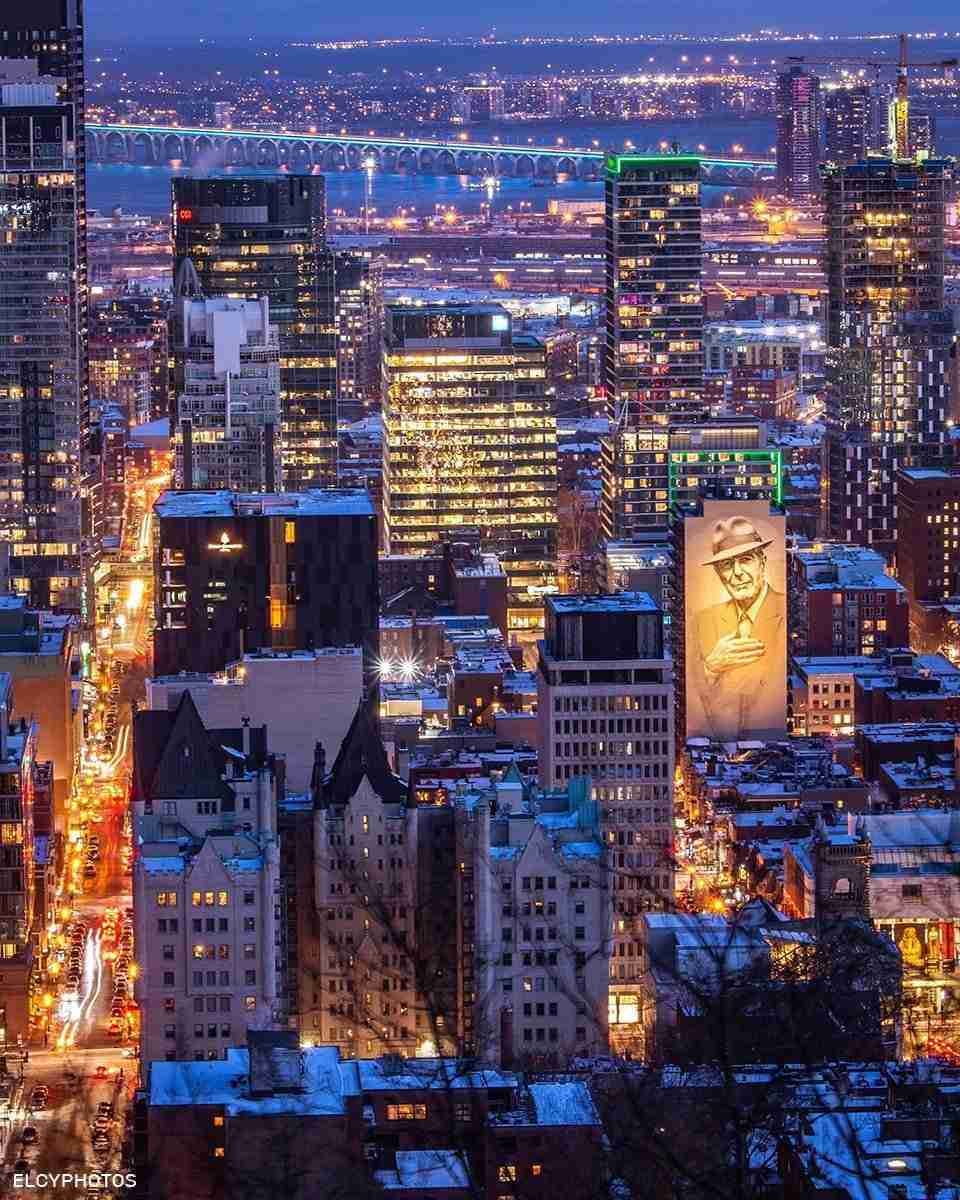
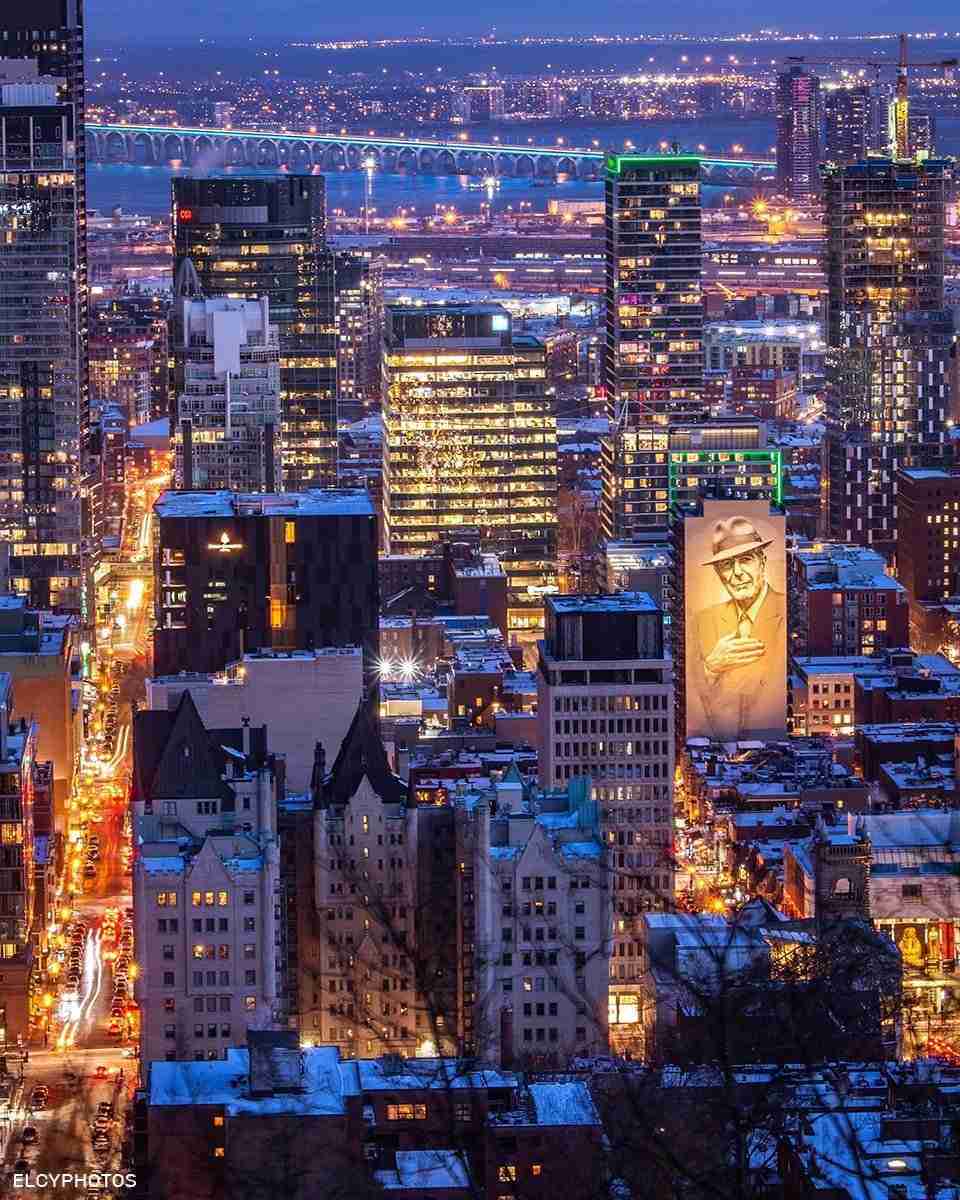
Mount Royal, the signature high point of Montreal's urban landscape, offers sweeping panoramic views of the downtown core, the St. Lawrence River, and the city's sprawling skyline. Among the many visual highlights visible from this iconic overlook is the towering Leonard Cohen mural—an evocative and emotionally charged piece of public art that appears to rise from the city itself. Painted across 21 storeys and covering more than 10,000 square feet, the mural depicts the legendary singer-songwriter with his hand to his heart, gazing upward as if in silent communion with the mountain.
Best Photography Opportunities
• Framed Skyline Composition from Kondiaronk Belvedere
The view from the main terrace at the Mount Royal Chalet is among the most photographed in the city, and for good reason. From this elevation, the city unfolds like a grid of geometry and color, anchored by the soaring presence of the Leonard Cohen mural. A medium-to-long telephoto lens (135mm–300mm) allows you to bring the mural forward in the frame while compressing the surrounding skyline into layers of visual interest. Including the mountain's ledge or railings in the foreground helps to contextualize the viewer's perspective and adds a sense of presence.
• Golden Hour with Sky Gradient and Silhouettes
At golden hour, the sun casts long shadows and envelops the city in a soft, amber glow. This is the time to shoot wide, incorporating silhouetted visitors along the terrace, layers of treetops, and the distant mural bathed in warm light. The sky often transitions through multiple tones during this window—orange, rose, and deepening blue—each providing a different emotional filter to your composition. Wait for moments when people pause at the railing for a natural, human focal point that echoes Cohen's contemplative gaze.
• Zoomed Detail Studies of the Mural Itself
Use a telephoto or super-telephoto lens to isolate the mural within its architectural environment. On clear days, you can frame just the mural and its immediate surroundings, capturing its subtle brushwork and the interplay of shadow across the folds of Cohen's jacket and hat. Including adjacent buildings or rooftop gardens provides a textural and contextual layer that speaks to the mural's integration with the urban fabric. Cloudy skies offer excellent diffused light for maintaining mural detail without hard contrast.
• Black and White Interpretations for Mood and Texture
Leonard Cohen's legacy is steeped in atmosphere, and black-and-white interpretations of the mural play well with this aesthetic. Converting your cityscape shots into monochrome emphasizes contrast between the mural's soft tones and the sharp geometry of the buildings around it. This is particularly effective in winter when bare branches and snowy rooftops add graphic elements to the frame. Experiment with film simulations or high-contrast presets to explore different tonal expressions of mood and memory.
• Seasonal Variations from the Overlook
Each season reinterprets the mural through a different palette and atmosphere. In autumn, vibrant foliage on Mount Royal's flanks adds a dramatic splash of color that frames the downtown view. Snow in winter adds clarity, stripping the city of distractions and turning the mural into a focal point against a soft, neutral background. Spring offers pink morning haze and the first green returns to the treetops, while summer brings lush fullness that contrasts the urban grid. Returning throughout the year gives you a comprehensive visual journal of Cohen's watchful presence amid Montreal's evolving seasons.
Best Time to Visit
Photographing the Leonard Cohen mural from Mount Royal is all about timing. Mornings offer a clean, crisp atmosphere with long sidelight from the east that adds volume and warmth to the mural's features. The air is usually clearer at this time, allowing for fine detail in distant buildings. Weekday mornings are particularly quiet, offering unobstructed access to the railing and minimal crowd interference.
Golden hour is arguably the best period for capturing this scene with emotional depth. The shifting colors in the sky and the slow descent of shadows across the skyline create constantly changing compositions. During the height of summer, golden hour stretches longer, allowing photographers time to try multiple focal lengths, angles, and exposures without rushing.
Blue hour is especially effective for creating mood-rich cityscapes. As lights begin to illuminate windows and street grids below, the mural remains softly visible, anchored in the ambient twilight. Long exposures allow for light trails and a smoothing of urban chaos, lending a meditative quality to the image—perfectly in tune with Cohen's own aesthetic.
Fall and winter provide the clearest sightlines due to the absence of leaves on surrounding trees. They also offer the richest atmospheric changes—from crisp golden sunlight to softly falling snow, each casting the mural in a dramatically different light. Avoid midday unless you're aiming for architectural clarity; the harsh light tends to flatten textures and heighten glare.
How to Get There
To reach the most iconic viewpoint of the mural, head to Mount Royal Park and make your way to the Kondiaronk Belvedere, adjacent to the Mount Royal Chalet. The most direct access is by foot, either via the serpentine trail from Smith House or by climbing the long staircase from Peel Street. Both offer scenic views and are well-maintained throughout the year.
If arriving by car, park near Smith House on Remembrance Road and walk the short distance to the terrace. Public transit options include the #11 bus from Mont-Royal Metro station, which stops near the eastern side of the park. Cycling is also popular in warmer months, with bike paths leading to the main plateau.
The belvedere is open year-round and free to access. It's fully accessible, with paved paths and ramps. Tripods are permitted, though space can be limited during peak times such as weekends and festivals. Early arrival or a visit during shoulder seasons ensures the most flexible shooting environment.
Recommended Photography Gear
To photograph the Leonard Cohen mural from Mount Royal, bring a versatile kit that can handle both wide cityscapes and isolated details. A telephoto lens (70–200mm or even 300mm) is crucial for isolating the mural and compressing the skyline into visually rich compositions. Consider bringing a 24–70mm zoom for contextual skyline shots that include people, terrace foregrounds, or wider scenes.
If you want to shoot handheld during low light, use fast lenses with wide apertures—f/2.8 or wider is ideal. Cameras with good high-ISO performance allow you to maintain sharpness in changing conditions. For long exposures, especially during golden and blue hour, a sturdy tripod is essential.
A circular polarizer helps enhance contrast and clarity on clear days, particularly when dealing with window glare or haze from the city. Graduated ND filters can help manage the balance between bright skies and darker buildings during sunset. A remote trigger or intervalometer is useful for timed exposures or timelapses as the city lights shift.
In colder months, bring weather protection for both yourself and your equipment. Batteries drain faster in low temperatures, so keep spares close to your body. A microfiber cloth will be helpful year-round for dealing with mist, fingerprints, or lens flare.
Nearby Photography Locations
A short hike past the belvedere leads to the iconic Mount Royal Cross. From here, photographers can capture expansive views of the city or focus on silhouettes against the sky. Early morning or twilight are best for photographing the illuminated cross.
Located on the opposite side of Mount Royal, this overlook provides a different visual experience, facing east toward the Olympic Stadium and the river. It's a quieter location ideal for long exposures and night photography.
• Saint Joseph's Oratory
One of the largest churches in Canada, this grand basilica atop Westmount's slope is striking in golden hour and offers interior photography opportunities as well. The steps leading to the oratory make for strong symmetrical compositions.
Head down the mountain to the Old Port for skyline shots that include Mount Royal itself. At dusk, the juxtaposition between modern downtown high-rises and the old city adds narrative richness to wide urban frames.
To experience the mural from the street level, walk to the base at Crescent and Sainte-Catherine. From here, you can photograph the scale of the piece in full vertical, include human interaction below, and create dramatic upward compositions that reveal its height and relationship with the sky.
Mount Royal doesn't just offer a sweeping view—it delivers a conversation between art, place, and memory. Framing the Leonard Cohen mural from this vantage isn't just a visual act, but a reflective one, where the artist's gaze meets your own and the city's voice becomes part of the frame. For photographers, it's a uniquely Montreal experience—one that invites you to return in every season, under every sky.
Comments
Loading comments…