
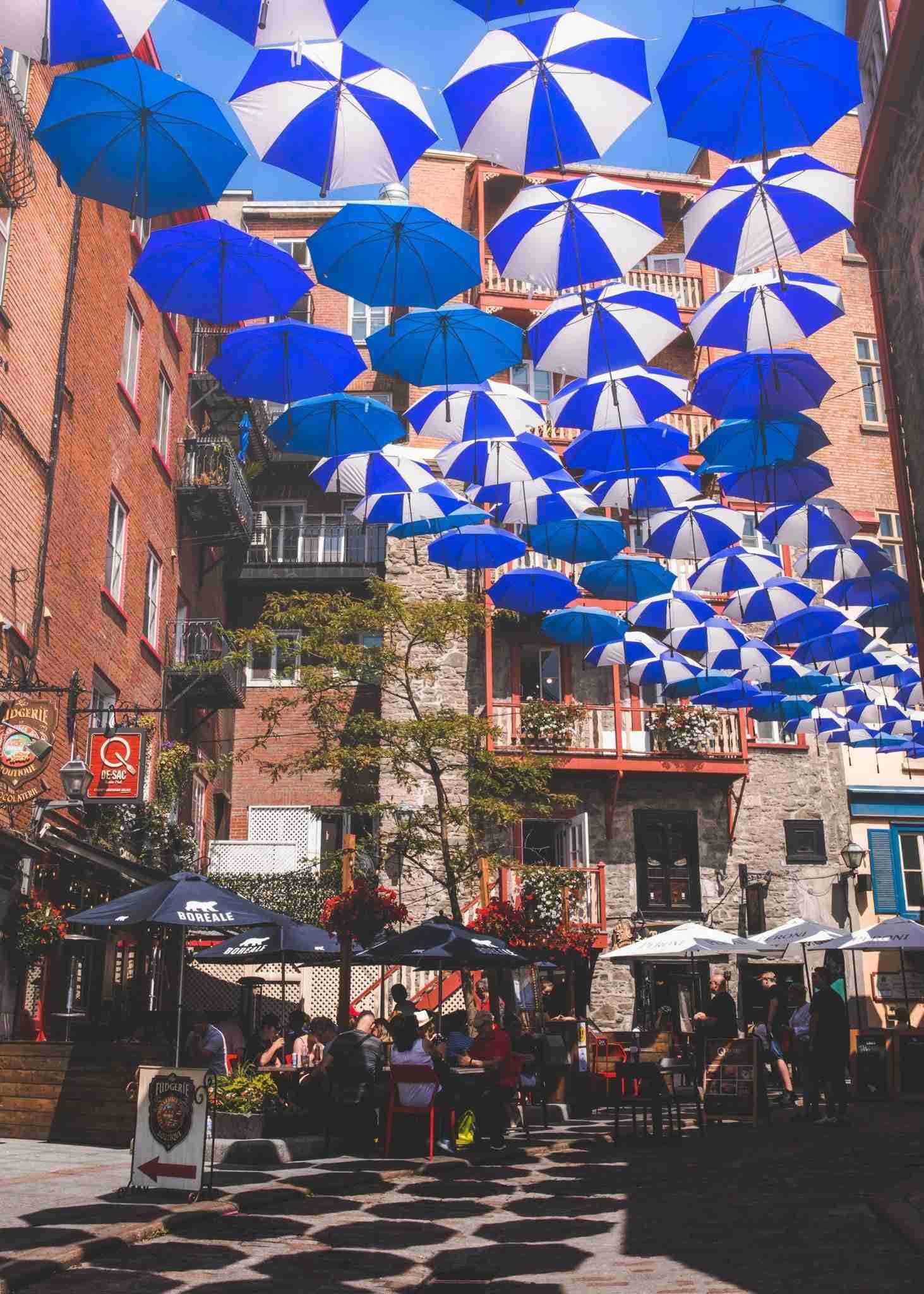
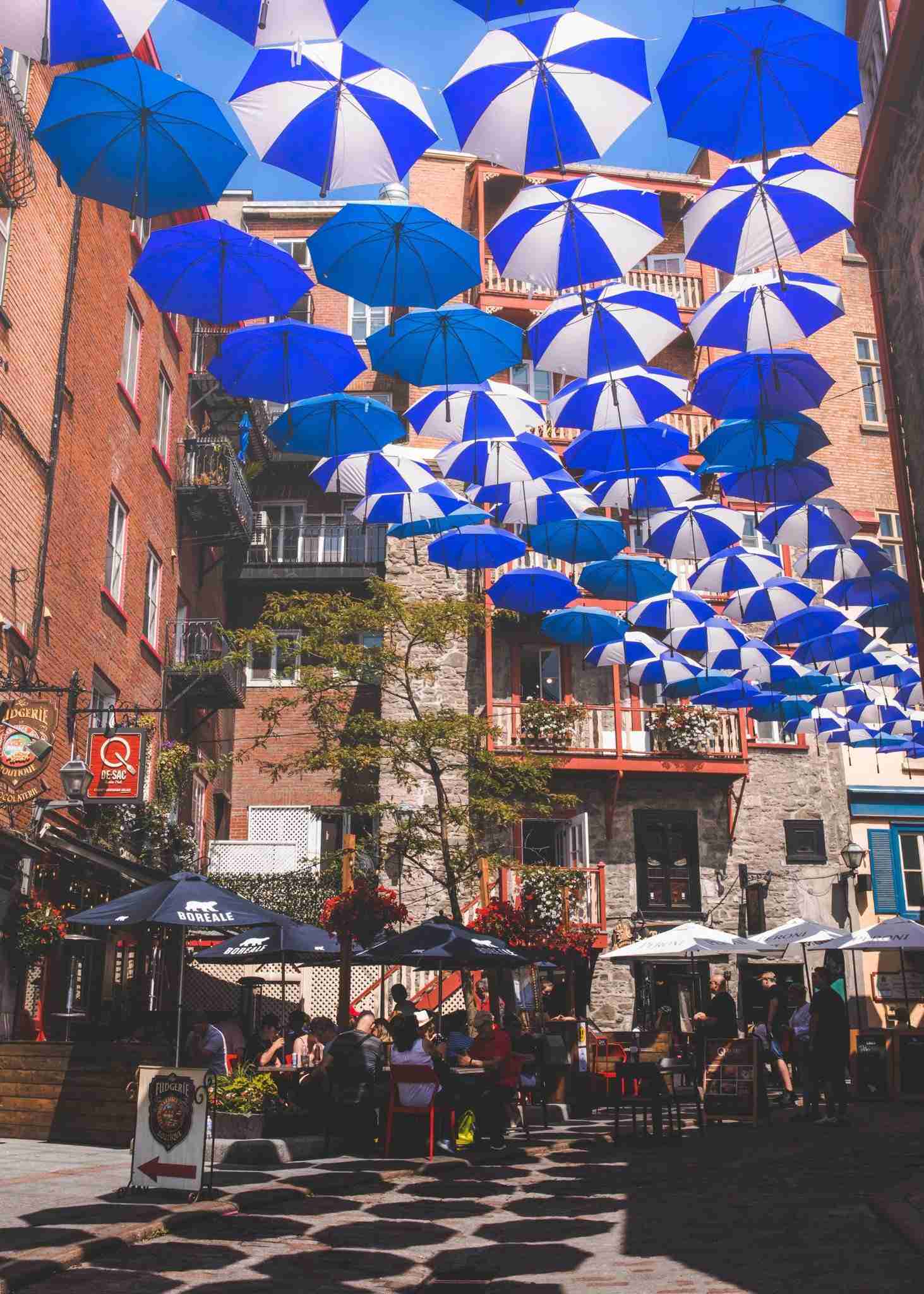
Umbrella Alley, located in Old Quebec on Rue du Cul-de-Sac, is a small yet incredibly photogenic stretch of cobblestone street where colorful umbrellas are suspended overhead in a vibrant canopy. Just steps from the historic Place Royale, this compact urban corridor offers a playful contrast to the surrounding colonial architecture. The visual rhythm created by the hanging umbrellas and the curve of the street makes it a creative gem for photographers interested in urban color, symmetry, and the balance between human activity and historical backdrop.
Best Photography Opportunities
• Overhead Symmetry of the Umbrella Canopy
Looking directly upward or down the street, the colorful umbrellas create strong graphical patterns. Shooting from a low angle with a wide-angle lens lets you fill the frame with vibrant fabric forms, contrasting them with the sky or adjacent building facades. These compositions work well in both flat light and full sun, depending on the mood you want to convey. To add variation, consider timing your shots to include the changing light as the sun moves across the sky, which casts unique patterns on the cobblestones and walls throughout the day. Including pedestrians, seated café patrons, or even street musicians under the canopy can introduce focal points that bring human scale and spontaneity to the frame.
• Café Life Beneath the Color
Tables beneath the umbrellas host a constant rotation of patrons, offering opportunities for candid shots of everyday interaction. Use a mid-range lens to capture people in context—framed by the umbrellas and stone facades. A shallow depth of field isolates subjects while retaining just enough environment to suggest place. Framing conversations, laughter, or the quiet concentration of someone enjoying a book adds narrative to your imagery. Early morning coffee drinkers and evening diners each cast the space in different emotional tones, making this subject endlessly versatile throughout the day.
• Evening Glow and Ambient Light
At dusk, the alley transforms under the glow of café lights and street lamps. The umbrellas darken into jewel tones, and shadows stretch across the stone. Tripod-supported exposures allow for soft illumination of the entire alley, ideal for creating mood-rich urban nightscapes. Using long exposure techniques can introduce motion blur to passing visitors while keeping the structural elements crisp, resulting in ethereal images that emphasize the dreamy quality of the location. If rain has recently fallen, reflections on the stone surface mirror the ambient lights, doubling the visual interest.
• Texture Studies and Ground-Level Compositions
The cobblestones and aged walls of the alley offer excellent material for detail studies. These textural elements contrast nicely with the synthetic color above. Shoot low to the ground to create a sense of depth and movement toward the canopy. Focus on the transitions between shadow and highlight where the umbrellas filter natural light unevenly across the street. Isolating the weathered masonry, iron fixtures, or even discarded petals from nearby floral displays adds subtlety and variation to an otherwise highly graphic environment.
• Seasonal and Weather Variation
The umbrellas often change colors with the seasons, and rainy conditions enhance their saturation and reflective quality. Wet cobblestones double the visual impact by mirroring the installation overhead. A polarizer helps manage reflections and increase contrast between the elements. In spring, blossoms from nearby trees may drift through the alley, while in autumn, fallen leaves scatter across the stones, offering a grounded contrast to the bright canopy. Even in winter, when the umbrellas are removed, the bare frames or seasonal lighting displays transform the alley into a different kind of photographic setting—more atmospheric and subdued, but equally rich in mood.
Best Time to Visit
The umbrella installation is typically in place from late spring through early fall, with the most stable light and activity in the mornings and evenings. Early morning provides soft shadows and minimal foot traffic, perfect for clean, symmetrical compositions. Late afternoon into blue hour offers warm tones and layered ambient light that enhances both the structure and mood of the alley.
Weekdays tend to be quieter, allowing more freedom for repositioning and slow tripod work. Overcast skies create even lighting, which is ideal for abstract or color-rich studies. Just after rain is one of the best times to visit, as reflections amplify the vibrancy and the street takes on a cinematic sheen.
How to Get There
Umbrella Alley is located just off Place Royale in Old Quebec, at the foot of Rue du Cul-de-Sac. From the upper city, take the funicular or Breakneck Stairs (Escalier Casse-Cou) down to the Lower Town and head toward the river. The alley is pedestrian-only, so it's best accessed on foot from surrounding attractions such as Rue du Petit-Champlain or the Old Port.
There is no cost to enter or photograph the area, and it remains accessible day and night. While tripods are allowed, they are best used during early or late hours to avoid interrupting café service. The surrounding neighborhood provides ample amenities, including restrooms, parking garages, and shaded spots to take breaks between sessions.
Recommended Photography Gear
A wide-angle lens is essential for capturing the curvature of the alley and the scale of the overhead installation. A focal length of 16–35mm allows you to work close and still include the umbrellas and buildings in the frame. A 35mm or 50mm prime lens is ideal for street portraits and lifestyle shots beneath the canopy.
Bring a sturdy tripod for twilight and night shooting, particularly if you want to capture the alley's lighting without increasing ISO. A circular polarizer is useful for managing reflections on windows and enhancing color contrast in the umbrellas. Consider a lens cloth and weather protection for rainy-day shooting, when surfaces become slick and visual interest doubles.
Nearby Photography Locations
• Place Royale
This historic square, just around the corner, features beautifully preserved 17th-century architecture and wide-open cobblestone framing. It's excellent for early morning architectural shots and blue hour mood work.
One of the most picturesque streets in Quebec City, this narrow lane is lined with boutiques and historic buildings. Especially photogenic during the holidays, it also shines year-round with strong linear perspective and vibrant storefronts.
This steep stairway connects Upper and Lower Town and offers elevated perspectives of Old Quebec's street network. It's a good spot for compressed architectural views and compositions with human scale.
Just minutes away, the waterfront boardwalk provides a broader change of pace from the dense urban core. It's ideal for sunrise light, long exposures of river traffic, and shooting back toward the city's skyline.
A short uphill walk, this iconic boardwalk offers sweeping views over the St. Lawrence River and is an excellent place for sunset compositions, as well as candid photography of street performers and visitors.
Umbrella Alley offers a rare mix of compact scale, architectural charm, and bold urban color. Whether you're photographing the canopy as a pure graphic element or using it as a setting for portraiture and documentary work, this small alley in Old Quebec punches far above its size in photographic potential.
Comments
Loading comments…