
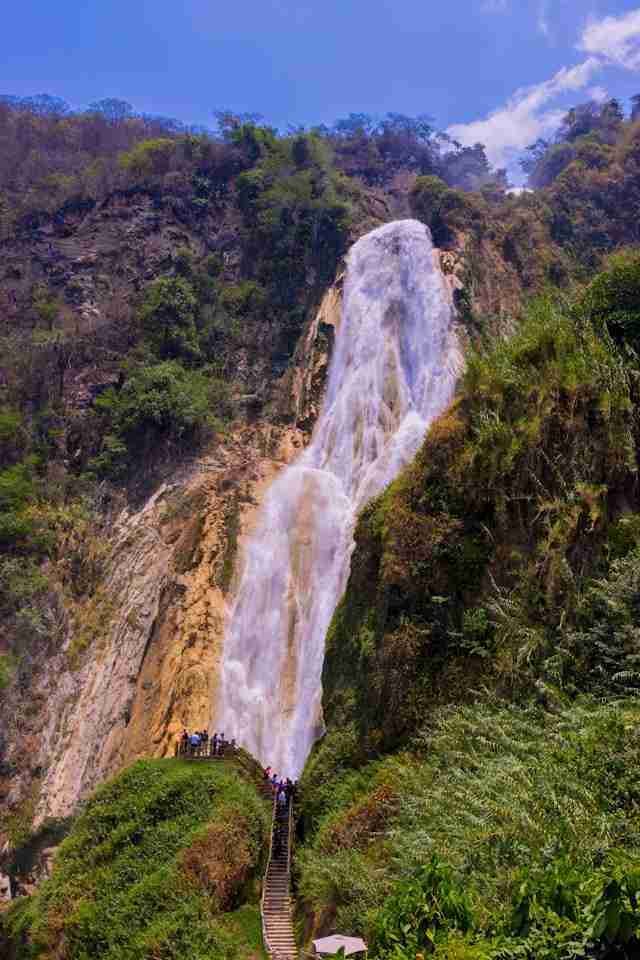
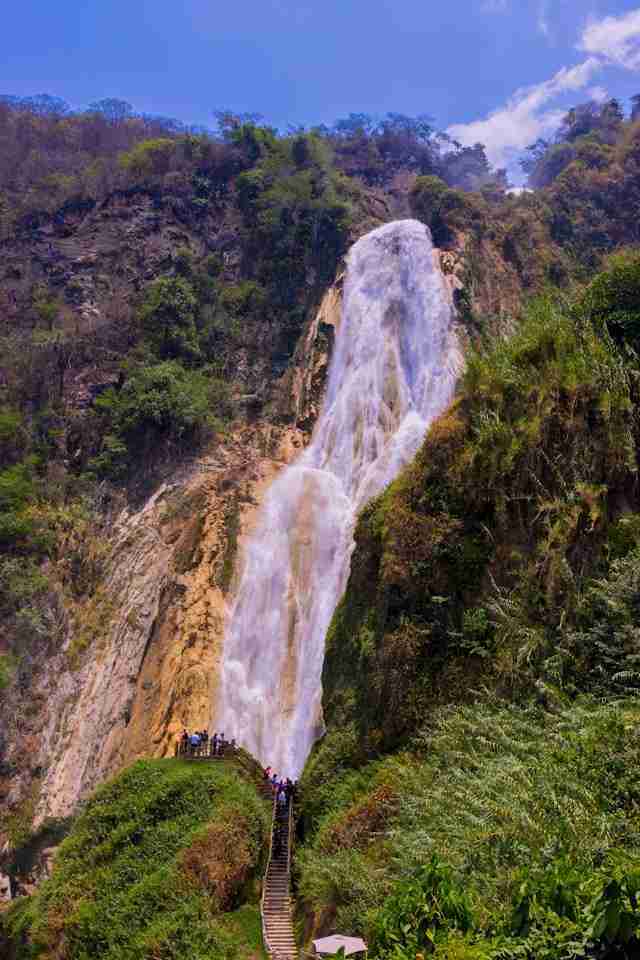
Cascada El Chiflón is one of Chiapas's most visually commanding natural spectacles, located deep within the state's highland rainforests. A series of five waterfalls set along the Río San Vicente, this destination is a dream for photographers looking to work with water, light, and the interplay between dense vegetation and dramatic vertical drop. The falls descend in stages from canopy to canyon, culminating in the majestic 120-meter Velo de Novia, or Bridal Veil, that erupts into a luminous turquoise basin. The lush jungle, elevated walkways, and mist-laden air give this entire site a cinematic quality that challenges and rewards every genre of nature photographer.
Best Photography Opportunities
Cascada Suspiro (The Sigh)
The entry-level fall is named for its gentle, sigh-like flow that dips serenely into a sapphire pool. It's perfect for subtle landscape work where the contrast between thin cascading water and thick jungle creates a calm, restorative mood. A longer exposure softens the flow into ethereal ribbons, while early morning light filtering through the trees highlights mist and water particles in the air. With a mid-range zoom lens, you can compose a frame that includes entering light, rippling water, and layered foliage for depth.
Cascada Ala de Ángel (Angel's Wing Falls)
This second fall invites you to explore symmetry and contrast. Twin streams fan out over a broad lip, resembling delicate wings spread against rock. Shot straight on, a square format works beautifully to reinforce symmetry, while a diagonal approach highlights dynamic flow. Golden hour brings richer contrast, with light illuminating droplets against shaded limestone and creating rainbow highlights within the mist. Pairing a polarizer with subtle HDR can preserve detail in bright water and shadowed forest.
Cascada Velo de Novia (Bridal Veil Falls)
The star of the series, this dramatic drop plunges from 120 m into a vast emerald pool and cloaks visitors in mist. Wide-angle lenses help capture the full scale, but don't miss details—the water's parachute-like curtain, the jewel-tone pool, and the mist fans at its base. Climb to various platforms: lower one for immersion, upper for top-down context. A shutter speed around 1/4 to 1/2 second keeps texture in the water while softening its expanse. Low sun backlighting the mist is especially rewarding.
Cascada Arcoíris and Cascada Quinceañera
Tucked upstream, these falls offer quieter, lesser-photographed moments. The arecoíris presents a broad, shallow cascade with thin sheets of water that shine across smooth rocks, while Quinceañera reveals narrow streams against steep moss-covered walls. These are opportunities for abstract close-ups—use macro or telephoto to find the patterns in water, stone, and light. Walk upstream for angles that layer vegetation, water, and rock into a rich natural tapestry, especially under midday light.
Jungle Setting and Aquamarine Pools
Beyond the waterfalls, the journey along the forest trail is full of photographic opportunity. Towering mahogany and cedar trees arch overhead, ferns carpet the floor, and pools of crystal-clear water convert sunlight into rich color. Seek compositions of tree trunks backlit by the turquoise river, or framed views of distant cascades beneath jungle canopy. Morning and late afternoon provide soft, filtered light that enriches textures and colors without high-contrast glare.
Best Time to Visit
The period from November to April, the Chiapas dry season, offers the clearest skies and most stable light, ideal for capturing Velo de Novia in its full grandeur. Those keen on dynamic weather atmospheres might also consider the shoulder seasons of October or May, when occasional light showers can deepen colors and enhance waterfall volume, though build-up of sediment after heavy rains may cloud the pools. Daily timing matters: arriving early, ideally around 7:30 am, helps you avoid tour crowds, take advantage of soft morning light and mist, and enjoy the forest in quiet . Midday brings more saturated water color but also stronger shadows, so balance your shooting strategy to accommodate both.
How to Get There
Located near San Vicente La Mesilla, El Chiflón is accessible by car or public transport. It is a 2–3 hour drive south from San Cristóbal de las Casas or about 45 minutes from Comitán. Private drivers or colectivo buses from Comitán drop you at the entrance, where a modest entry fee is charged. plus optional charges for camping, access facilities, or zip lines. The main entry trail is well-marked and mostly paved, climbing toward each waterfall via platforms and stairs. Other trails lead to the quieter upper falls. The park is open daily from morning to late afternoon, and while no formal permit is needed, small conservation fees help maintain facilities and paths.
Field Gear That Makes the Shot
Shooting at El Chiflón demands durable, weather-resistant equipment. Use a wide-angle zoom (16–35 mm) to capture the grandeur of Velo de Novia, and add a mid-range zoom (24–70 mm) to compose scenes of symmetry and scale across waterfalls Suspiro and Ala de Ángel. A telephoto zoom (70–200 mm) or macro lens reveals intricate patterns in cascades, moss, and aquatic life. A robust tripod with non-slip or spiked feet is essential for long exposures and stability on uneven, wet terrain; a remote shutter release will ensure sharp results during motion shots. Filters are critical: a circular polarizer cuts glare off water, enhances contrast, and deepens sky; graduated ND filters help retain detail in bright sky and shaded forest. For multi-minute exposures in daylight, a 6–10-stop ND filter transforms rushing water into ethereal mist. Microfiber cloths and protective rain covers for your kit help maintain lens clarity in mist and spray. Consider waterproof harness straps to keep your gear safe while shooting beneath falls.
Nearby Photography Locations
Only a short drive away, this national park hosts a collection of vibrant lakes in shades of turquoise, emerald, and cobalt. Each lake is ringed by pine and oak woodlands, ideal for reflections, macro detail studies of shoreline vegetation, and aerial panoramas. The diversity of hues and light quality make it an excellent extended session after El Chiflón.
Further north near Tuxtla Gutiérrez, this deep, sheer-walled canyon carved by the Grijalva River offers dramatic cliffs, riverine wildlife, and changing mist patterns at sunrise and sunset. Boat trips provide close engagement with geological structures and condors, while viewpoints above offer sweeping canyon perspectives.
This colonial highland city is a colorful destination full of photographic contrasts. Cobbled streets, historic churches, and vibrant markets create endless opportunities for street photography, architecture, and cultural documentation. Golden hour in the city reveals rich hues on painted facades and lively public squares.
South of Comitán and near the Guatemalan border, Lagos de Colón is a lesser-known but visually compelling area. A mix of jungle, freshwater lagoons, and small waterfalls, it is an ideal location for tranquil compositions and sunrise reflections. The clarity of the water allows for underwater shots of submerged roots and aquatic plants.
About three hours southeast of El Chiflón, Las Nubes is a series of stepped waterfalls set in pristine jungle. The turquoise river carves its way through rock terraces, forming small cascades and rapids that are perfect for slow shutter compositions. The surrounding forest offers strong leading lines and canopy layers, especially in morning mist.
Cascada El Chiflón is more than a single waterfall. It is a dynamic environment of sound, light, mist, and motion set within one of Chiapas's most beautiful forested valleys. Every step along its trail presents new subjects to frame, from powerful vertical drops to quiet, reflective pools. For photographers seeking variety, scale, and the challenge of capturing moving water in all its forms, El Chiflón is an unforgettable experience that rewards both preparation and creative patience.
Comments
Loading comments…