
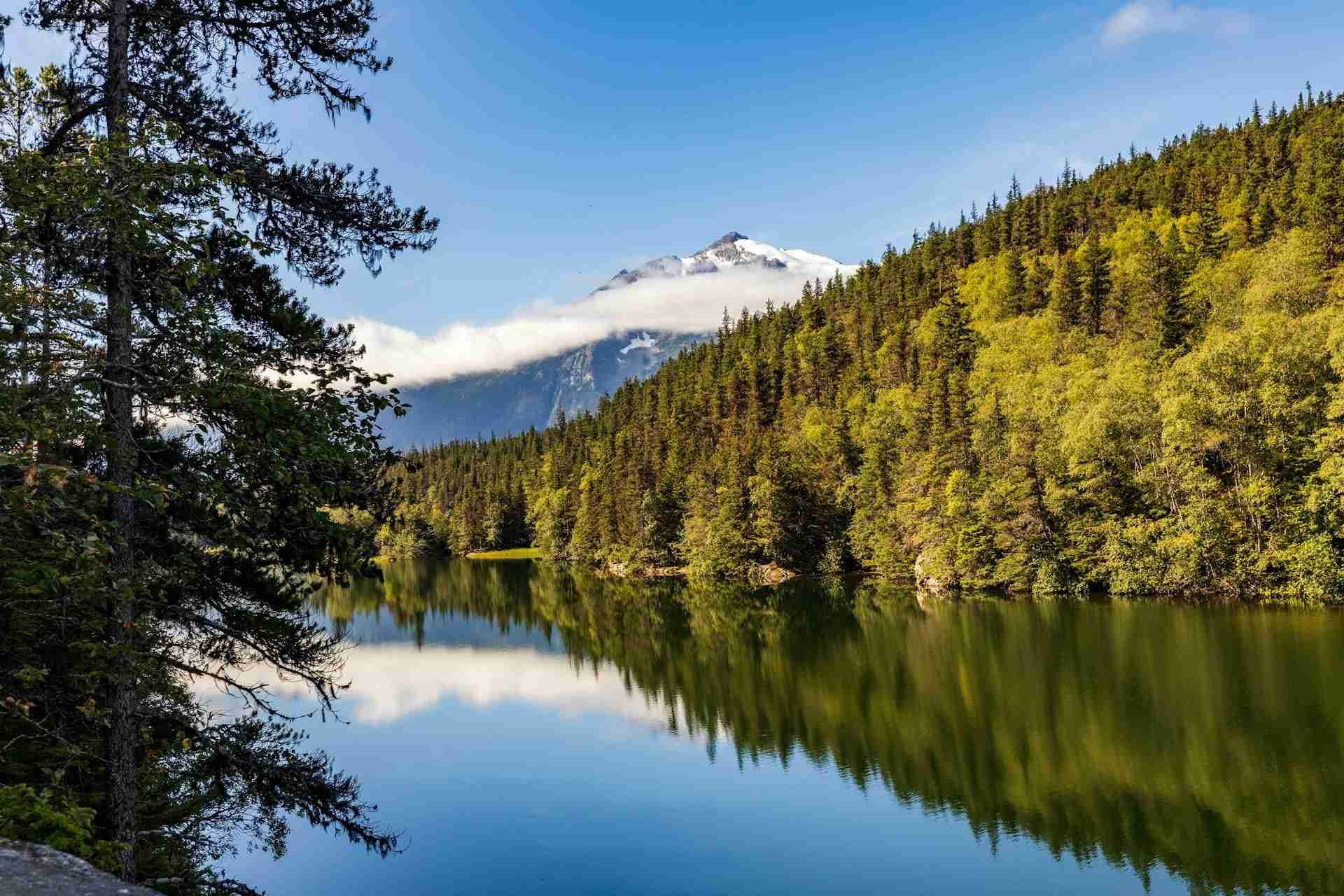
Tucked into the forested hills above Skagway's old Gold Rush-era streets, Lower Dewey Lake is a quiet and visually rich destination for landscape photographers. Its crystal-clear waters reflect towering evergreens and snow-dusted ridgelines, creating symmetrical compositions that feel almost surreal in calm conditions. The lake sits just above sea level but offers the kind of alpine tranquility usually found hours into the backcountry. Mist often lingers along the surface in the morning, and the surrounding spruce and hemlock forest keeps the light shifting and soft. With year-round access, minimal crowds, and constantly changing conditions, Lower Dewey Lake delivers reliable beauty for both creative exploration and technical image-making.
Best Photography Opportunities
Still Water Reflections at Golden Hour
One of the most rewarding features of Lower Dewey Lake is its ability to hold a perfect reflection when the wind is calm. In the early morning, the water often looks like polished glass, reflecting the surrounding spruce trees and distant ridgelines with precise clarity. As the sun rises, warm light begins to skim the tops of the trees and paint the lake's surface with soft highlights and shadow patterns. These conditions are perfect for working with symmetry and contrast. A wide-angle lens allows you to frame both the sky and its reflection in a single clean shot, and by arriving just before sunrise you can capture that quiet transition from blue hour into full daylight.
Framed Forest Pathways Along the Loop Trail
The trail that loops around Lower Dewey Lake passes through a thick forest of hemlock and spruce, offering a different kind of compositional challenge. Here, it is about working with vertical lines, filtered light, and foreground interest. The trail itself makes a useful leading line and can help add depth to your compositions. On cloudy days, the forest becomes evenly lit, which is ideal for capturing rich color and subtle shadow without harsh contrast. This section of the hike invites a slower pace and attention to detail, especially in areas where tree roots, lichen, and stones create natural patterns across the ground.
Elevated Angles from Overlooks and Bluffs
Several informal side trails branch off from the main loop and lead up to rocky outcrops above the lake. These spots allow for elevated compositions that look down across the water and into the distant hills. From above, the shoreline curves become more apparent and can serve as strong graphic elements. Using a telephoto lens or zoom range helps compress distant trees and reflectivity into layered images with tight framing. These high points are especially effective in late afternoon, when sidelight begins to rake across the scene and highlight the contours of the land and water. Be cautious when climbing these areas, as footing can be loose or muddy after rain.
Long Exposures at the Stream Inlets
A few small streams feed into Lower Dewey Lake, and while they are not dramatic in scale, they are excellent locations for long exposure photography. With a tripod and a neutral density filter, you can slow the water down to capture silky flow textures that contrast with the still lake behind them. These inlets are most photogenic in the morning when light is soft and detail can be preserved in both water and surrounding vegetation. Framing tight compositions that include mossy rocks, overhanging branches, and moving water can result in images with both motion and mood. If you are shooting on a bright day, a polarizing filter can also help reduce glare on wet surfaces.
Seasonal Color and Shifting Light
Lower Dewey Lake changes appearance throughout the year and offers new creative opportunities with each season. In early summer, the dominant greens are bold and saturated, especially after a rain. As the season progresses into August and September, color variation increases as shrubs and smaller trees along the shoreline begin to change. Subtle yellows and rust tones appear in the understory, adding complexity to compositions that might otherwise be uniform. The position of the sun also shifts noticeably by early fall, creating different lighting angles even at familiar locations. This allows returning photographers to rework favorite spots under new light and color combinations.
Best Time to Visit
The most productive window for photography at Lower Dewey Lake stretches from late May through early October when the trail is snow free and the lake is fully accessible on foot. June and July are particularly good for reflection photography because of long daylight hours, consistent calm conditions, and clear skies that support extended shooting around both sunrise and sunset. The lake often sits still in the early morning, providing clean reflections with rich light across the treeline. Later in the day, as wind increases, you may want to focus on forest work or elevated angles where surface clarity is less important.
In August the weather begins to shift. While skies may be more overcast, early mornings often produce mist over the lake, which can add depth and layering to your compositions. September brings shorter days and lower sun angles, creating longer shadows and more directional light across the lake and trail. Subtle changes in color emerge in the foliage, especially among shrubs and undergrowth. This is an excellent time to revisit known locations and experiment with different framing and tonal balance.
Winter photography is possible but requires experience and preparation. The trail can become icy or snow packed and is not maintained, so traction aids or snowshoes may be needed. Light becomes more dramatic but also more difficult to manage due to low sun angles and strong shadow. The lake often freezes in midwinter, which creates entirely different textures and compositional challenges. If you are prepared for cold conditions and variable weather, the quiet and frozen landscape can produce unique results. Spring is a shoulder season and may offer glimpses of ice melt, but trails are often muddy and access can be inconsistent.
How to Get There
Lower Dewey Lake is located just above the center of Skagway, Alaska and is reached by a short but moderately steep hike. From the intersection of 2nd Avenue and Broadway, head east on 2nd Avenue until it becomes a dirt path that leads to the official trailhead. The hike to the lake is roughly 0.7 miles in length with about 500 feet of elevation gain. It is a well maintained trail but can be slick in wet conditions or early in the season when snow may linger. Once you arrive at the lake, the trail levels out and a loop path provides access to different viewpoints and forest scenes along the water. Several unofficial side trails branch off the main loop and lead to elevated overlooks.
There is no entrance fee or permit required to access Lower Dewey Lake. Parking is available along nearby streets in Skagway but not directly at the trailhead, so plan to walk a few blocks from where you leave your vehicle. During the summer cruise ship season, it is best to start early in the day to avoid trail traffic. There are no facilities along the trail or at the lake, so be sure to bring water, snacks, and any supplies you might need for your shoot. Mobile service is generally available near the trailhead but may drop off deeper into the forested sections.
Recommended Photography Gear
Lower Dewey Lake rewards photographers who come prepared with a flexible kit that balances weight with capability. A wide-angle lens in the 14 to 35 millimeter range is essential for capturing the lake's full reflections, forest interiors, and expansive shoreline curves. This range allows for centered symmetry in reflection shots and helps frame compositions that include both sky and foreground. A polarizing filter is useful in managing glare, particularly when shooting down into the water from elevated bluffs. Be cautious when using it on wide views, since uneven polarization across a mirrored lake surface can create visual imbalance.
A 24 to 70 millimeter zoom is useful for trail work, tighter lake scenes, and transitional compositions between forest and water. This range also works well when shooting verticals that emphasize the height of the surrounding trees or the depth of the path ahead. A 70 to 200 millimeter lens is ideal for compressing layers of shoreline, picking out distant details, or shooting across the lake to catch patterns in light and color. This can be especially helpful in the fall when tree color varies along different sections of the shore.
Tripods are recommended, especially for long exposures at stream inlets or for low light shooting at dawn and dusk. A compact tripod with independently adjustable legs will help you work on uneven trail terrain and soft ground. If you plan to do long exposure work, bring a set of neutral density filters in six or ten stop strengths. These can smooth out flowing water and add motion effects to mist or passing clouds. A remote shutter release or timer will help reduce vibration on longer shots.
Other useful gear includes weather protection for both yourself and your equipment. Bring a waterproof shell for your pack, lens cloths to manage moisture buildup, and a rain jacket in case of passing showers. Drones are not recommended here due to proximity to the airport and possible airspace restrictions. Many elevated perspectives can be captured on foot with minimal gear and a little exploration.
Nearby Photography Locations
These two coastal locations offer a complete change of scenery from Lower Dewey Lake. Yakutania Point features a rocky shoreline with wide views over Lynn Canal and excellent opportunities for horizon line compositions. Just beyond, Smuggler's Cove is more intimate, with tide pools, sea-worn logs, and soft evening light filtering in from the west. Both are reachable by foot from town and are especially good for sunset photography or moody overcast conditions.
This higher elevation lake is a challenging climb above Lower Dewey but opens into a much more rugged alpine environment. The lake sits in a granite basin with snowfields and open rock faces that remain visible well into summer. From above, you get commanding views of Skagway, distant ridgelines, and dramatic skies that shift quickly. The trail is much steeper but offers photographic rewards for those who make the effort.
Downtown Skagway offers a contrasting subject with its preserved Gold Rush era buildings, wooden sidewalks, and vintage rail lines. The area is well suited for photographers interested in architectural details or documentary style work. Early morning and late afternoon light cast long shadows across storefronts and signage, while overcast days bring out subtle textures in wood and stone.
Accessible by the White Pass and Yukon Route train, this trail leads into a glacial valley with braided rivers, sharp peaks, and a retreating glacier. The terrain is open and dramatic with strong linear features and fast changing light. It is an excellent location for scale based compositions, and cloud movement can add tension or softness depending on the conditions.
North of town, the Taiya River Valley opens into a wide corridor of water channels, gravel bars, and distant hills. The early morning light here often hits low cloud cover and creates a painterly quality across the landscape. Wildlife sightings are possible, and the open nature of the valley works well with long lenses or panoramic stitching. The Chilkoot Trail begins nearby and continues into higher country if you want to extend your shoot further.
Lower Dewey Lake continues to be one of the most rewarding yet accessible photo locations in southeast Alaska. Whether you are focused on soft light and reflection, interested in forest texture and trail composition, or exploring higher vantage points for compressed lake views, it delivers consistent results without requiring a full day's hike. Its variety, calm setting, and creative flexibility make it an ideal destination for photographers who want to move between styles while staying close to town.
Comments
Loading comments…