
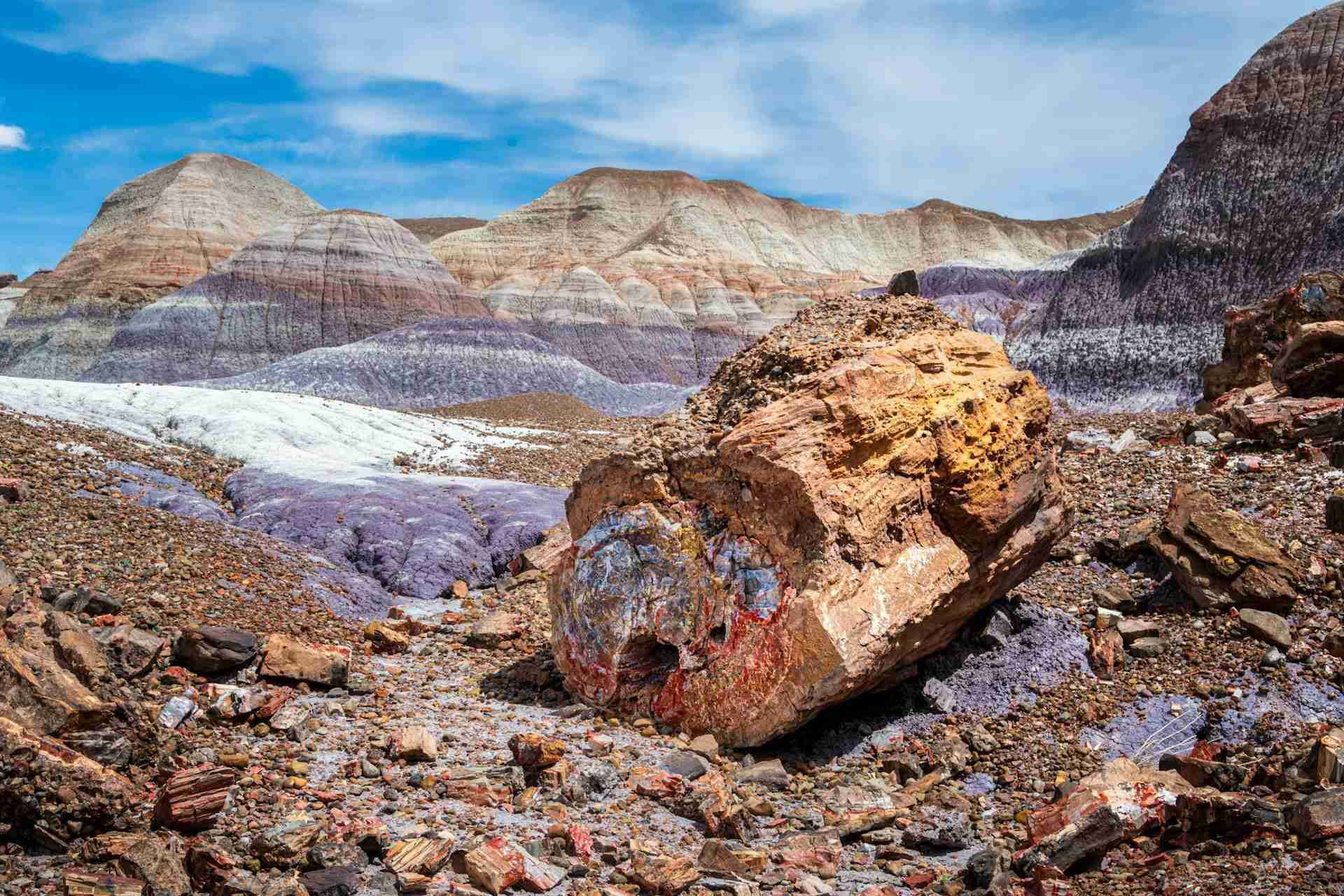
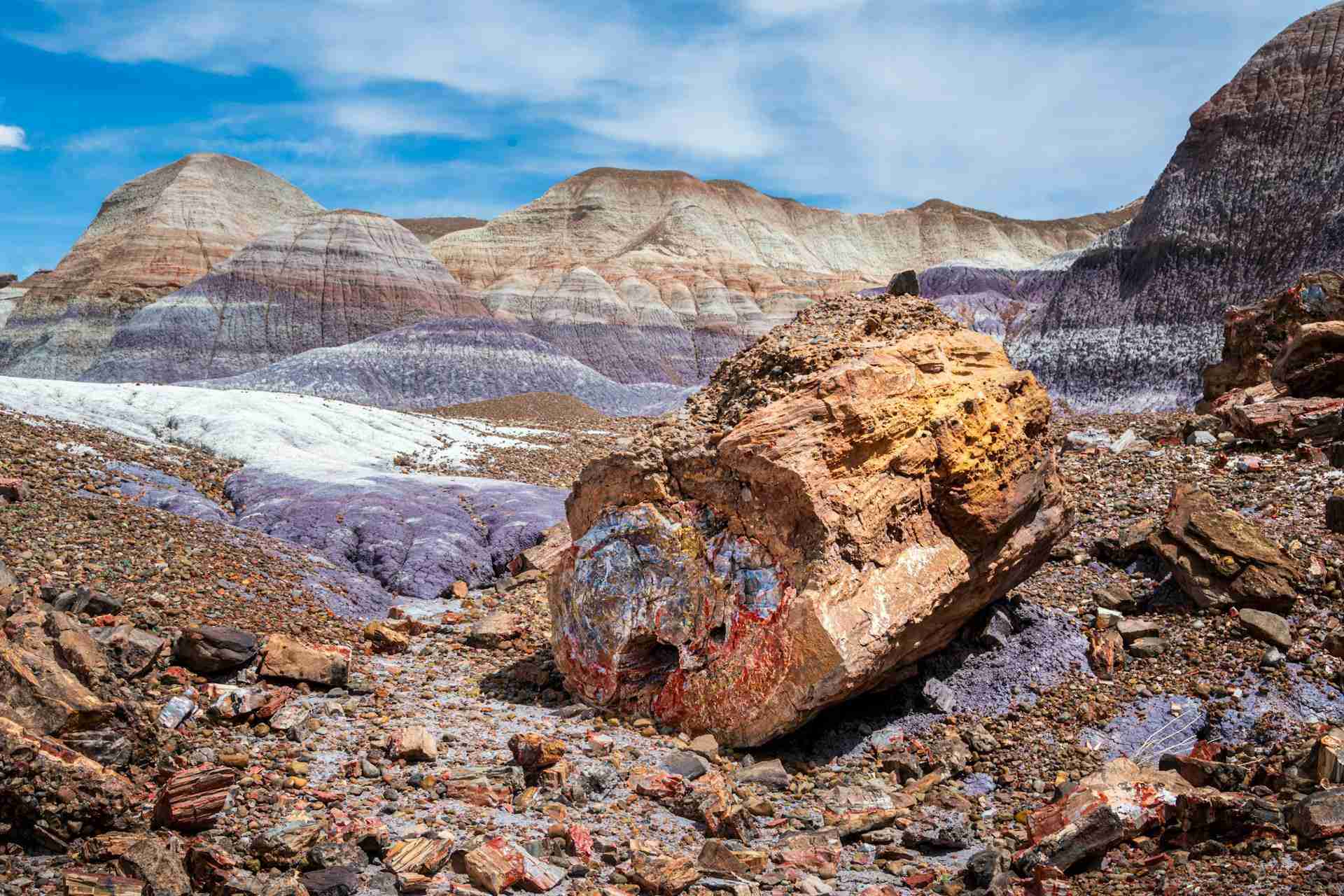
The Blue Mesa Trail winds through one of the most visually distinctive areas in Arizona's Petrified Forest National Park, offering photographers access to colorful badlands, scattered petrified wood, and a landscape shaped by time and erosion. This short loop trail descends into a maze of bluish gray hills layered with bands of white, lavender, and pale green, creating a painterly terrain that shifts in character with each change in light. What makes Blue Mesa unique is its combination of wide open vistas and intricate textures, allowing for a full range of compositions from sweeping landscapes to tightly framed geological details. With a paved path and manageable distance, the trail is both accessible and incredibly rewarding for photographers seeking abstract forms, strong natural color, and an authentic sense of the American Southwest.
Best Photography Opportunities
Layered Hills Along the Trail Loop
The heart of the trail passes directly through rounded badland hills banded with soft pastel tones that change color throughout the day. Shooting wide from trail level lets you capture the full shape of the hills, while placing foreground textures like cracked clay or fossilized wood into the frame builds depth and interest. This is a place where the landscape speaks in subtle shifts rather than dramatic peaks, so careful framing and patience with light go a long way. Mornings and late afternoons are best when the sun is low and the hills take on deeper tones. A standard zoom lens allows for quick adaptation as the terrain opens and tightens along the loop.
Petrified Wood in Natural Context
Scattered along the trail are large segments of ancient petrified trees, their rich colors and crystallized textures contrasting with the surrounding pale terrain. These fossilized logs make strong focal points when isolated against the soft lines of the badlands. Shooting at a low angle places the wood prominently in the frame and helps convey scale. Early side light brings out the rich reds, golds, and purples in the petrified material, while overcast days enhance texture without glare. These compositions work well both in color and black and white, depending on how you want to emphasize form and detail.
Abstract Textures and Clay Cracks
At ground level, the cracked clay and fine sediment offer opportunities for minimalist and abstract images that focus on repeating patterns. Getting close with a wide or midrange lens reveals spiderweb fractures, dry washes, and erosion lines that make strong graphic elements. These scenes are best captured under soft light when shadows are less harsh, making early morning or cloudy conditions ideal. Including a small piece of petrified wood or a plant in the frame adds a subtle focal point that ties the pattern to the landscape. These types of images work especially well as part of a series or to provide visual contrast to wider shots.
Midpoint Overlook Views
At the midpoint of the trail, the path climbs slightly and opens to a view that stretches across the badlands toward distant ridges. This overlook provides a moment to pause and capture the broader scope of the terrain, where soft hills blend into the horizon in a series of painted layers. A telephoto lens can compress the view and exaggerate the rhythm of the hills, while a wide lens can include more foreground for scale. This location is particularly strong during golden hour when the angle of the sun rakes across the hills and pulls texture out of the folds. Waiting for light to break through passing clouds can also bring drama and variation to the composition.
The Descent Into the Basin
The opening section of the Blue Mesa Trail descends into the badlands, offering strong leading lines and a sense of transition as you move from open desert into the heart of the layered hills. This descent works well as a storytelling composition, particularly when photographed with a figure walking ahead to add human scale. Using a higher vantage point near the start of the trail lets you frame the path as it curves and disappears into the terrain. Shooting in early light helps define the edges of the hills and keeps the contrast manageable. This scene also works well in backlight when the edges of the hills glow and the shadows fall long across the trail.
Best Time to Visit
The best time to visit the Blue Mesa Trail is during the spring and autumn months when temperatures are moderate and light conditions are more manageable throughout the day. From March through May, the landscape is still dry but the air is cooler, and occasional clouds add interest to wide skies without blocking sunlight for long periods. Autumn, especially from late September to early November, brings crisp light and deeper shadows that enhance the sculptural quality of the hills. These shoulder seasons also see fewer visitors, giving photographers more space and flexibility on the trail.
Summer can be intense, with high temperatures and direct sun creating harsh contrast during midday. However, early morning and late evening light during the summer months is often dramatic and colorful, especially after brief monsoon storms. Winter brings cooler temperatures and thinner crowds, and while snow is rare, frost and ice can briefly highlight surface textures in interesting ways. Regardless of the season, the angle of the sun plays a significant role in how the hills appear. Low light from sunrise to mid morning and again from late afternoon to sunset reveals more detail and deepens the color range in the clay and stone.
Cloudy days are excellent for detail work and abstract photography, as the even light brings out color and texture without harsh shadows. These conditions also work well for longer exposures or building series that focus on surface variation and form. Because the trail is relatively short and loops back to the starting point, it can be walked multiple times in a single session to take advantage of changing light.
How to Get There
The Blue Mesa Trail is located within Petrified Forest National Park in northeastern Arizona, near the town of Holbrook. The park is accessed via Interstate 40 and U.S. Route 180, with entrances at both the north and south ends. The trailhead is clearly marked off the main park road, about halfway between the north entrance and the visitor center. Paved parking is available at the Blue Mesa overlook, with space for cars and small RVs. From the parking lot, the trail descends quickly into the badlands and loops through the terrain for just under one mile.
No special permits are required for photography along the trail, and park entry fees cover access to all official trails and viewpoints. The entire trail is paved, though the descent and ascent can be steep in parts. Tripods are allowed but be aware and try not to block the path for other visitors. This is a protected area please stay on the clearly marked trail. Facilities are limited at the trailhead, so it's recommended to bring water, sun protection, and any needed supplies before entering the area. The trail is open year round, with best conditions in the cooler months.
Recommended Photography Gear
A lightweight and flexible kit works best on the Blue Mesa Trail where you'll be working with both expansive landscapes and small geological features. A 24 to 70 millimeter lens covers most scenes comfortably, from wider terrain shots to midrange compositions of petrified wood or trail textures. For wider views or compositions that emphasize scale, a 16 to 35 millimeter lens allows you to exaggerate the shape of the hills and include foreground elements like cracked earth or fossilized trees.
A telephoto lens in the 70 to 200 millimeter range helps compress the rolling terrain and isolate patterns within the painted layers. This range is especially useful from the overlook or when shooting distant forms along the trail without needing to reposition. A sturdy but lightweight tripod is helpful for long exposure work or low light sessions during sunrise or sunset. A circular polarizer can help manage reflections on bright surfaces and enhance contrast in the sky, especially when clouds are present. Neutral density filters are useful if you want to create long exposures in soft light or balance the brightness between ground and sky.
Because the trail is fully exposed, sun protection and hydration are essential. The short loop allows you to revisit favorite scenes multiple times under changing conditions, so a lightweight setup that allows mobility and quick adjustments will keep you focused on the creative potential of the landscape.
Nearby Photography Locations
Just a short drive from Blue Mesa, this area features a large concentration of colorful petrified logs scattered across a broad desert plain. The wide spacing between specimens allows for clean compositions with soft backgrounds, and early light enhances the warm tones in the wood. The flat terrain makes it easy to work close to the ground for intimate detail shots.
Located near the north entrance of the park, this short trail follows the edge of the Painted Desert and offers expansive views of layered rock stretching toward the horizon. Sunrise and sunset produce glowing color gradients across the landscape, while midrange lenses are useful for picking out repeating forms and distant ridges.
This protected viewing area allows you to photograph ancient petroglyphs etched into stone panels visible from a distance. A long lens is essential here, and early morning light is best for casting shadows across the carvings to bring out detail. The site also provides an opportunity to contrast human history with natural erosion.
This natural feature is a large petrified log spanning a small wash, forming a bridge-like structure that stands out dramatically against the flat desert floor. It's a strong subject for centered compositions and minimalist desert photography. Soft side light brings out the structure's warm colors and enhances the contrast between the log and surrounding gravel.
Close to the park's midpoint, this ancestral site offers crumbling stone structures and views of open desert dotted with low vegetation. The site is best in the morning when light reaches the pueblo walls at a low angle, casting long shadows that emphasize the shapes and openings of the building remains.
The Blue Mesa Trail is a compact but powerful location for photography, offering variety in tone, texture, and light within a short walking distance. It is a place that rewards returning to the same subjects with fresh perspective and where slow observation often leads to your best frames. Whether you are working with wide desert views or small patterns in the clay, this trail presents a visual experience as layered as the landscape itself.
Comments
Loading comments…