
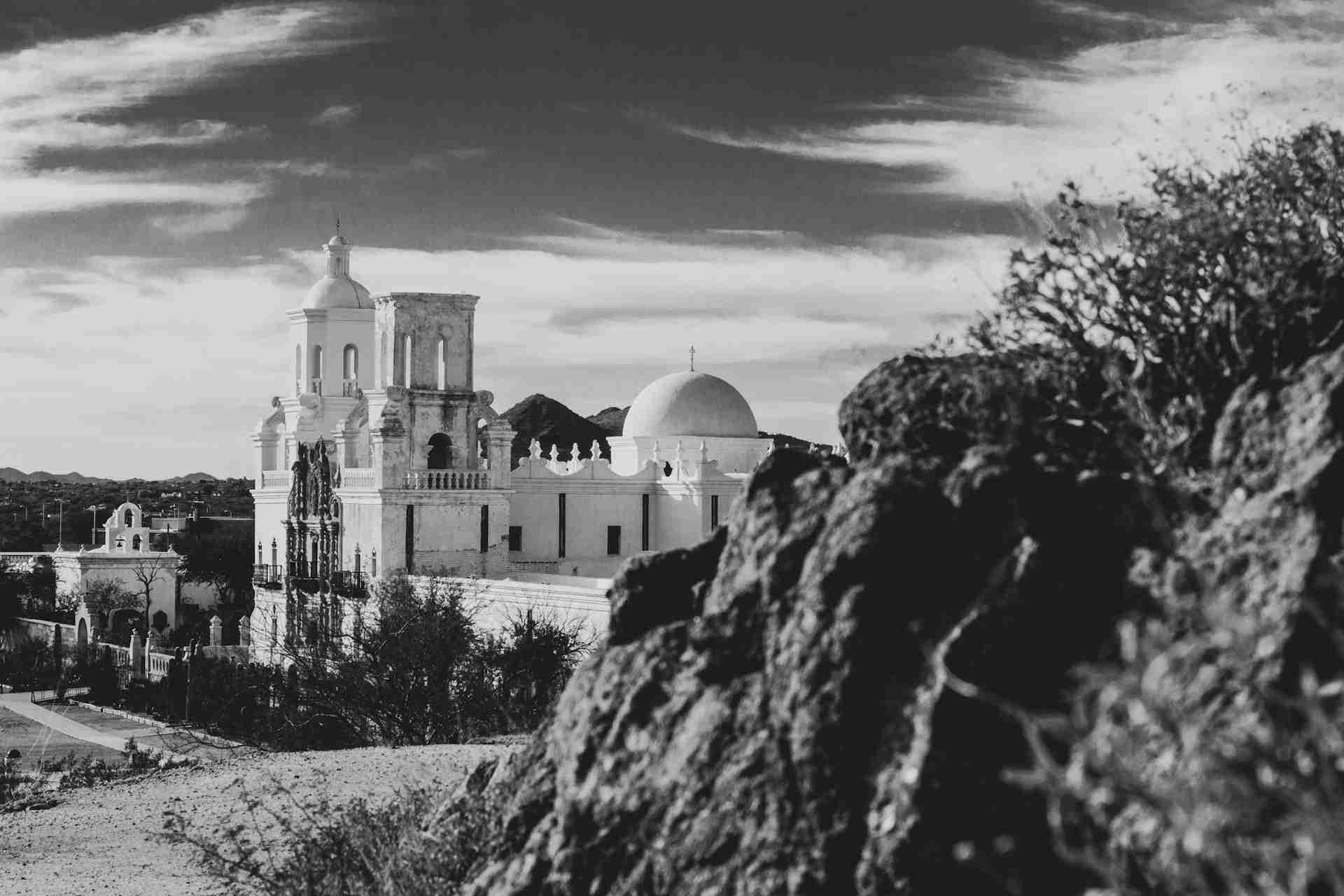
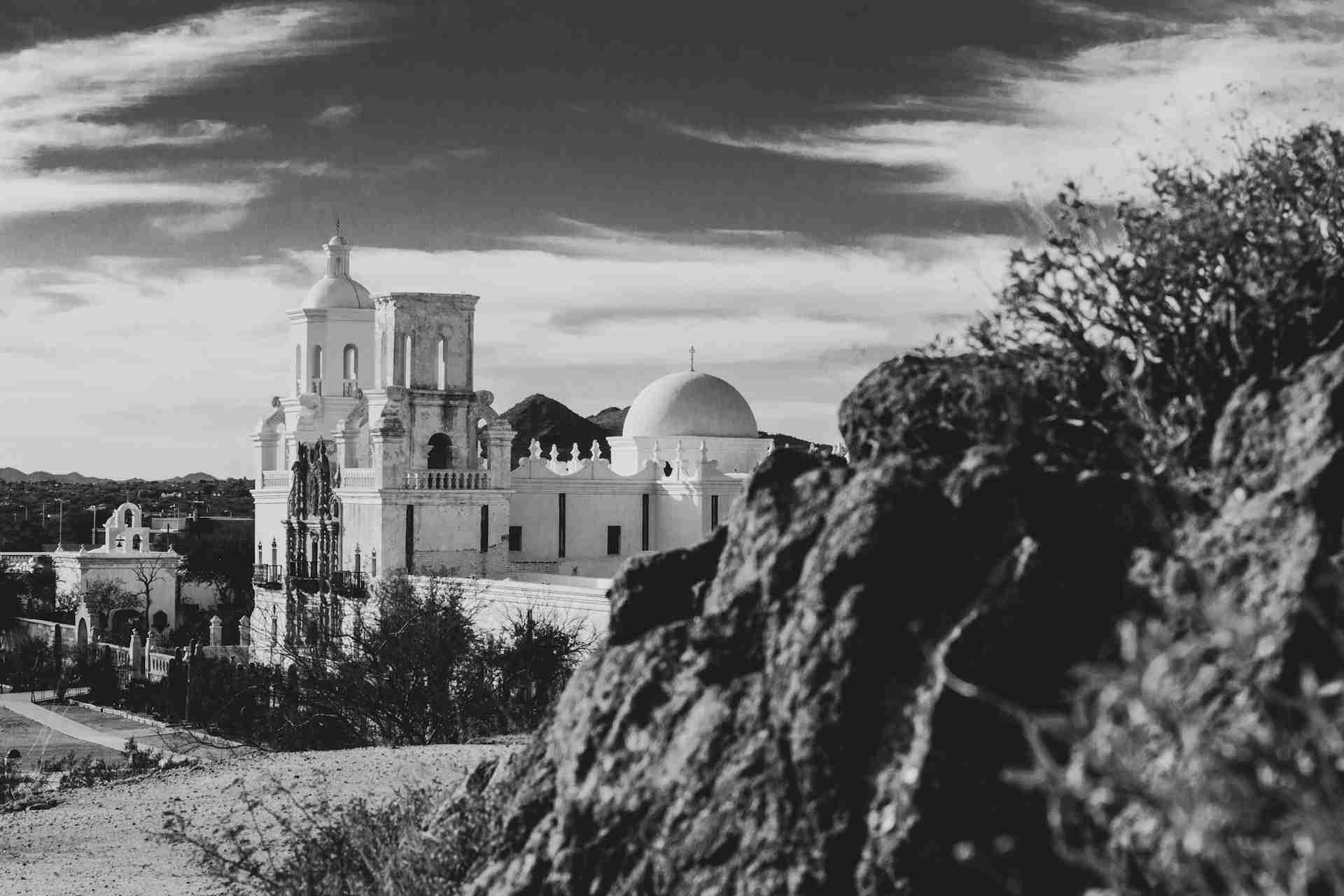
Rising from the Sonoran Desert south of Tucson, San Xavier del Bac is one of the most visually compelling Spanish colonial missions in the American Southwest. Built in the late 18th century and still active today, the mission blends Moorish, Mexican, and Baroque architectural elements into a luminous structure of whitewashed limestone, sculpted domes, and intricate stonework. For photographers, it offers both grand, symmetrical compositions and quiet, texture-rich details. The church sits on the Tohono O'odham Nation's land and is surrounded by desert terrain, distant mountains, and vast skies, providing a stark and beautiful backdrop throughout the day. Its ornate façade, weathered by time and sunlight, transforms under shifting light, offering opportunities for everything from wide desert landscapes to intimate architectural studies.
Best Photography Opportunities
• Frontal Symmetry of the Façade
The mission's ornate front elevation, with its sculptural bell towers and carved entrance, presents a classic symmetrical composition best captured from a moderate distance using a standard or short telephoto lens. Early morning light from the east washes the surface in soft warmth, while late afternoon offers deeper shadows that reveal the structure's form. Pay attention to the asymmetry in the towers since one is finished while the other was never completed, and use this irregularity as part of your framing story. A tripod allows for careful alignment and makes bracketing exposures easier in changing light. Avoid mid-day when the contrast becomes too harsh and flattens the texture of the plasterwork.
• Side Angles with Desert Foreground
Moving around the mission to the south or north side reveals strong diagonal compositions, especially when cactus, adobe walls, or decorative ironwork are used in the foreground. These compositions place the mission within its desert context and create depth through layered framing. A wide-angle lens works well here, especially if you include desert plants or walking paths leading toward the church. Late afternoon and sunset produce long shadows that stretch across the gravel and stone, enhancing form and directing the viewer's eye. Composing at an angle also helps separate the structure from any background distractions.
• Interior Chapel and Dome Details
The mission's interior is richly decorated with painted walls, carved saints, and an intricately adorned altar. Low light levels inside require a fast lens or high ISO settings, though a tripod may not be permitted. Focus on architectural elements such as the curved arches, color patterns, and ceiling domes, particularly the main dome above the altar. Use natural light from windows and doorways to softly illuminate parts of the interior, creating quiet compositions with layered depth. Respect the fact that this is an active place of worship, and photograph unobtrusively to preserve the experience for visitors and parishioners.
• Bell Towers Framed Against the Sky
The bell towers stand cleanly against the open desert sky and work beautifully in minimalist compositions. A moderate telephoto lens compresses the form and creates separation between tower and clouds, especially on days with dramatic weather. These images work well in black and white, especially when the contrast between sky and structure is pronounced. For color work, early morning tends to produce subtle gradients in the sky, while sunset can turn the limestone warm and glowing. If possible, frame your shot with low vegetation to keep visual balance between sky and foreground.
• Detail Studies of Stone and Plaster
Weathered walls, carved wooden doors, wrought iron, and cracked plaster all offer opportunities for close-up detail shots. These elements photograph well in overcast conditions or soft sidelight when the contrast is manageable and textures come forward. Use a prime lens for shallow depth of field and careful composition. Look for small scenes like a candle alcove, a sunlit corner of a window, or shadow play across textured surfaces. These intimate frames build a layered portrait of the mission beyond its grand form and help tell the story of its age and craftsmanship.
Best Time to Visit
San Xavier del Bac is photogenic throughout the year, but light and heat make certain seasons and times of day more favorable. Winter and early spring offer the best conditions, with low-angle sunlight, cooler air, and more comfortable shooting conditions during the middle of the day. The mission's white façade takes on golden hues during sunrise and sunset in these months, while shadows from surrounding vegetation add dimension to wide frames.
Summer brings intense heat and harsh light for much of the day, though monsoon storms in July and August can produce dramatic skies. If you visit during the summer, plan for early morning or golden hour to take advantage of the best conditions. In all seasons, weekdays are quieter than weekends, especially in the early hours. Morning is ideal for photographing the east-facing front of the mission, while late afternoon is best for the sides and bell towers.
Interior photography is most effective when natural light is strong enough to avoid high ISO settings but still directional enough to create contrast. Overcast days are excellent for shooting texture and color detail without strong glare or reflections.
How to Get There
San Xavier del Bac is located approximately ten miles south of downtown Tucson, just off Interstate 19. From central Tucson, take I-19 south and exit at San Xavier Road. Follow the signs west for about two miles until you reach the mission's parking area, which is free and open to visitors during daylight hours.
The grounds are open daily, and access to the mission exterior and most of the interior is free. Photography is permitted outside and inside, though tripods may not be allowed in the chapel without prior permission. The area surrounding the church includes walking paths, cactus gardens, and historical features that also make excellent photo subjects.
Public restrooms, a small gift shop, and food stands are located on-site. Arrive early to avoid crowds and to make the most of the changing light across the structure. Be respectful when shooting near worshippers, and avoid obstructing access to doors or pathways with equipment.
Recommended Photography Gear
A standard zoom lens, such as a 24 to 70 millimeter, will cover most exterior and interior compositions effectively. A wide-angle lens is especially useful for full façade shots, interior altar framing, and wide contextual scenes with sky or foreground elements. A telephoto lens in the 70 to 200 millimeter range allows for clean isolation of the bell towers or distant detail in sculptural elements.
A tripod is helpful for early morning, low light, and bracketed exposures outside the chapel, though interior tripod use may be limited. A fast prime lens around 35 or 50 millimeters is ideal for working in the dim chapel without pushing ISO too high. A lens cloth is essential for cleaning desert dust off lenses and filters throughout the day.
A circular polarizer helps manage glare on white surfaces and brings out texture in stone and clouds. During monsoon season, weather protection for gear is a smart addition, as rain can arrive suddenly. Bring extra batteries and a lens hood to manage high sun angles and changing conditions throughout the day.
Nearby Photography Locations
This short trail to the west of the mission offers a wide view across the surrounding desert with the mission on the horizon. It is best at sunset when long shadows stretch across the low ground and the church glows against the darkening sky.
Located northwest of downtown Tucson, this elevated viewpoint overlooks the entire Tucson basin and offers panoramic views during sunrise and sunset. The light here is often dramatic, especially after monsoon storms.
A short drive from the mission, this national park features classic Sonoran Desert scenery with giant saguaros, rolling hills, and distant mountain backdrops. It is ideal for early morning or golden hour desert landscape photography.
Accessible by foot from central Tucson, this paved trail climbs steadily and offers wide city and mountain views. The path's curves and changing elevation make it a good spot for shooting both urban and natural subjects.
This downtown Tucson neighborhood is filled with colorful adobe homes, old doors, and quiet streets. Soft light enhances the colors and textures, making it ideal for urban detail photography and architectural framing.
San Xavier del Bac is both a sacred site and a masterpiece of design, where history and landscape combine to create a space that is as photogenic as it is meaningful. Its quiet presence in the desert invites photographers to observe closely, work with shifting light, and uncover beauty at every scale.
Comments
Loading comments…