
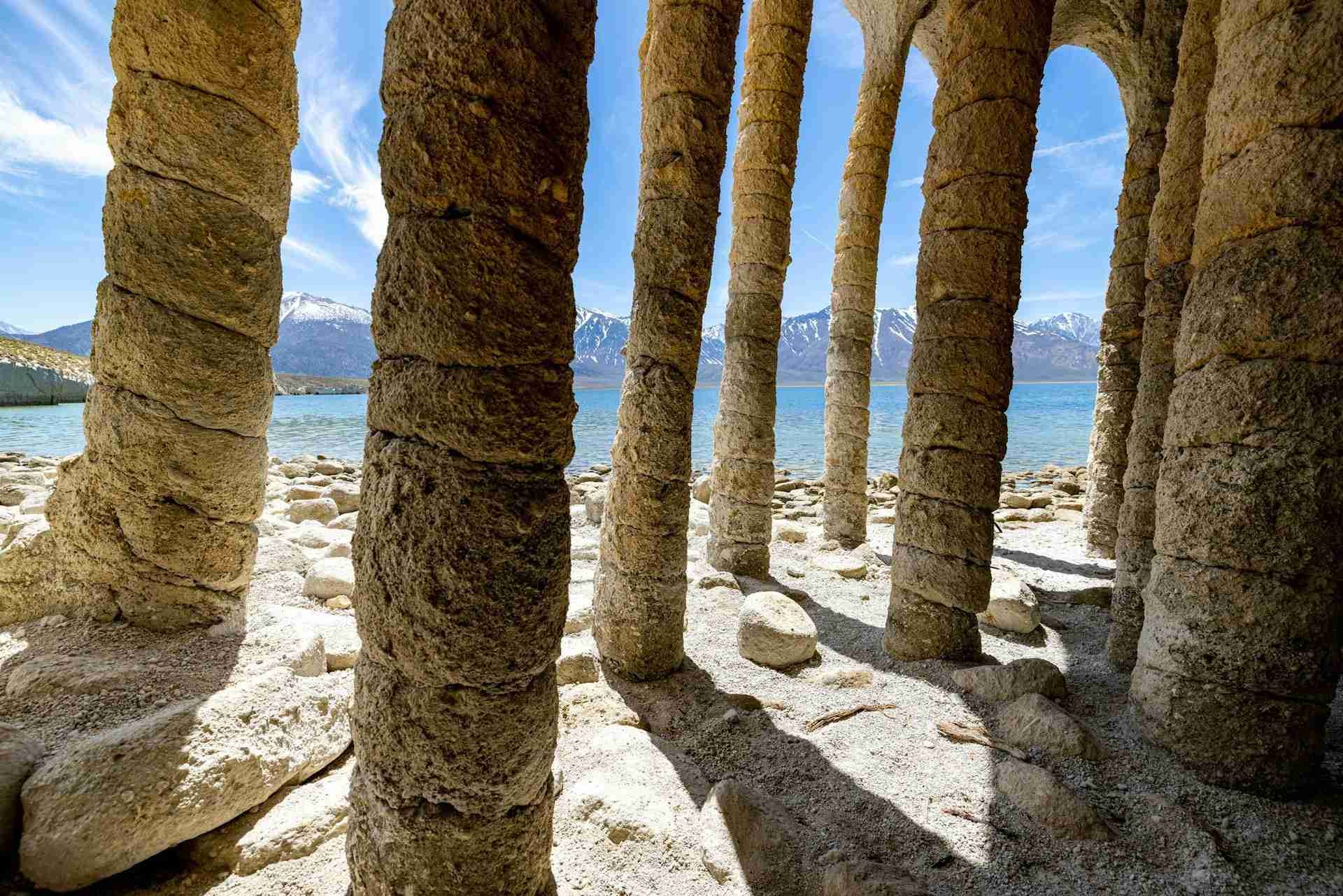
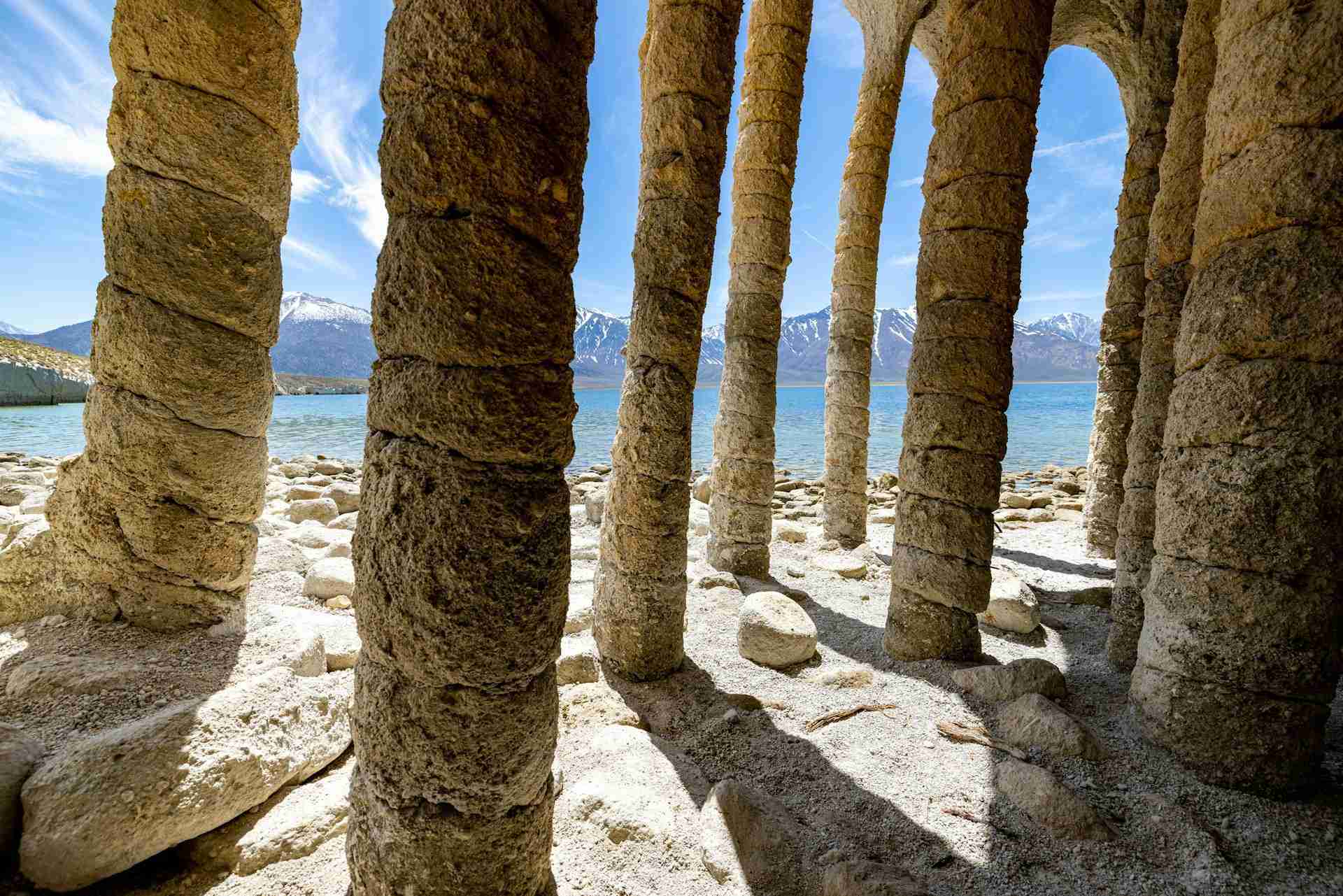
Along the shores of Crowley Lake in eastern California lies one of the state's most curious geological formations: the Crowley Lake Stone Columns. These towering, naturally formed pillars line the base of an eroded lakeside bluff and are shaped like something from a lost world. Each column is carved by time and wind, their hollow interiors and ribbed surfaces looking more like the remains of an ancient cathedral than a natural landform. The site is raw and remote, offering a playground of symmetry, texture, and contrast for landscape photographers who enjoy photographing the unusual. Light moves quickly across the columns, casting deep shadows and revealing subtle patterns in the stone, making timing and angle essential tools for crafting compelling images.
Best Photography Opportunities
• Symmetrical Columns and Repeating Patterns
The most striking aspect of the stone columns is their symmetry. These nearly vertical formations stand side by side, some hollowed through by wind and water, giving the appearance of sculpted arches and fluted supports. Photographers can use these patterns to create visually rhythmic compositions, especially when shooting directly into the columns with a wide lens. The play between shadow and light adds visual tension, particularly in the morning when sunlight enters the hollows at a sharp angle. This is an excellent subject for black and white work as well, where the shapes and shadows take priority over color.
• Natural Frames Within the Columns
Some of the columns are open from one side to the other, forming natural windows that look out over Crowley Lake and the surrounding Eastern Sierra. These openings are perfect for framing distant mountain peaks or shoreline details in a way that feels immersive and layered. Using a small aperture for greater depth of field lets you keep both the stone texture and the background sharp. Consider shooting low to the ground and tilting upward to give the columns a monumental feel and emphasize their sculptural quality. Timing is key here, as midday light tends to flatten the forms, while early or late sunlight brings out their depth.
• Close-Up Texture Studies
The columns are full of detail, from pitted rock surfaces to tiny fissures and layered mineral lines. Macro and short telephoto lenses can reveal these intricacies in a way that complements wider landscape shots. Focus on the base of the columns where sediment patterns are most visible, and use directional side light to bring out the depth. Texture shots also benefit from overcast conditions, which remove harsh shadows and allow the stone's surface to read more clearly. These studies can work well as standalone images or as supporting frames in a series.
• Reflections at the Water's Edge
Depending on the lake's water level and recent weather, sections of the stone columns may be reflected in still pools or along the shoreline. These moments are fleeting but powerful, especially during sunrise or sunset when warm tones hit the rock face and the water remains undisturbed. Bring a tripod and neutral density filter to experiment with long exposures that smooth out ripples and create abstract, mirrored compositions. A polarizer can help manage surface glare while enhancing contrast between the stone and the reflected sky.
• Drone Views
Aerial perspectives reveal the linear formation of the columns as they wrap around the lakeshore like a ribbed collar. From the air, the erosion patterns become more visible, and the relationship between the lake, shoreline, and stone structures becomes clearer. Flying along the curve of the bluff lets you capture the full scope of the formation, especially during golden hour when the low sun grazes across the surface. Just be cautious of wind conditions, which can be unpredictable due to the site's exposed location.
Best Time to Visit
Late spring through early fall is the most practical season to visit Crowley Lake, as snow and mud can make the access road impassable during winter and early spring. May and June offer reliable conditions with snow still visible on the Sierra crest, providing an impressive backdrop. Summer brings longer days and easier access, though midday heat can make the site challenging for extended sessions. Morning is the best time for photography, especially on clear days when sunlight illuminates the eastern facing columns. Sunset can be effective too, but less so for direct light on the formations unless you're using them as a shadowed foreground with alpenglow in the background. Avoid windy afternoons, which can stir up dust and affect stability for long exposures or drone flights.
How to Get There
The Crowley Lake Stone Columns are located on the northwestern shore of Crowley Lake, just off US Highway 395 near Mammoth Lakes. Access is via a dirt road that turns off from Benton Crossing Road. From there, you'll need to drive several miles on an unpaved and sometimes rutted road that leads toward the lakeshore. High clearance vehicles are recommended, especially after rain. Once you reach the shore, it's a short walk to the base of the columns, depending on current water levels. There is no official trail or signage, and access may require walking along wet or uneven shoreline. There are no entrance fees, but the area is under the jurisdiction of the Los Angeles Department of Water and Power, and access can be restricted during seasonal closures or for water management reasons. Always check local conditions before planning a visit.
Recommended Photography Gear
Due to the remote nature and changing conditions of this location, flexibility is key. A wide angle lens is essential for capturing the columns up close or for fitting entire sections into the frame from tight quarters. A sturdy tripod will help with long exposures and careful compositions, especially in low light. Bring a polarizer to control reflections off the lake surface and to deepen blue skies. A telephoto lens is helpful for isolating abstract forms or capturing distant mountain backdrops. If you plan to shoot aerials, make sure your drone is rated for moderate wind resistance and has spare batteries, as flying time may be limited due to signal interference from nearby cliffs. Pack extra water, sunscreen, and protective cases, as the location is exposed and lacks any shelter or facilities.
Nearby Photography Locations
Located just a short drive north along Highway 395, Convict Lake is a striking alpine lake backed by sharply rising peaks. The reflections here during early morning are almost mirror perfect, especially when the wind is still. In autumn, aspens along the shoreline add bright color to the scene, and the bowl-shaped geography makes it easy to create balanced compositions from almost any angle.
Roughly 20 minutes away, Hot Creek offers steaming water, mineral deposits, and a jagged canyon that cuts through the high desert landscape. It is especially photogenic during colder months when the steam contrasts sharply with the crisp air and snow-dusted peaks in the background. Early morning or twilight light helps bring out the textures and color shifts in the earth and water.
About an hour north, Mono Lake is home to towering tufa formations that rise from the lakebed like limestone spires. These structures are best photographed during sunrise and sunset when the light is low and the lake is still. The interplay of color, reflection, and texture at Mono Lake makes it one of the most rewarding locations in the Eastern Sierra for surreal, almost otherworldly compositions.
This lesser-known canyon near Crowley Lake is an excellent spot for photographing rushing water, aspen groves, and red rock cliffs. It is particularly vibrant in the fall when the trees shift to gold, but it also offers strong contrast in spring when snowmelt swells the creek. The trail climbs gradually, giving access to multiple perspectives without a difficult hike.
South of Crowley Lake, Rock Creek offers alpine scenery at higher elevation. Surrounded by pine forest and granite ridgelines, the lake is calm and pristine, especially at dawn. Reflections, light on the peaks, and quiet inlets make it a worthwhile stop, particularly for photographers interested in more classic Sierra compositions.
Though hidden in plain sight, the Crowley Lake Stone Columns deliver a rewarding mix of strangeness and structure. For photographers who are drawn to shape, pattern, and geological mystery, this is a location that challenges you to shoot thoughtfully and with intention. There is no obvious way to photograph it perfectly, which is exactly why it stays in your mind long after you leave.
Comments
Loading comments…