
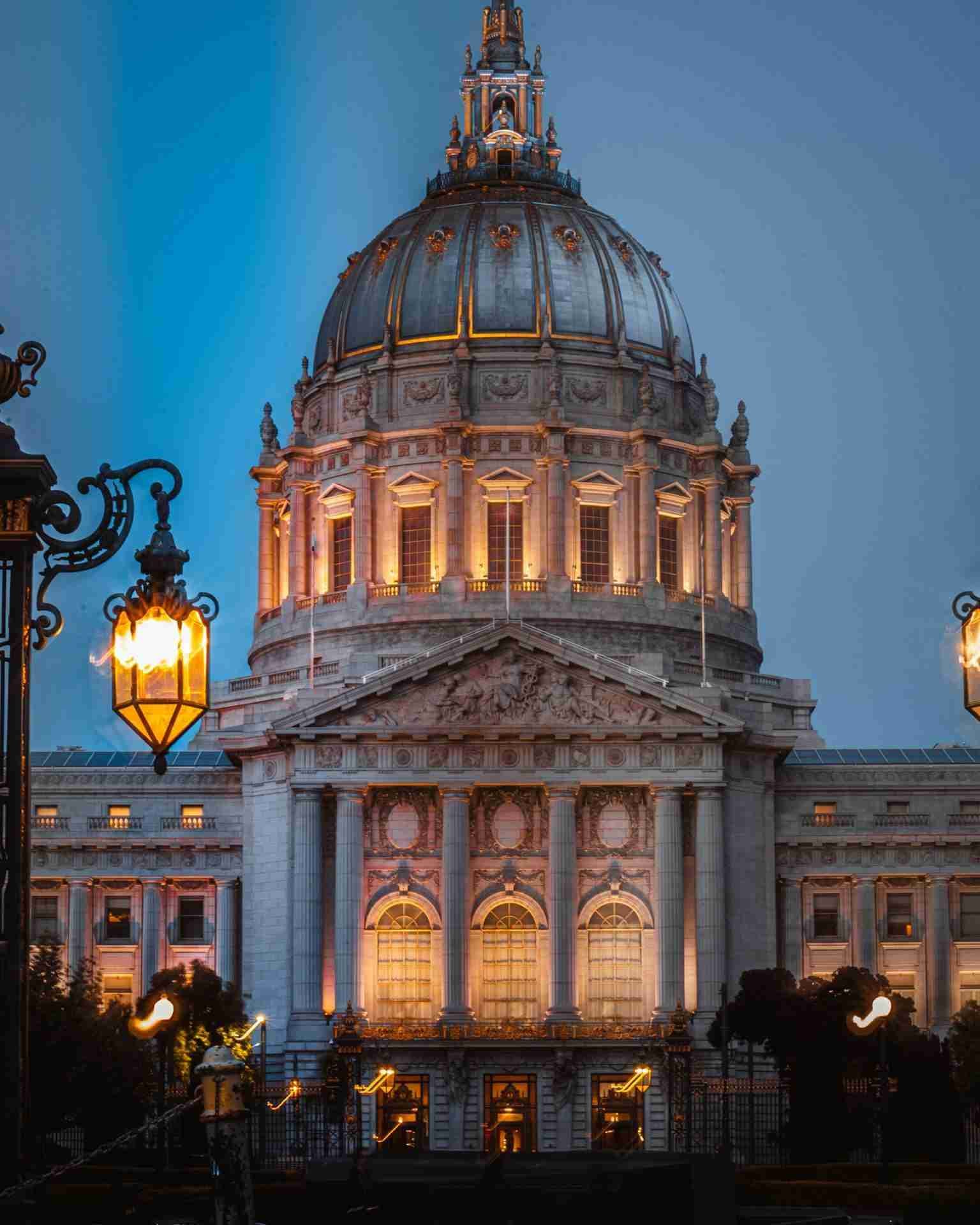
San Francisco City Hall offers photographers a rare mix of classical symmetry, grand architectural detail, and constantly shifting light in the heart of a busy urban setting. Its Beaux-Arts dome dominates the skyline, but the building's real photographic interest lies in the layers of structure, texture, and tone both inside and out. Marble staircases, arched hallways, and coffered ceilings give you a full range of compositions whether you're working with a wide lens or focusing on architectural detail. Changing light through the large south facing windows transforms the interior throughout the day, casting clean shadows across stone and highlighting subtle design features. Outside, reflections, movement, and color in the surrounding plaza add to the creative range.
Best Photography Opportunities
• Main Rotunda and Grand Staircase
The interior rotunda is the most photogenic space in the building.The marble staircase leads to a central dome lit by tall arched windows, and the structure's symmetry creates strong vertical and horizontal frames. Early morning light comes in at an angle and creates soft gradients across the stone, while midday light is more even and balanced. This space works well with a wide angle lens for full room shots, but also offers many chances for more focused compositions, such as the curve of a railing or the transition between floor and wall. For best results, arrive early before foot traffic increases, as the area is a frequent site for civil ceremonies and tours.
• Dome Interior from the Second Floor Balcony
Looking upward from the second level allows you to frame the inner structure of the dome, which is patterned with ornate relief work and fine detail. The play of light and shadow at this height helps isolate forms that may get lost from ground level. A longer lens can be used to compress lines and focus on specific elements of the dome's design, such as floral motifs or architectural repetition. This perspective also lets you capture the sweep of the grand staircase from above, with people moving through the frame to add scale and motion. Best light here often comes mid to late morning, when sun through the upper windows defines texture without flattening it.
• Exterior Plaza and South Façade
Outside, the south-facing side of City Hall presents one of the most formal compositions in downtown San Francisco. From the Civic Center Plaza, you can frame the building with rows of trees and clean foreground lines that emphasize its balanced form. This area is especially strong in late afternoon, when golden light hits the façade directly and creates strong contrast between the dome and the sky. Including elements like people, shadows, or movement in the plaza adds life to the composition and can help ground the building in its urban setting. A tripod is useful if you're working toward sunset or looking to blur foot traffic for contrast against the solid geometry.
• Side Hallways and Ornamental Detail
The less obvious parts of City Hall are equally strong for photographers who enjoy detail and quiet visual rhythm. Long hallways with repeating arches, brass fixtures, and polished floors offer minimalist compositions where light and form are the subject. These spaces are often empty, especially early or late in the day, and work well with a mid range or short telephoto lens. Reflections on the floor, partial light on the wall, and transitions between brightness and shadow create a subtle, evolving canvas. These shots often benefit from shooting in manual exposure to avoid the camera overcompensating for bright windows or deep shadow.
• Twilight and Blue Hour at the Dome
Once the sun sets, the dome becomes the central element of City Hall's night photography. Lit by warm interior and exterior lighting, the dome stands out against the cooling tones of the evening sky. A longer lens can isolate it against nearby buildings or the sky, while a wider composition from across the plaza gives you full symmetry with the added dimension of streetlights and movement. Twilight and blue hour offer a short but rewarding window when ambient and artificial light are balanced, allowing for detail without overexposing the highlights. This is also an excellent time for long exposures that capture passing cars or shifting color in the sky.
Best Time to Visit
The best time to photograph San Francisco City Hall depends on whether you are focused on exterior or interior work. For exterior shots, late afternoon to sunset is ideal. The sun falls directly on the south facing façade and dome, creating warm highlights and deepening shadows that bring out architectural shape. This light also works well for reflections in nearby buildings or for long shots down Van Ness Avenue. For twilight images, arrive at least 30 minutes before sunset and stay through blue hour for a full range of options.
Interior photography is strongest in the morning when natural light enters from the southeast and spreads across the rotunda and main hallways. Midday is useful for even light across the interior, while later in the day, certain corners become more dramatic as light falls low and shadows lengthen. Weekdays tend to be busier with official events, so if you want quiet time to work, aim for early weekday mornings or weekends. Holidays may offer reduced foot traffic as well, though access hours may be limited.
Weather rarely disrupts indoor shooting, but for outdoor work, clear days provide stronger definition on the dome and cleaner skies. Fog can be used creatively but often obscures details at a distance. In all cases, plan your session with lighting direction and shadow in mind, as the building's strong symmetry works best when matched with clean, intentional light.
How to Get There
San Francisco City Hall is located in the Civic Center district, easily reached by public transit, car, or on foot from downtown. The Civic Center BART and Muni Metro station is just a short walk away, and multiple bus lines serve the area directly. If you're arriving by car, metered street parking is available around the plaza, and several paid parking garages are located nearby, including the Civic Center Garage and the Performing Arts Garage.
The building is open to the public during regular business hours, though certain areas may be restricted during official events. Entrance is free, and tripods are permitted for personal use, though you may be asked to avoid blocking walkways or interrupting ceremonies. The rotunda and main staircase are easily accessed from the main entrance, and elevators provide access to upper floors. Photographers should be respectful of the building's use as a civic space and avoid disrupting scheduled events, weddings, or tours.
Recommended Photography Gear
A wide angle lens between 16 and 24 millimeters is key for working inside the rotunda and capturing full room compositions from tight corners. For detail work, a 24 to 70 millimeter lens gives you the ability to isolate sections of the dome, staircases, or hallway arches without changing your position frequently. A telephoto lens around 70 to 200 millimeters is useful for exterior shots from across the plaza or compressing skyline elements behind the dome.
A tripod is important for both indoor and twilight work, especially when shooting at low ISO to maintain clarity. If you plan to shoot long exposures outside, a remote trigger or timer is helpful to avoid vibration. A circular polarizer can improve clarity when photographing the exterior under bright skies by reducing glare and enhancing contrast in the stone. For indoor shooting, avoid flash and work with natural or ambient light to preserve the mood and texture of the space.
Bring extra batteries and memory cards, as the building offers a wide range of subjects that invite experimentation with both light and angle. A lightweight backpack and protective cloth are useful when moving between indoor and outdoor settings, and consider a lens cleaning pen if you're shooting through windows or dealing with city grit on glass surfaces.
Nearby Photography Locations
Directly across from City Hall, this building features strong neoclassical columns and symmetrical arches. The exterior is especially striking in the late afternoon when warm light defines the stonework. It works well for wide compositions or detail studies of windows and entryways.
Just steps away, the library's modern architecture contrasts with the older buildings around it. Reflections, leading lines, and the interplay of glass and stone make this a good subject for structural and abstract photography. Morning light creates clean separation between forms.
The plaza in front of the Asian Art Museum provides excellent sightlines toward City Hall, especially with people, trees, or event setups that add depth to the frame. This is a good place for street photography mixed with architectural context.
• Van Ness Avenue Corridor
Shooting down Van Ness toward City Hall provides a long, vanishing perspective that places the dome at the visual center. This works well at sunset or after dark, especially when including traffic trails or ambient city light. A longer focal length helps compress the space for greater impact.
Just west of Civic Center, the streets of Hayes Valley offer low-angle views of City Hall framed by storefronts, street trees, and passing cars. These compositions work especially well in the evening when storefronts light up and the dome glows in the distance.
San Francisco City Hall is a location that rewards both first-time visitors and return sessions. Its mix of light, structure, and civic presence provides photographers with an accessible yet rich setting for architectural study, creative framing, and quiet moments of design-driven composition. Whether you're shooting in natural morning light or capturing the dome against a twilight sky, it remains one of the most visually generous buildings in the city.
Comments
Loading comments…