
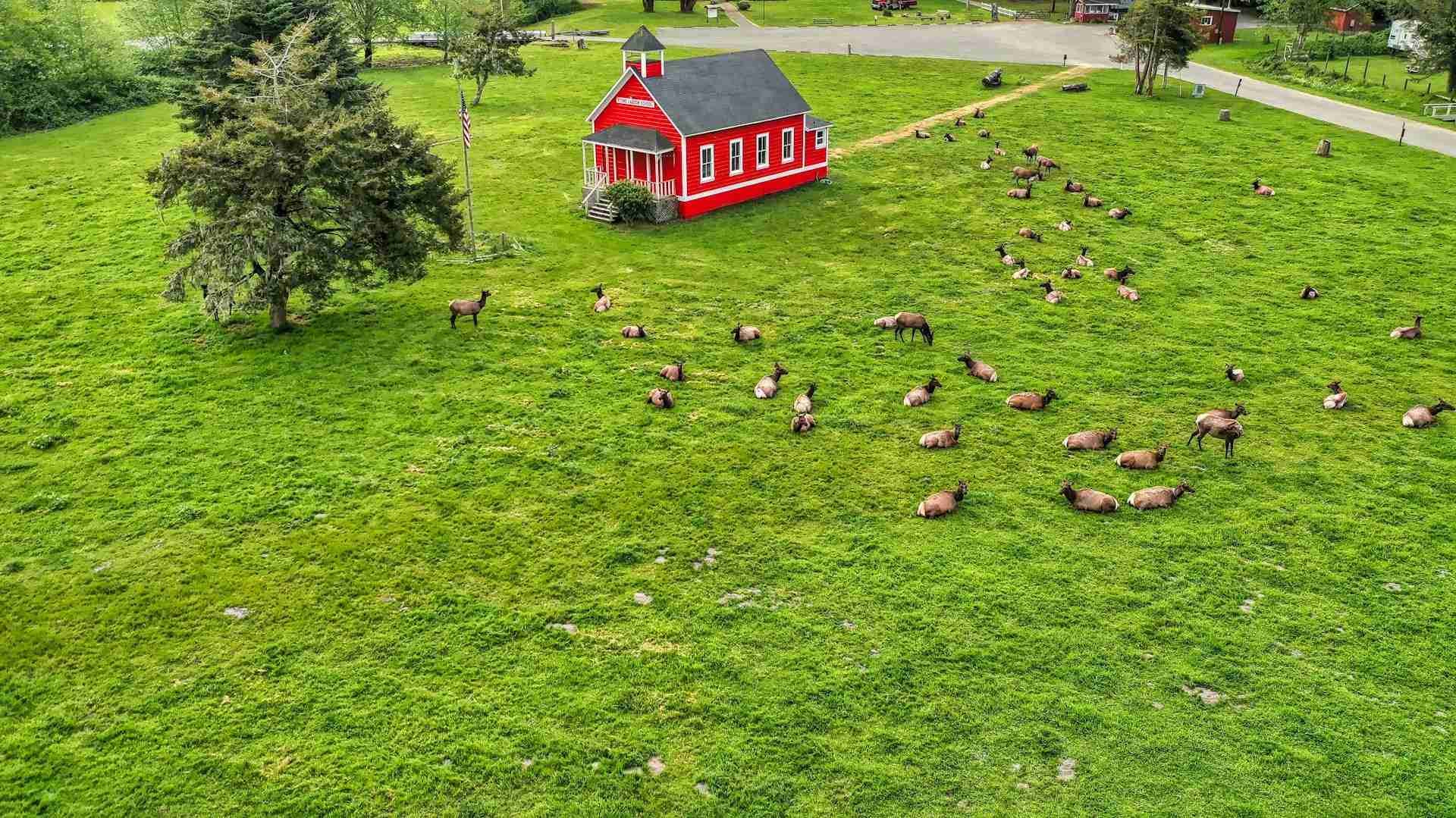
Just off the quiet curves of Highway 101 in Northern California, the Stone Lagoon Red Schoolhouse stands like a preserved memory in a clearing of grass and light. This restored 19th century one room schoolhouse sits inside Humboldt Lagoons State Park, surrounded by forested slopes and coastal fog. Painted in deep red with bright white trim, it offers a classic form that reads clearly in photographs from any angle. The building's clean lines, natural textures, and isolated position away from visual clutter make it an ideal location for shooting rural Americana with a controlled, timeless feel.
Best Photography Opportunities
• Symmetrical Composition
The front facing side of the schoolhouse features a central white door flanked by evenly spaced windows, all framed by clean white trim. This makes it a natural subject for a centered, symmetrical composition that emphasizes balance and structure. Shooting during early morning or late afternoon softens the red siding and eliminates harsh shadows. A standard lens works well here, keeping lines straight and details crisp. Using a tripod allows you to precisely align the roof and base with the frame edges, especially if you are shooting for documentary or architectural clarity.
• Three Quarter Views
Stepping back to photograph the schoolhouse from the front corner reveals the shape and volume of the building, along with the open grassland and tree line beyond. This angle is especially productive during golden hour when side light runs across the siding and picks up wood grain. Including a portion of the surrounding environment gives context and mood to the image, grounding the schoolhouse in the larger Humboldt landscape. A wide to medium zoom gives you the range to adjust without needing to reposition frequently.
• Detail Studies
The painted surfaces of the schoolhouse carry subtle variations in color and wear that become more visible in diffused light. Tight compositions on window frames, corners, or door handles tell a quieter story about the building's construction and preservation. Overcast days work well for this type of image, as shadows are minimized and color becomes more even. A short telephoto or macro lens helps isolate specific surfaces without including distractions.
• Foggy Mornings
The North Coast's frequent morning fog can transform the scene entirely, softening contrast and simplifying the background. On days when mist hangs over the field, the red schoolhouse stands out with a bold but quiet presence. This is a strong setup for minimalist compositions where the building becomes a central shape surrounded by muted tones. Shooting early increases your chances of capturing this look before the sun burns off the moisture.
• Low Light and Twilight
As the sun sets behind the forest line, the schoolhouse often catches the last warm tones of daylight while the clearing falls into shadow. This transitional light creates depth and contrast between foreground and background. If the sky has color, it reflects subtly off the schoolhouse roof and trim, adding a cool warm interplay that reads well in both color and black and white. A tripod and low ISO help maintain sharpness and detail in these conditions.
Best Time to Visit
The Stone Lagoon Schoolhouse is photogenic throughout the year, but some times offer more favorable conditions depending on your goals. Spring and early summer provide lush green grass around the structure, while autumn introduces warmer tones that complement the building's red siding. Winter offers the best chance of foggy mornings, particularly between November and February, which create soft, moody images with flattened contrast.
Light quality is consistently strongest in the morning and evening hours. Golden hour on clear days lights the schoolhouse from the west, bringing out wood texture and giving the forest edge a warm glow. Morning light is softer and more diffuse, especially if fog is present. Midday light is less ideal due to overhead sun flattening detail and introducing glare off the white trim. Overcast days are useful for even lighting and detail work, especially when photographing surfaces and architectural elements up close.
This location is quiet year round, but early mornings are best if you want the site to yourself. There are no gates or timed access restrictions, so photographers can plan around light without being limited by opening hours.
How to Get There
The Stone Lagoon Schoolhouse is located just off Highway 101 inside Humboldt Lagoons State Park, roughly 25 minutes north of Trinidad, California. Heading northbound, take the signed exit for the Stone Lagoon Visitor Center and continue along the short access road to the dedicated parking area next to the schoolhouse. There is no entry fee or permit required to photograph the site, and the parking lot is typically quiet with room for several vehicles.
The building sits in an open clearing a few feet from the parking area, allowing easy transport of gear without any hiking or elevation gain. There are no barriers or fences around the schoolhouse, and visitors are allowed to approach freely, though interior access is usually not permitted. Cellular service is intermittent, so downloading maps or coordinates in advance is recommended. The turnout from the highway is easy to miss at high speed, so reduce speed as you approach the lagoon area.
Recommended Photography Gear
A standard zoom lens such as a 24 to 70 millimeter is the most useful tool at this site, giving enough flexibility to frame the full building and shift into tighter compositions without changing lenses. For more controlled architectural images, a prime lens in the 35 to 50 millimeter range offers sharpness and straight lines with minimal distortion. A tripod is strongly recommended for low light and evening work, and for aligning structural elements with precision during symmetrical shots.
A polarizing filter helps control reflections on the white trim and can darken skies for more contrast when clouds are present. A neutral density filter is useful if you are working with long exposures in bright light, especially to smooth the movement of low fog or to balance exposure when the sky is significantly brighter than the ground.
A lens cloth is useful during foggy conditions or after light rain, and a ground cloth or low stool helps when working from a lower angle to emphasize the schoolhouse against the horizon. Extra batteries are useful in colder months when temperatures near the coast drop. Because the location is right next to the parking area, you can bring a full gear bag and adjust your tools as the light changes without much interruption.
Nearby Photography Locations
Just a few miles south, this long stretch of coastal lagoon and driftwood beach offers broad, open views toward the Pacific. The flat shoreline and moody skies make it ideal for minimalist landscape photography, especially on foggy days when the horizon disappears into gray.
Located just south of the town of Trinidad, this beach has high rock outcroppings, tide pools, and a trail network offering changing views from different elevations. Sunrise and sunset both work well here, with waves often glowing under low light as they break around the sea stacks.
Ten minutes north of Trinidad, this headland offers cliffside views, forested trails, and dynamic coastal light. Early morning light works particularly well as it cuts through the trees and opens up over the ocean. The open meadows and rocky bluffs offer contrast and variety.
North of the schoolhouse, this quieter area within the park provides access to marshland, dune vegetation, and distant tree lines. The calm water often reflects sky color, and wildlife is common in the early morning. It's a useful stop for capturing soft toned horizontal landscapes.
A loop trail that offers elevated views over the town and harbor, this short hike provides strong vantage points for layered compositions. The west facing views are ideal for sunset, with boats, cliffs, and shifting weather often creating dynamic conditions for seascape work.
Photographing the Stone Lagoon Schoolhouse is less about spectacle and more about slowing down. The simplicity of the structure, the openness of the field, and the quiet forest edge provide a controlled environment where light and line are all that matter. It is a place where subtle changes in weather and time of day can completely reshape your images. Whether you are building a series of architectural studies or just waiting for the fog to lift, this is a scene that rewards returning to.
Comments
Loading comments…