
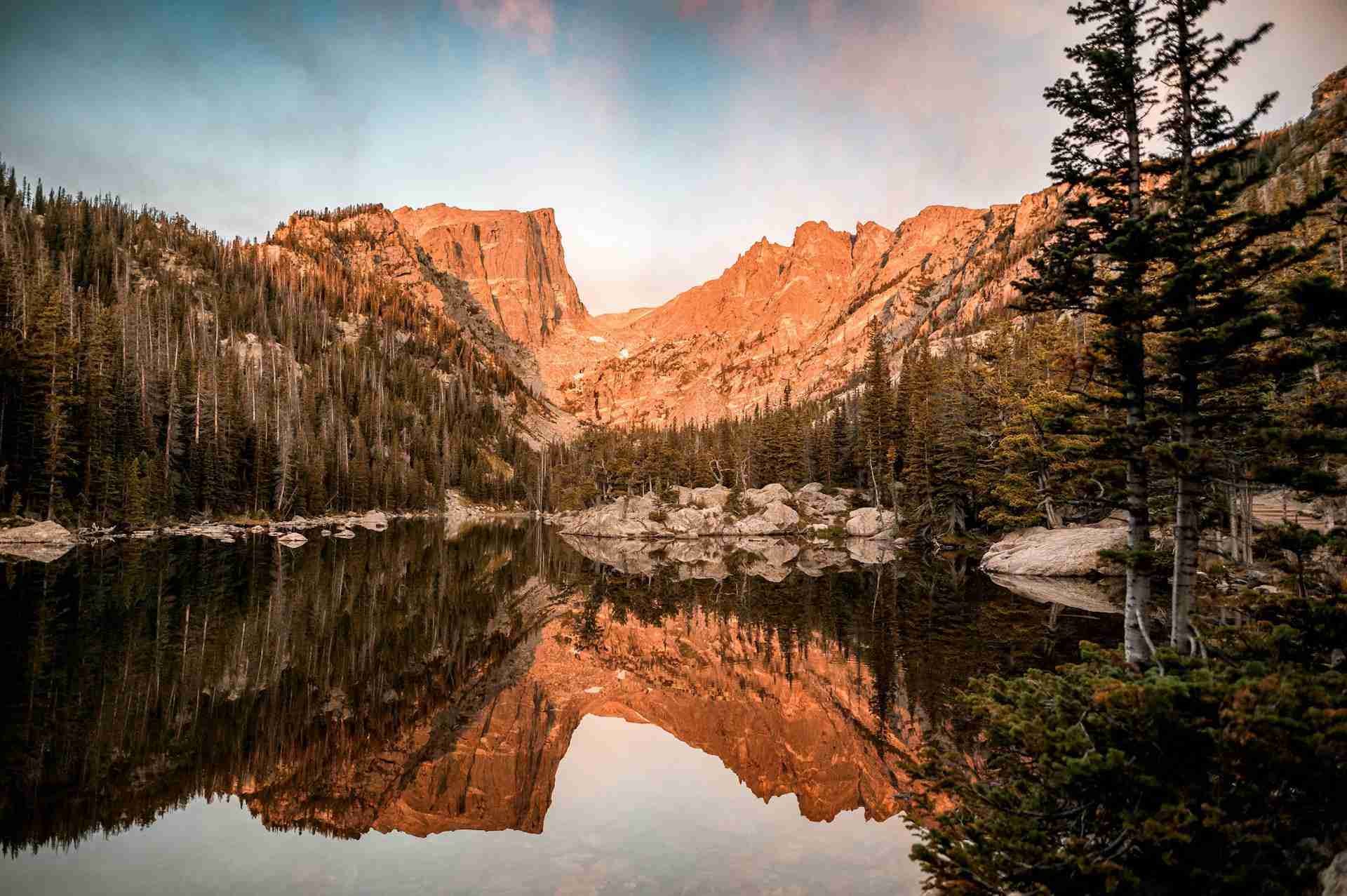
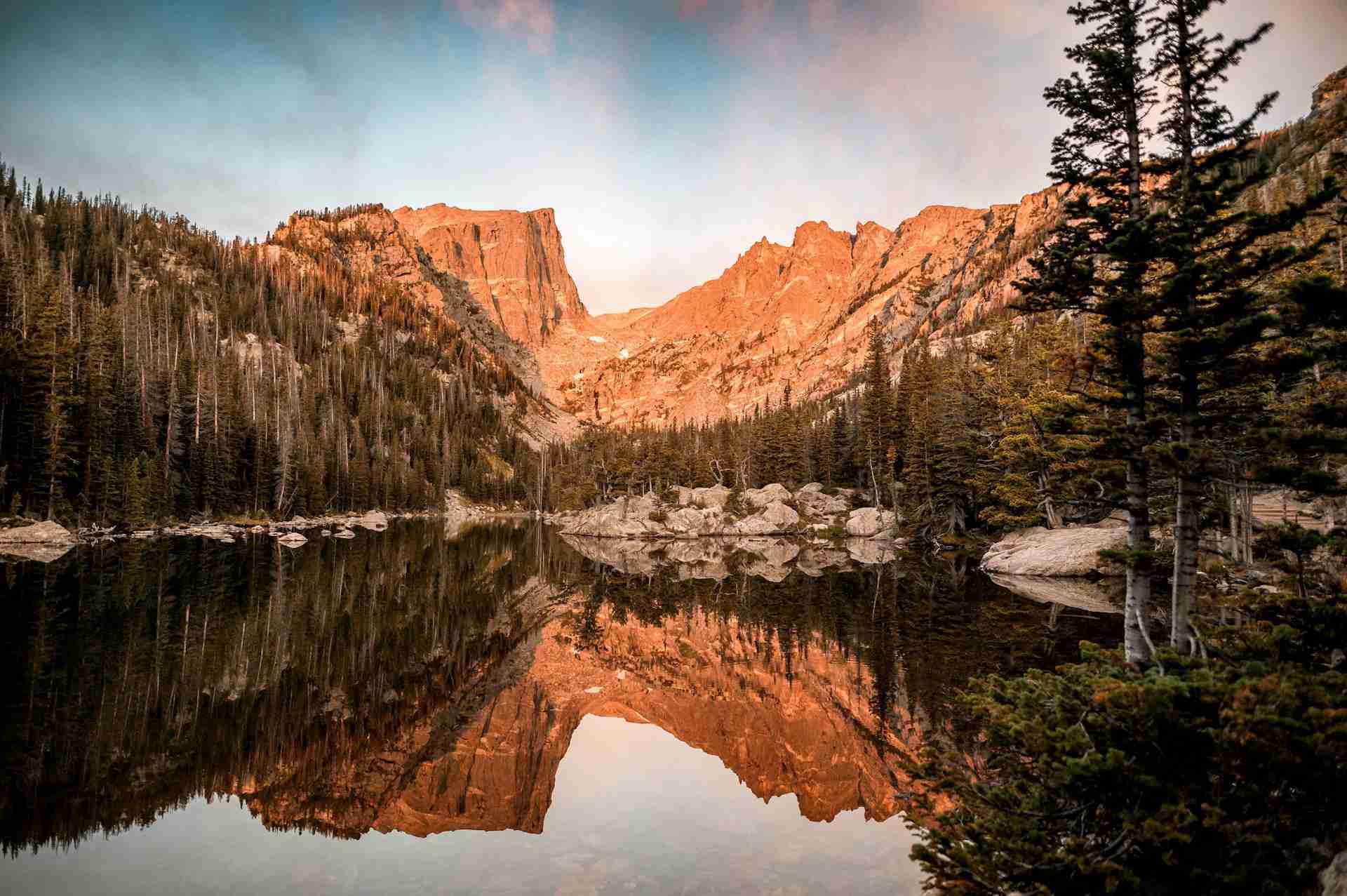
Cradled in the heart of Rocky Mountain National Park, Dream Lake is a photographer's dream not just in name but in essence. At an elevation of over 9,900 feet, the lake sits in a high alpine basin framed perfectly by the sheer walls of Flattop Mountain and the striking prow of Hallet Peak. The lake's clear, reflective surface captures the grandeur of the Continental Divide in pristine symmetry, especially in the calm hours of early morning. Accessible year-round, Dream Lake offers diverse photographic conditions—frosted winter stillness, golden autumn glow, vivid summer greenery, and spring's thawing drama. Every season presents new ways to frame this iconic alpine scene in a location where light, reflection, and topography harmonize with elegance.
Best Photography Opportunities
• Classic Reflection of Hallet Peak at Sunrise
The definitive composition at Dream Lake involves placing the mirror-like surface of the lake in the foreground with Hallet Peak and Flattop Mountain rising directly behind. This image works best at sunrise in late spring through early autumn when the water is calm and free of ice. Arriving before first light allows time to set up and observe how color slowly creeps into the scene. A wide-angle lens lets you anchor your frame with rocks, roots, or snow patches in the foreground, while polarizing filters can be selectively rotated to control the intensity of reflection. In early summer, the grasses and wildflowers near the lake's edge add vivid natural framing.
• Frozen Patterns and Ice Textures in Winter
During winter months, the lake typically freezes solid, transforming its surface into a playground of abstract compositions. Cracks, bubbles, and hoarfrost create detailed patterns that pair beautifully with the towering backdrop of snow-draped peaks. Wide to standard focal lengths are excellent for framing these textures under soft winter light. Composing from just inches above the surface emphasizes the relationship between near-ground detail and towering vertical cliffs. This is also the best time to work in black and white, as the strong tonal contrasts lend themselves well to minimalism and drama.
• Golden Hour on Hallet's East Face
In the hour after sunrise and just before sunset, the east face of Hallet Peak ignites with alpenglow, particularly in autumn and early spring when the light cuts at a shallow angle. Shooting with a medium telephoto allows you to crop in tightly on the peak's rugged features as they catch color, especially if the lake is turbulent and reflection shots aren't viable. Capturing that warm granite against a cool-toned foreground—be it ice, forest, or lake water—provides dynamic temperature contrast that elevates the scene.
• Trail Views and Approach Perspectives
The trail to Dream Lake offers several pull-off points and ledges with partial views of the peak rising above alpine forest. These spots allow for layered compositions that include aspen in autumn, snow-covered limbs in winter, or sun-dappled pine in summer. Including hikers in the scene adds a sense of scale and narrative to the approach. A flexible mid-range zoom is perfect for this portion of the hike, giving you the range to adapt to changing light and depth.
• Night Sky and Astrophotography
While Dream Lake is not a true backcountry destination, its high elevation and position beneath Hallet Peak make it an outstanding location for night photography. On new moon nights between May and September, the Milky Way arcs over the Continental Divide, and the lake's still surface can double the starlight. The hike in pre-dawn or post-sunset requires proper headlamps and preparation, but the reward is unmatched alpine tranquility. Use a fast wide prime and bracket for sky and foreground to capture depth and clarity.
Best Time to Visit
Each season brings a new mood to Dream Lake, making it a year-round destination for photographers. Late spring through early summer, from mid-May to early July, is marked by receding ice, bright green foliage, and snowfields lingering on the high peaks. Water clarity and alpine bloom make this a stunning time for wide-angle reflection shots and color-rich compositions. Be aware of snow on the trail early in the season—traction may be needed.
Summer, from July through September, offers reliable access, vibrant greenery, and longer golden hours. Morning shoots between 5:30 and 7:30 a.m. provide the most stable light and calm water for reflection, before the wind rises mid-morning. Afternoon thunderstorms are frequent in midsummer—dramatic cloudscapes are common but require caution and quick setup.
Autumn, from late September to mid-October, is short but spectacular. The trail is lined with gold-tinged alpine shrubs and stands of aspen visible from nearby ridges. The lower air moisture and angled light produce vivid contrast and clear atmospheric separation between the lake and peaks. Snow often begins to dust Hallet's summit during this period, providing contrast with autumnal tones.
Winter, from late November through April, is a season of frozen serenity. The lake becomes a crystalline platform, and snow softens every shape into an abstract sculpture. This is the quietest season in terms of crowds, but the trail requires microspikes or snowshoes, and temperatures can be extremely cold at sunrise. Yet for those prepared, the high alpine silence and clean winter compositions are profoundly rewarding.
How to Get There
Dream Lake is located in the Bear Lake Corridor of Rocky Mountain National Park, near Estes Park, Colorado. From the Beaver Meadows Entrance Station, follow Bear Lake Road for approximately 10 miles to the Bear Lake Trailhead parking area. In summer and fall, this corridor fills early—often by 5:30 to 6:00 a.m.—so arrive before sunrise or use the park shuttle system, which runs from the Park & Ride lot further down Bear Lake Road.
From the trailhead, the hike to Dream Lake is 1.1 miles one-way with 425 feet of elevation gain. The trail is well-maintained and passes Nymph Lake en route, providing additional photographic opportunities. In winter, the trail is often snow-packed or icy—traction devices are strongly recommended. While the trail is relatively short, the elevation makes exertion noticeable, especially when carrying gear. The best compositions are found near the lake's eastern edge and along the shoreline heading north.
There are vault toilets at the trailhead but no facilities at the lake itself. Cell service is extremely limited within the park—download offline maps in advance.
Recommended Photography Gear
A versatile yet carefully curated kit is key to making the most of Dream Lake's diverse conditions. A full-frame mirrorless or DSLR with high dynamic range is ideal for managing contrast between reflective water and shadowed ridges. A wide-angle zoom is essential for classic lake reflections and foreground-focused compositions, especially at sunrise. A mid-range zoom covers trail scenes, hikers, and tighter lake views with ease. A telephoto lens allows you to isolate Hallet Peak and compress the surrounding terrain, particularly in moody or low-visibility conditions.
In winter and early spring, a tripod is critical for low-light and long-exposure work—choose one with snow baskets or wide feet to avoid sinking. A polarizing filter is useful for reducing glare on the lake's surface and enhancing color saturation in foliage, though care should be taken not to eliminate reflection when it's central to the composition. For long exposure work, pack ND filters in the 6 to 10 stop range.
Essential accessories include microfiber cloths, a lens hood to reduce flare at sunrise, and a remote shutter release or intervalometer for bracketing, time-lapse, or astro work. In winter, extra batteries are a must, and a headlamp is vital for early morning or late-night hikes. For comfort and safety, carry layers, water, and traction devices—even when the trail appears dry, ice may persist near the lake.
Nearby Photography Locations
Just 0.5 miles below Dream Lake, Nymph Lake offers lily pads in summer, reflective water in fall, and a snow-covered alpine bowl in winter. The smaller scale makes it ideal for detail-oriented compositions, with the same peaks subtly reflected at a closer range.
Just beyond Dream Lake, this alpine tarn is flanked by towering cliffs and snowfields. The final portion of the trail provides dramatic scale, glacier-fed reflections, and a more rugged aesthetic, especially in early spring or after fresh snow.
• Bear Lake
A short walk from the main trailhead, Bear Lake is extremely photogenic at both sunrise and twilight. Its wider shore offers classic pine-framed lake reflections with varying compositions from multiple viewpoints, and it's easily accessible even in deep winter.
• Tyndall Glacier Basin
Adventurous photographers can scramble or snowshoe into the upper basin west of Emerald Lake to shoot the remnants of Tyndall Glacier and the cirque beneath Hallet Peak. This is more strenuous and should only be attempted with proper backcountry awareness and equipment.
Dream Lake is not just a location—it's a meditative space where granite, water, and sky meet in perfect balance. Whether you seek mirror-like reflections, abstract ice formations, or the Milky Way suspended over jagged stone, this high alpine basin offers moments of stillness and clarity that reflect far more than just the mountains. It's a landscape best photographed slowly, quietly, and with reverence for the light that reveals it.
Comments
Loading comments…