
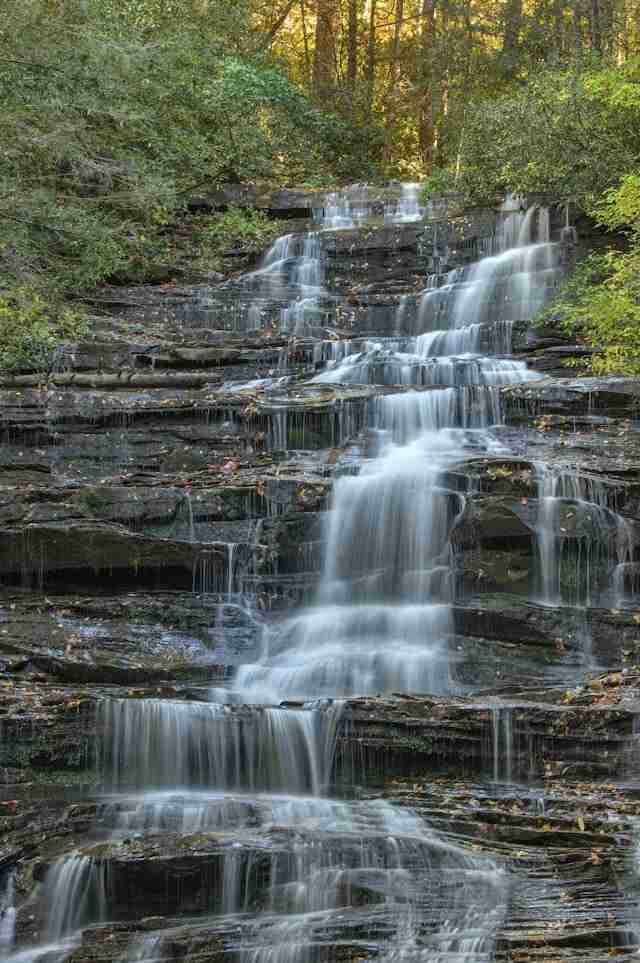
Tucked into the woodlands near Lakemont, Georgia, Minnehaha Falls offers a peaceful, rewarding subject for landscape photographers looking to explore the gentler side of the southern Appalachian foothills. This tiered waterfall, named after the fictional Native American character in Longfellow's poem "The Song of Hiawatha," spills over a rock face in a wide, fan-like descent. Unlike many high-drama waterfalls, Minnehaha is about subtlety, with ribbons of water spreading across mossy ledges framed by forested slopes. The approach is short and accessible, making it ideal for repeat visits under different conditions.
Best Photography Opportunities
• Frontal wide-angle composition at the base
The classic perspective of Minnehaha Falls is captured from directly below, where a wide-angle lens allows you to take in the full height of the tiers while including the stream in the foreground. Early in the day, soft light filters through the trees, avoiding harsh contrast on the rock face. Shooting slightly off-center can add depth and help separate the layers of water. Use a tripod and small aperture to keep the whole frame sharp.
• Close-up detail of the upper tiers
Each segment of the falls has its own character. The upper levels in particular feature delicate streams that curl over stones and create silky patterns in long exposures. A telephoto lens or mid-range zoom helps isolate these details without climbing. Overcast skies or shaded light are best for this, preventing blown highlights and letting the texture of the water shine through.
• Stream reflections and cascades downstream
Below the falls, the stream twists through rocks and roots, forming smaller cascades and mirror-like pools. These can be used for foreground interest or as subjects in their own right. Look for leaves, branches, or patterns in the streambed to build a textured composition. A polarizing filter is useful here to cut glare and enhance clarity in the water.
• Seasonal color and forest context
In late October through early November, the forest surrounding Minnehaha Falls turns into a palette of orange and gold. Including these colors at the edges of your frame adds warmth and contrast to the cool tones of the water. Spring also provides fresh greens and higher flow from rainfall, making the falls feel more active and vibrant. Position yourself slightly uphill to include tree trunks, foliage, and the fall itself in a layered frame.
• Vertical orientation for depth
Because the waterfall spans multiple tiers, vertical compositions emphasize its height and movement. These are especially effective when shot from mid-slope, where you can include both the lower plunge pool and the canopy above. Vertical framing also helps create leading lines as the water draws the viewer's eye from top to bottom.
Best Time to Visit
The best months to photograph Minnehaha Falls are April through early June and mid-October through November. In spring, rainfall feeds the falls, mosses are lush, and the surrounding forest glows with fresh growth. Autumn brings color and a softer angle of light that works well with the shaded location.
Early morning is the ideal time of day. The falls are set in a hollow that stays in shade for much of the morning, making it easier to work with long exposures without blown highlights. Cloudy days are excellent as well, providing even, diffuse light that brings out the texture in both water and rock. Midday can be harsh and should generally be avoided unless the sky is overcast.
Rainfall from the previous days can dramatically change the flow rate. After heavy rain, the volume and speed of the water increase, filling out the rock face and deepening the sound of the stream. Drier periods may thin the falls into more delicate patterns, but the structure still holds visual interest.
How to Get There
Minnehaha Falls is located off Bear Gap Road near Lakemont in Rabun County, Georgia. From the town of Clayton, take US-23/441 south to Old 441 and follow signs toward Lake Rabun. Turn onto Lake Rabun Road and continue until you reach Bear Gap Road, a narrow gravel road that leads uphill toward the trailhead.
The trailhead is marked by a small wooden sign and lies next to a gravel pull-off where a few cars can park. There is no official parking lot, and space is limited, so arriving early is helpful, especially on weekends. From the trailhead, it's a short 0.4-mile hike to the falls, following a well-worn and clearly marked path.
There is no fee to access the trail or falls. The path is manageable for most visitors, but it can be muddy or slick after rain. Waterproof footwear is recommended, especially if you plan to shoot near the stream or lower rocks.
Recommended Photography Gear
A wide-angle lens (16–35mm or 24mm prime) is essential for capturing the full spread of the falls and placing them in the forested context. A mid-range zoom or 70–200mm lens is helpful for isolating textures, top-tier water movement, and framing smaller compositions downstream.
Bring a sturdy tripod to manage long exposure shots, particularly in low light or when using slower shutter speeds to smooth the water. A circular polarizer is useful for removing glare from wet rocks and leaves while enhancing clarity in the water. Neutral density filters are recommended for slowing shutter speed, especially on brighter days.
Waterproof boots, a microfiber cloth, and a small towel for your gear can make a big difference if conditions are damp. A lightweight pack allows you to carry in and out comfortably without difficulty on the short hike.
Nearby Photography Locations
, located about 20 minutes south, offers dramatic canyon views, suspension bridges, and multiple waterfalls. The park's layered rock formations and high overlooks are excellent for sunrise or golden hour.
sits to the north and provides expansive mountain views from several overlooks and trails. Autumn is especially strong here, with far-reaching ridgelines covered in fall color.
, just minutes away, offers lakeside photography with docks, boats, and tree-lined reflections. Early morning mist or sunset light across the water makes for tranquil, painterly scenes.
, not far from Minnehaha, offers a longer hike with access to another beautiful waterfall surrounded by thick woodland. It is a good choice if you're looking to add a second, less crowded destination to your day.
, in nearby Tiger, Georgia, has open vineyard rows with backdrops of the Blue Ridge foothills. In late summer and fall, it offers softer golden light and a pastoral feel that complements the woodland scenes of nearby waterfalls.
Comments
Loading comments…