
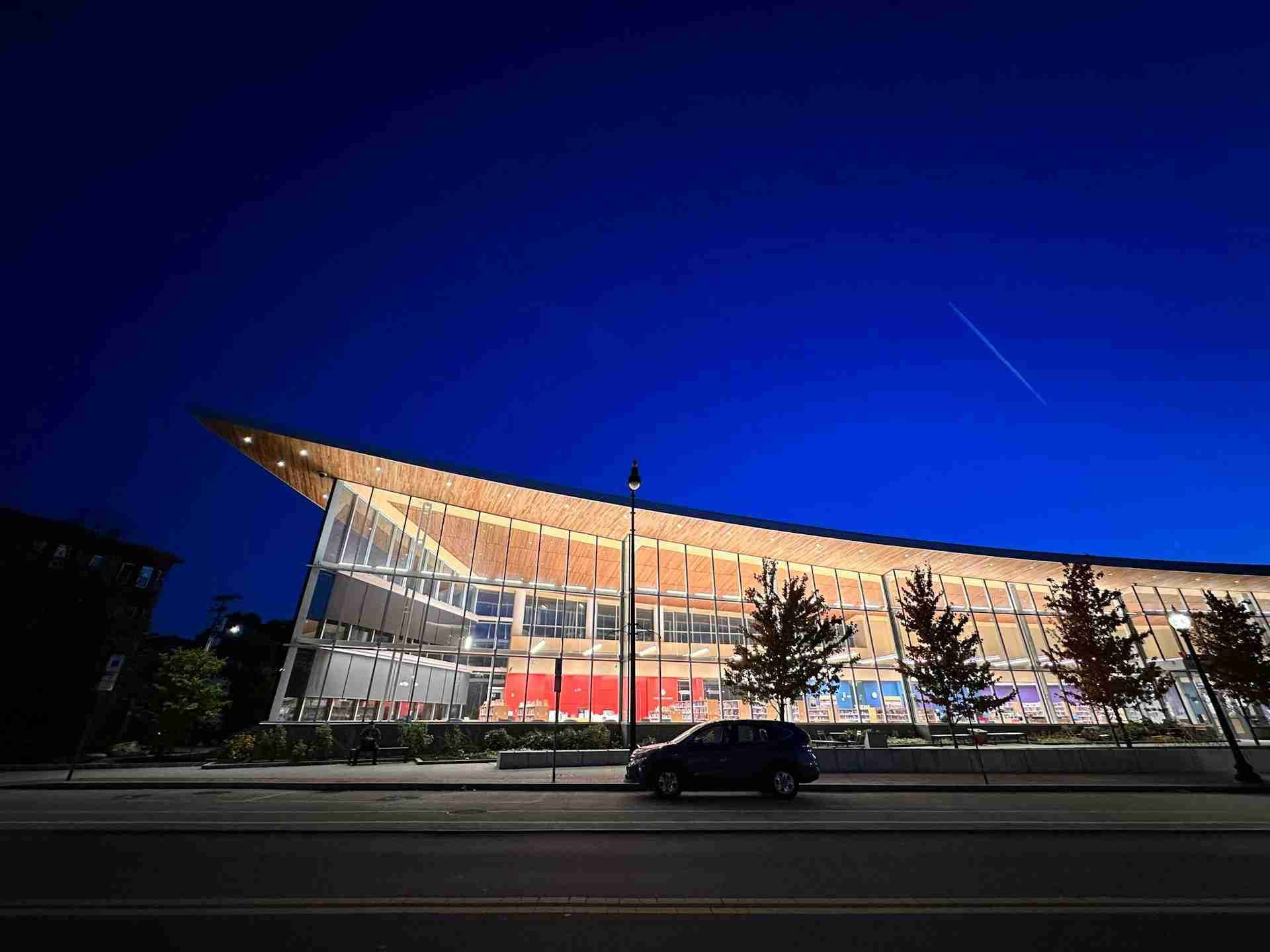
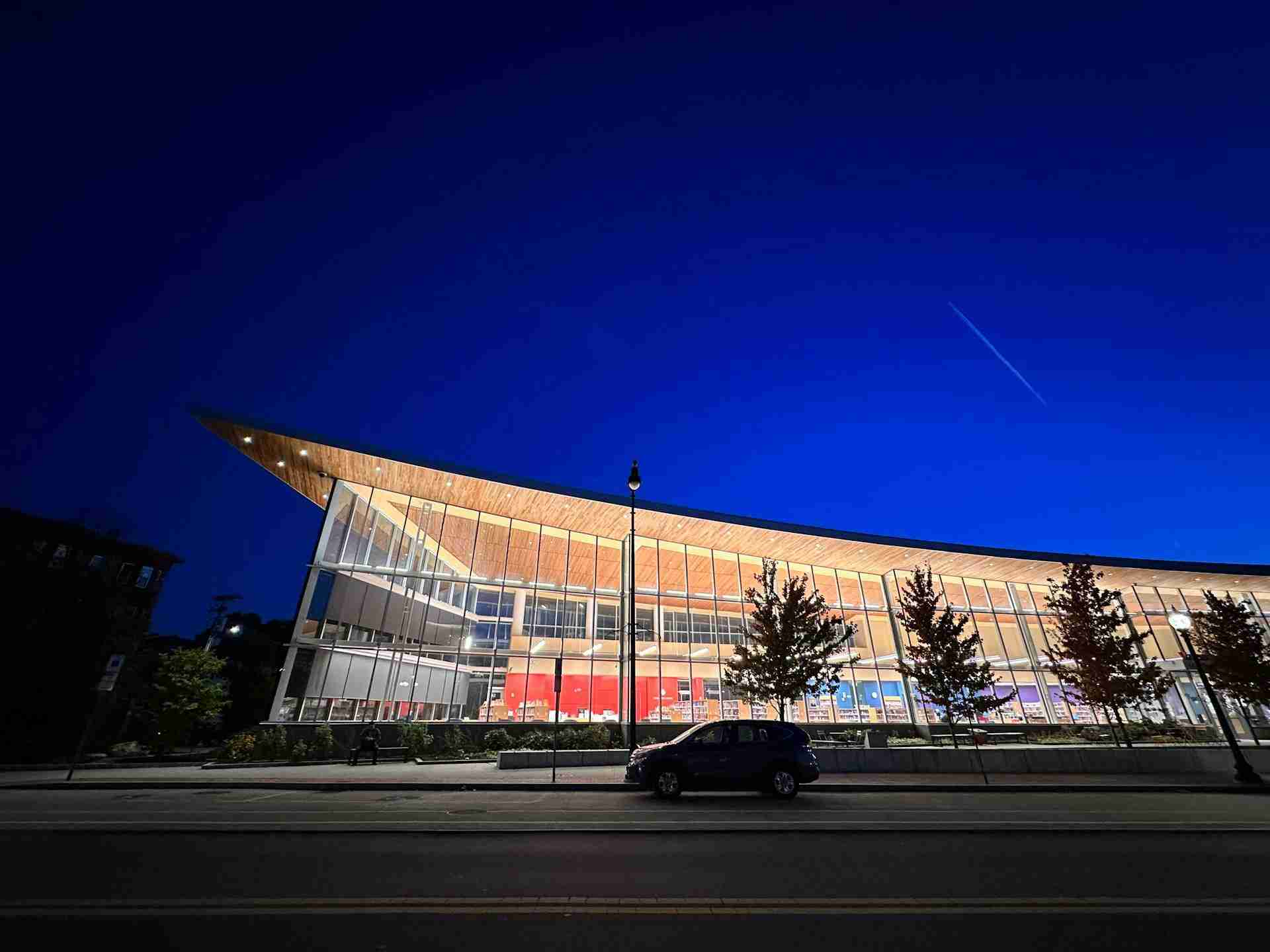
Located in the Wellington-Harrington neighborhood of Cambridge, the Valente Branch of the Cambridge Public Library is a modern community hub with strong architectural presence. Completed in 2019, the building was designed to balance contemporary form with openness and accessibility. Its clean lines, glass façades, and wood accents create inviting spaces both inside and out, while its landscaped surroundings add texture and warmth to the structure. For photographers, the Valente Branch offers opportunities to explore symmetry, reflections, and light play across different materials. Unlike historic civic buildings in Cambridge, this branch celebrates simplicity and transparency, making it a compelling subject for those interested in architectural photography as well as community-focused design.
Best Photography Opportunities
• Exterior Architecture and Street Perspective
The Valente Branch's exterior is best appreciated by walking the perimeter and shooting from multiple angles. Its combination of glass walls and wood cladding offers strong contrasts that respond differently depending on the time of day. Shooting from across Berkshire Street captures the building's scale and its relationship to the surrounding neighborhood. Wide-angle lenses highlight its sharp lines and integration with green space, while telephoto lenses allow for detail shots of the façade's rhythm. Early morning and late afternoon provide angled sunlight that casts strong shadows, enhancing the geometry of the design.
• Reflections and Transparency Through Glass
Much of the library's design is based on openness, and its glass surfaces provide opportunities for layered compositions. Reflections of nearby trees, clouds, or surrounding buildings add complexity to exterior shots, particularly when framed with precision to create symmetry. From inside, the glass walls allow photographers to play with transparency, capturing both interior activity and exterior views in a single frame. These layered images work well with mid-range focal lengths that balance depth without distortion. Overcast days reduce glare, making it easier to work with reflections and transparency.
• Interior Design and Reading Spaces
Inside the Valente Branch, natural light floods the reading rooms, filtered through large windows that create soft, even illumination. Wooden ceilings and beams add warmth and texture, contrasting with the clean lines of the furniture and shelving. Shooting wide establishes the openness of the spaces, while focusing on individual reading areas creates intimate images of design and function. Morning light is particularly effective, as it fills the interiors with subtle glow. Details such as pendant lighting, children's reading corners, and the interplay of wood and glass provide endless opportunities for interior studies.
• Details in Material and Craftsmanship
Beyond its form, the Valente Branch rewards close attention to its materials. The interplay of warm wood, concrete, and glass surfaces offers abstract compositions that highlight modern design principles. Mid-range zooms and macro lenses can isolate the junctions of materials, the grain of the wood, or the rhythm of vertical supports. Shooting in black and white emphasizes geometry and texture, removing distraction from color. These detail-oriented images complement wide architectural shots by showing the human scale and craftsmanship of the building.
• Community Use and Human Interaction
As an active library, the Valente Branch is also defined by the people who use it. Including visitors in your compositions adds narrative, showing the building's role as a community gathering space. Children in the reading areas, adults working at desks, or groups interacting in shared spaces provide scale and life to the architecture. These moments are best captured with respect and discretion, ideally in wider scenes where people are part of the environment rather than direct portraits. Afternoon hours often bring more activity, while quieter mornings are better for capturing calm architectural studies.
Best Time to Visit
The Valente Branch can be photographed year-round, with seasonal changes subtly influencing the mood of the images. Spring and summer bring greenery that reflects in the glass walls, while autumn adds warm tones from surrounding trees. Winter produces sharper light and longer shadows, which highlight the building's geometry against bare branches and snow-covered ground.
For lighting, mornings offer soft illumination that gradually fills the glass-wrapped reading rooms, while afternoons create stronger contrasts on the exterior façades. Sunset sessions can highlight the warm tones of the wood siding and create golden reflections in the glass. Twilight is particularly rewarding, as interior lighting begins to glow through the transparent walls, contrasting against the cooler tones of the evening sky. Overcast days work well for detail studies, as even light prevents glare and maintains consistency across reflective surfaces.
How to Get There
The Cambridge Public Library – Valente Branch is located at 826 Cambridge Street in Cambridge, Massachusetts. It is easily accessible by public transportation, with MBTA bus routes stopping along Cambridge Street and nearby access to the Red Line via Kendall/MIT or Central stations. For those arriving by car, street parking is available in the surrounding neighborhood, though spaces can be limited during peak hours. Cyclists can take advantage of Cambridge's extensive bike lanes and racks near the library entrance.
There are no fees to access the building, as the library is open to the public during regular hours. Photographers should check opening times in advance, as interior access is only possible when the library is open. The surrounding neighborhood is safe and walkable, with cafés and shops nearby that make it easy to combine photography with a longer visit. Tripods can be used outdoors without issue, though inside the library, discretion and sensitivity to visitors is important.
Recommended Photography Gear
For exterior and interior work, a wide-angle lens in the 16 to 35 millimeter range is essential to capture the full scale of the building and its open spaces. A 24 to 70 millimeter lens is highly versatile, suitable for balanced compositions both indoors and out. For detail studies of materials, a macro or fast prime lens works well to isolate craftsmanship and textures. A telephoto lens in the 70 to 200 millimeter range is less essential but useful for compressing reflections or capturing the building within its neighborhood context.
A tripod is valuable for twilight sessions and long exposures, especially when balancing interior and exterior light levels. A circular polarizer helps manage reflections on the glass façades, though it should be used carefully to avoid losing the layered transparency effects. For interior photography, fast lenses with wide apertures are helpful in lower light conditions, especially if tripods are not practical. Neutral density filters can be used creatively outdoors to smooth movement in clouds or passing traffic, adding dynamism to the architectural subject.
Nearby Photography Locations
Just a short distance away, Harvard Yard offers classic academic architecture, shaded paths, and historic brick buildings. It is especially photogenic in autumn, when the trees turn vivid shades of yellow and red.
Located nearby in Cambridge, Kendall Square is known for its mix of contemporary architecture, technology campuses, and lively urban spaces. Glass towers, reflections, and night photography opportunities abound, offering a modern counterpoint to the Valente Branch.
The riverfront paths provide sweeping views across the Charles toward Boston's skyline. Early morning and sunset are the most rewarding times, with soft light reflecting across the water. Long exposures of rowing teams or traffic on bridges add dynamic elements.
The Massachusetts Institute of Technology campus is filled with architectural variety, from Frank Gehry's Stata Center to minimalist modern labs and older brick halls. Its combination of forms and materials makes it a playground for architectural photography.
A short drive or bike ride from the library, Mount Auburn Cemetery combines landscaped grounds, historic monuments, and wide views of Boston from its tower. It offers tranquil compositions with strong seasonal variation, particularly in spring and autumn.
The Cambridge Public Library – Valente Branch is a subject that blends community life with architectural precision. Its clean design, transparency, and integration with its surroundings create endless opportunities for creative photography. By working with reflections, light shifts, and both wide and intimate perspectives, photographers can build a diverse set of images that highlight how this small neighborhood library embodies modern civic design in the heart of Cambridge.
Comments
Loading comments…