
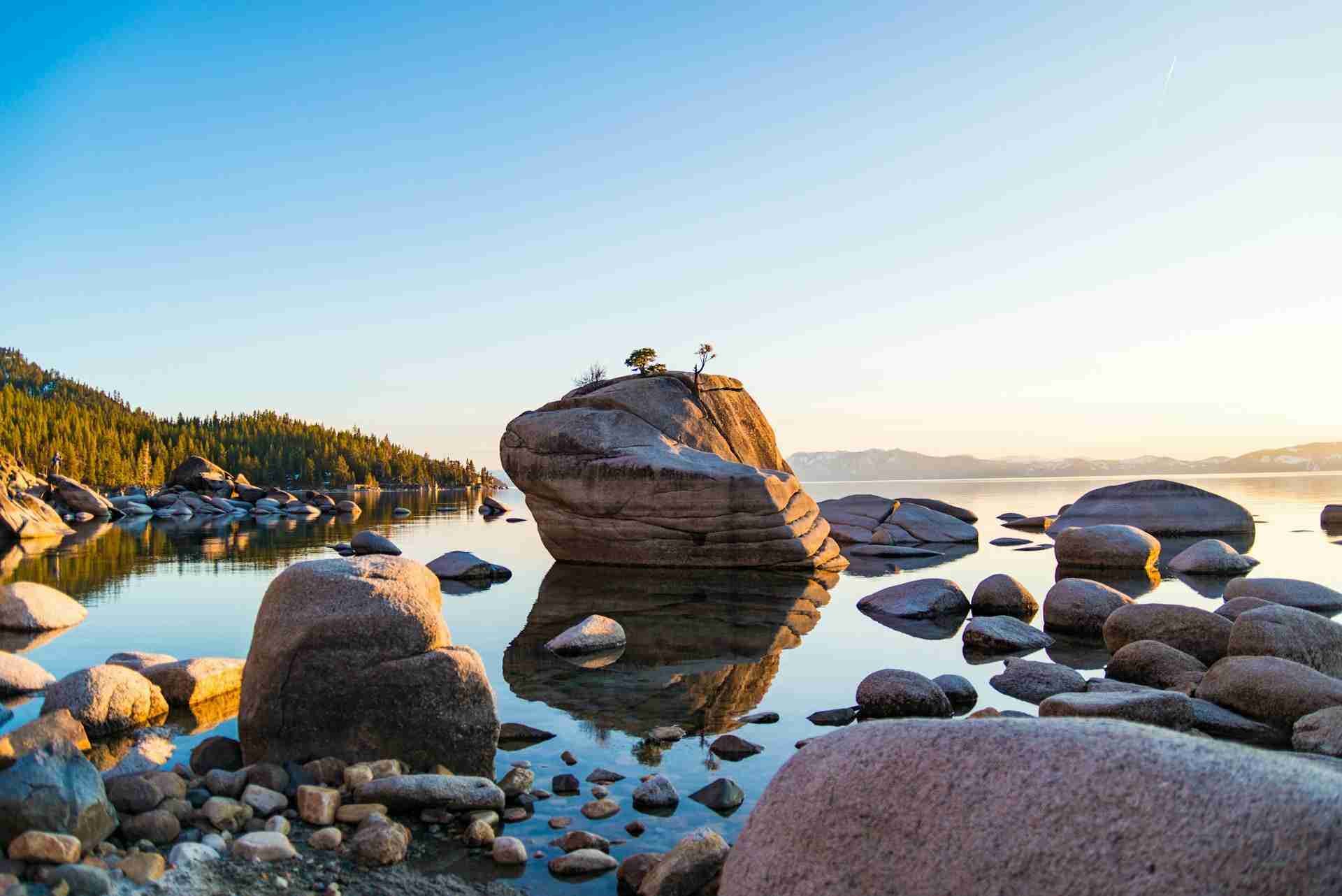
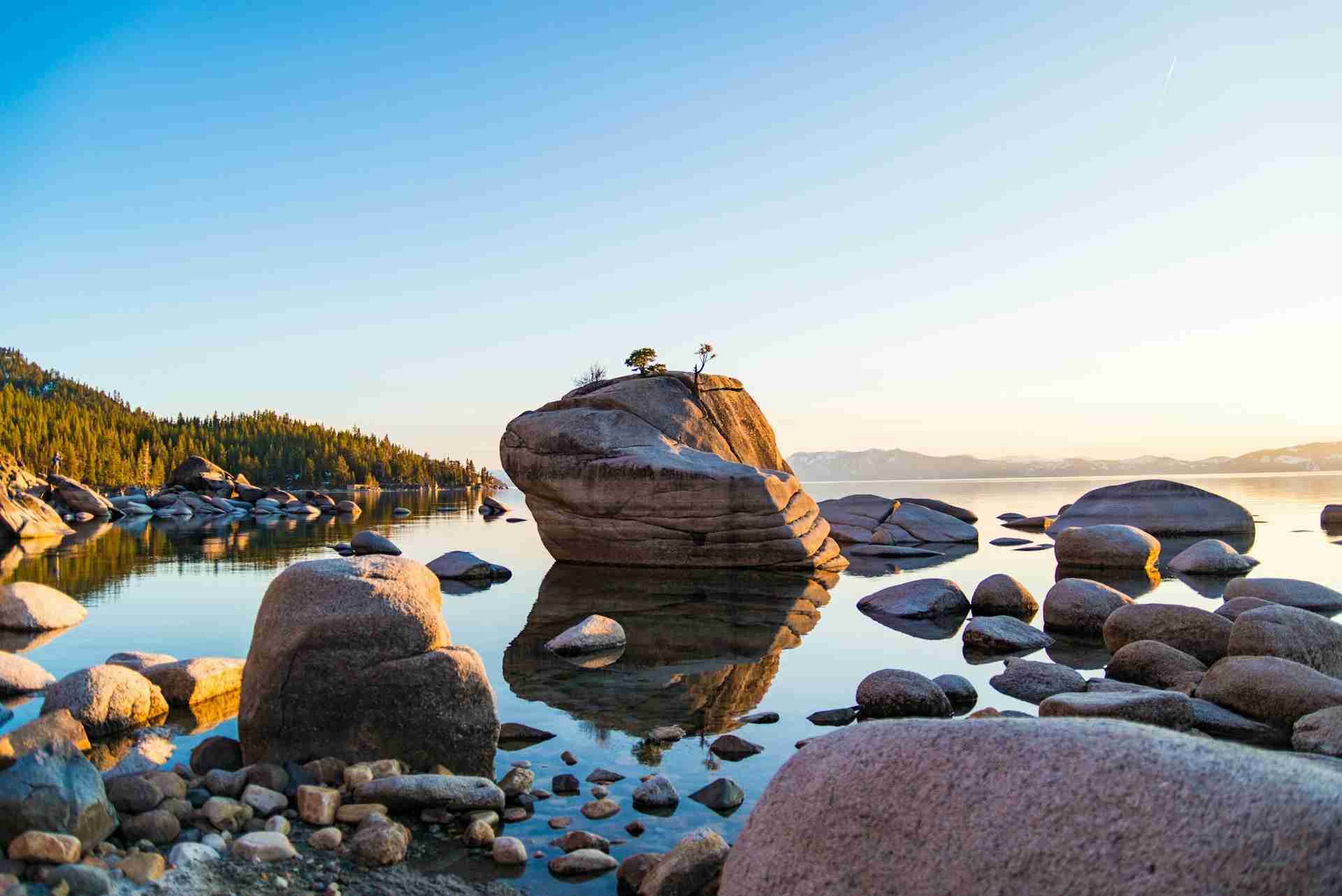
Bonsai Rock, just south of Sand Harbor on Nevada's side of Lake Tahoe, is a compact but visually striking boulder that rises from the lake's crystalline water, topped with a cluster of small trees that resemble cultivated bonsai. Set against the vast expanse of the lake and the Sierra Nevada mountains, this solitary rock presents a beautiful contradiction of scale, where delicate growth meets deep, cold water. Photographers are drawn here for the clarity of the water, the minimalism of the subject, and the remarkable light that passes over the lake during twilight and sunrise. With its ease of composition and natural simplicity, Bonsai Rock rewards patient framing and sensitivity to the subtle shifts in sky, water, and weather.
Best Photography Opportunities
• Sunset over Still Water
Bonsai Rock is best known for its sunset sessions, where warm tones reflect off the lake and silhouette the tiny trees perched atop the rock. As the sun dips below the ridgeline across the lake, the sky typically shifts through gradients of pink, orange, and purple, which are mirrored perfectly in the water. From the sloped granite shoreline, you can frame the rock slightly off-center to make use of the lake's expansive backdrop. Long exposures help smooth the water and enhance the surreal quality of the scene. A neutral density filter is essential here to extend shutter speeds even as light fades, creating clean, mirror-like reflections that isolate the rock against an abstract wash of color.
• Twilight and Blue Hour Minimalism
After the sun has set, the lake transitions into soft blue and purple tones that create a minimalist palette ideal for fine art compositions. The trees on Bonsai Rock take on a silhouette effect, and the water begins to lose texture, becoming a flat mirror for the evening sky. A tripod is required for these exposures, which can range from several seconds to over a minute depending on conditions. Composing with negative space in mind allows you to highlight the shape of the rock and its trees against a nearly featureless background. Use a standard or short telephoto lens to compress the composition and isolate the subject within the broader context of the lake's geometry.
• Foreground Framing with Granite and Water
The area around Bonsai Rock is dotted with granite slabs and smaller boulders that can be used to frame the main subject. Shooting from a lower position and including a textured foreground adds depth to the composition and draws the viewer's eye toward the rock. Early morning is best for this approach, when the light from the rising sun begins to strike the higher ridgelines and softly illuminate the shoreline. A wide-angle lens will help exaggerate the foreground elements while still keeping Bonsai Rock prominent in the frame. Reflections and submerged stones near the water's edge can also add texture and color contrast.
• Clear Water and Submerged Stone Studies
Lake Tahoe's famously clear water provides excellent opportunities for shooting the submerged rocks and patterns beneath the surface, especially around midday when the sun is high and directly overhead. These compositions work well with polarizing filters, which reduce surface glare and allow you to reveal the structure of the lakebed. Shifting your angle and height relative to the water changes the amount of visible underwater detail, so experiment with elevation and lens choice. These images offer a visual counterpoint to the usual sunset compositions, focusing more on light clarity, natural color, and geological detail than atmospheric mood.
• Winter Snow and Seasonal Contrast
During winter, when snow settles on the surrounding boulders and occasionally atop Bonsai Rock itself, the scene transforms into a stark monochrome landscape. The trees become more defined against the white snow and muted sky, while the rock stands out sharply from the water. Winter light is softer and lower throughout the day, making it easier to shoot without heavy shadows or contrast. If the lake partially freezes, patterns of ice can further enhance compositions with abstract shapes and texture. Because access may be more difficult during snowy conditions, photographers should plan carefully and carry appropriate gear for icy terrain.
Best Time to Visit
The best time to photograph Bonsai Rock is between May and October, when the shoreline is easily accessible and the water is at its clearest. Sunset is the most popular and productive time, especially in summer when skies are often clear and the glow of the setting sun lights up both the water and the distant mountains. During these months, twilight lasts longer and gives you more time to experiment with exposures as the light fades. Arrive at least an hour before sunset to scout your composition and prepare for rapidly changing light.
Spring and early summer often bring more active skies, with scattered clouds that catch light and add interest to the horizon. These conditions help break up the uniformity of clear sunsets and provide more opportunities for dramatic color and shape. Early morning can be equally rewarding, especially if the lake is calm and the water takes on soft blue tones before the sun rises. This is a quieter time, with fewer visitors and excellent conditions for longer exposures.
Autumn offers crisp air and a quieter experience overall, though sunsets shift earlier and temperatures drop quickly once the sun disappears. Winter introduces a unique mood to the location, especially after snowfall, though access becomes more difficult due to snow-covered slopes and icy granite. The rock and surrounding shoreline take on a stark, high-contrast look that rewards photographers willing to make the extra effort to reach the site. Regardless of season, clear skies offer the best chance for deep reflections and clean water detail, but changing weather can introduce more atmospheric options.
How to Get There
Bonsai Rock is located on the eastern shore of Lake Tahoe, just off Highway 28 between Sand Harbor and Hidden Beach in Nevada. The rock itself is not marked by official signage, and there is no formal parking lot or trailhead, which adds to the secluded feel of the spot. The best parking option is a small pull-off area along the westbound side of Highway 28, about 1.2 miles south of Sand Harbor State Park. Space is limited, especially during the summer and on weekends, so arrive early if possible.
From the roadside, the trail to Bonsai Rock descends steeply through granite boulders and loose sand. While the hike is short—about five minutes—it requires caution and sturdy footwear, especially when carrying camera gear. There is no maintained path, but the general direction is clear as you follow the slope down toward the water. Once at the shoreline, you'll find a wide granite outcrop from which to shoot. There are no fees to access the site directly, but if you park within Sand Harbor State Park, day-use fees apply.
Tripods are permitted, and there is plenty of space to set up along the rocks without disturbing other visitors. As there are no facilities at Bonsai Rock, bring all necessary supplies with you and pack out everything you bring in. Cell service is limited, and there is no lighting along the road or trail, so headlamps are essential if you plan to shoot past sunset.
Recommended Photography Gear
Bonsai Rock is best approached with a kit tailored to wide-angle landscapes and long exposure work. A full-frame camera paired with a wide-angle lens in the 14 to 35 millimeter range will allow you to capture the expansive scene while controlling perspective distortion. For compositions that place Bonsai Rock within the broader context of the lake, a 24 to 70 millimeter lens offers excellent flexibility. This is especially useful during changing light conditions when you may want to reframe quickly without switching lenses.
A sturdy tripod is critical, particularly for twilight and long exposure photography. The uneven granite surface allows for stable placement, but bring a tripod with adjustable legs for better grip and leveling. A circular polarizer will help manage surface glare on the water and enhance underwater visibility when the light is high. For extended exposures at sunset or during brighter twilight, a three-stop or six-stop neutral density filter is useful to smooth water and add drama to the sky.
Bring a remote shutter release or use your camera's self-timer to avoid vibration during long exposures. A lens cloth or microfiber towel is essential to manage condensation or spray, especially near the water. Weather can change quickly in the mountains, so pack a light windbreaker and gloves during cooler months. For winter shooting, microspikes or traction footwear are strongly recommended due to icy granite and snow-covered trails. A compact backpack with water, a flashlight, and extra batteries will make the short hike safer and more comfortable.
Nearby Photography Locations
Located just north of Bonsai Rock, Sand Harbor offers a wide stretch of shoreline, dramatic boulder formations, and excellent swimming coves that shine in late afternoon light. The clear water and shallow depth create vivid color gradients ideal for aerial photography or abstract compositions.
This quieter section of shoreline lies just south of Bonsai Rock and features a mix of smooth sand, large granite outcrops, and clear views of the lake's western horizon. The sloped beach and rocky framing make it ideal for sunrise photography and long exposure seascapes.
Further south along the lake, Cave Rock is a volcanic formation that offers elevated viewpoints of Lake Tahoe's eastern shore. A short hike leads to a wide vista perfect for panoramic shots during golden hour or moody twilight scenes when clouds gather over the lake.
• Spooner Lake and Meadow
Located inland off Highway 28, Spooner Lake offers a different landscape with forest trails, open meadows, and reflections in a quiet alpine lake. In autumn, the aspen trees turn yellow, providing contrast against the darker conifers and soft trail light.
• Incline Village Lookouts
Driving north toward Incline Village, you'll find several roadside pullouts that offer sweeping views over Lake Tahoe. These high vantage points are especially productive at sunrise or during changing weather, when layers of clouds and light interact with the mountain ridgelines.
Bonsai Rock may be one of the smallest photographic subjects on Lake Tahoe, but its simplicity, setting, and atmosphere offer remarkable depth. Whether framed against glassy stillness or set beneath a canvas of twilight color, the rock stands as a symbol of balance between fragility and permanence. For landscape photographers who value mood and minimalism, it is one of the most rewarding locations on the lake's eastern shore.
Comments
Loading comments…