
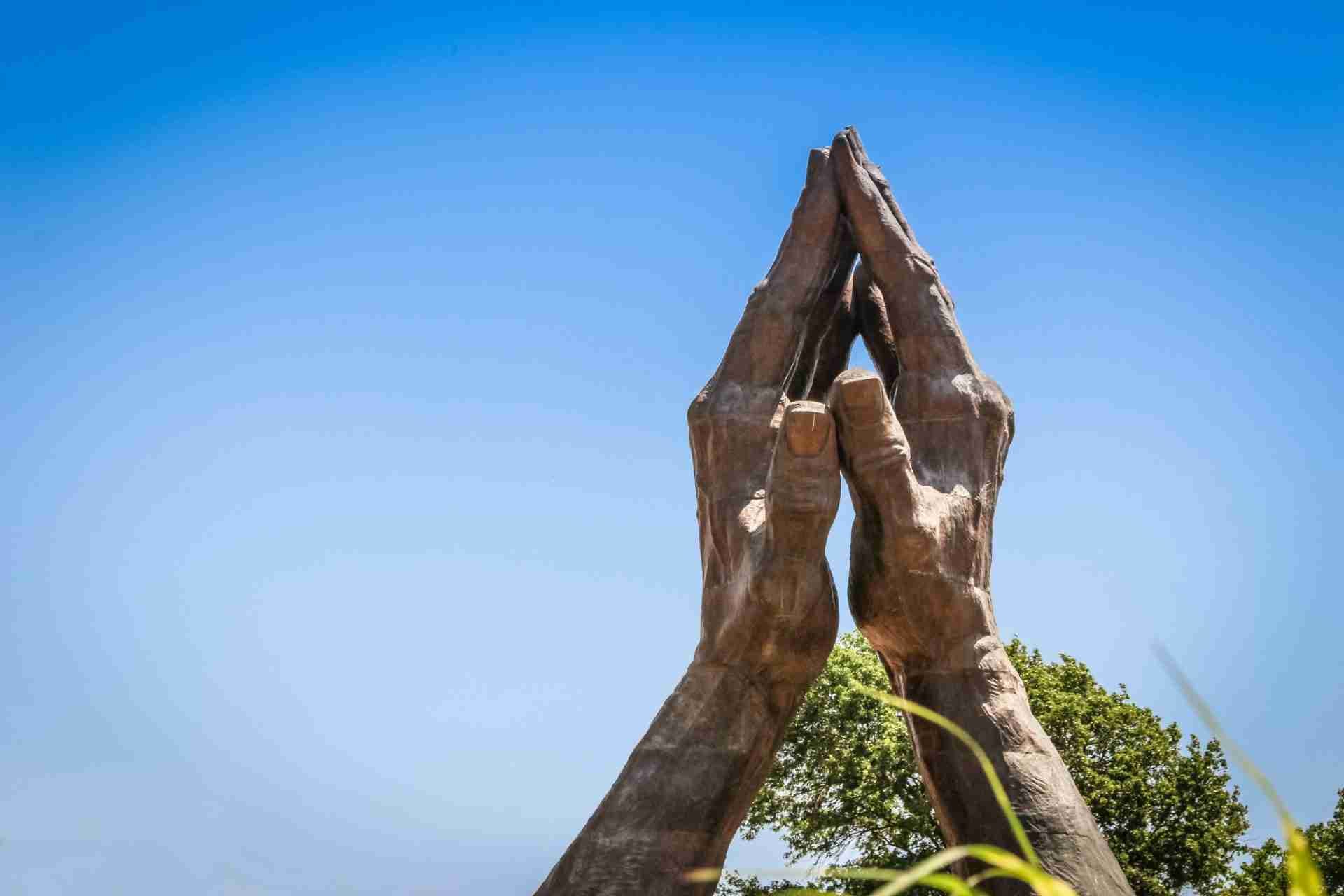
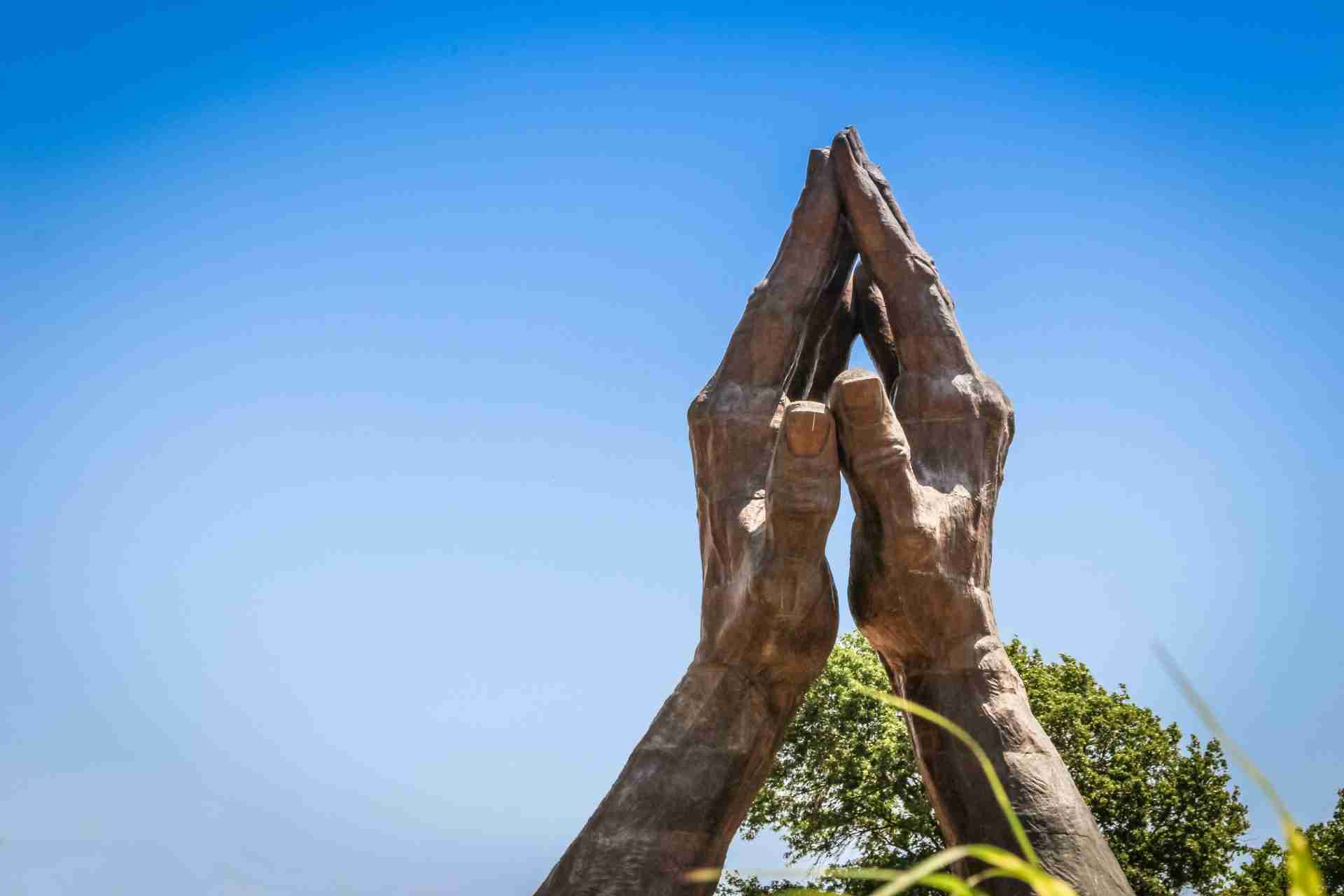
The Healing Hands sculpture stands at the entrance of Oral Roberts University in Tulsa, Oklahoma. Rising more than 60 feet into the air, the enormous bronze hands are pressed together in a gesture of prayer, making them one of the largest sculptures of praying hands in the world. Created by sculptor Leonard McMurry, the scale is what immediately captures attention. Standing beneath the sculpture, the fingers stretch high into the sky and the palms form a steep triangular shape that dominates the surrounding lawn and campus entrance. The bronze surface carries subtle texture and color variation that changes with the light throughout the day. For photographers, the subject is simple but powerful: strong vertical form, recognizable symbolism, and a sculpture that reads clearly from multiple angles.
Best Photography Opportunities
• Low Angle Views –
One of the most effective ways to photograph the Healing Hands is from close to the base looking upward. This perspective exaggerates the height of the sculpture and makes the fingers feel even more monumental against the sky. A wide lens works well here because it emphasizes the vertical shape of the hands and the narrow gap between the palms. Shooting slightly off center can help separate the fingers so they do not visually overlap too much. Early morning or late afternoon light creates shadow along the knuckles and joints, which reveals detail in the bronze casting. Including a small portion of the surrounding lawn at the bottom of the frame can help anchor the composition.
• Symmetry Looking Straight Up –
Standing directly in front of the sculpture and aligning the camera with the center of the palms creates a strong symmetrical composition. The two hands mirror each other almost perfectly, forming a clean triangular shape that leads the eye upward to the fingertips. A wide lens works best, but keeping the camera level helps maintain the symmetry of the sculpture. The sky becomes an important part of the composition, so days with light cloud texture can add visual interest without distracting from the subject. This is one of the most recognizable ways to photograph the monument.
• Framing the Hands with Campus Trees –
Several areas around the sculpture allow you to include surrounding trees in the frame. From a slightly greater distance, the hands rise above the greenery, which helps emphasize their scale. A mid range zoom is useful here because it allows you to adjust how much of the surrounding environment is included. In spring and summer, the green foliage contrasts nicely with the bronze tones of the sculpture. Late afternoon light can illuminate the hands while leaving the trees slightly darker, which naturally draws attention to the subject.
• Details of the Bronze Surface –
The sculpture contains subtle textural details across the fingers, knuckles, and palms. A longer focal length allows you to isolate these areas and focus on the craftsmanship of the casting. Side lighting works especially well because it reveals depth in the surface and highlights small variations in color. These detail images provide a different perspective from the wider compositions that emphasize the full scale of the sculpture. They are particularly useful when midday light makes larger scenes feel flat.
• Sunset or Blue Hour Sky –
As the sun lowers, the hands can be photographed as a dark shape against a colorful sky. The pointed fingertips create a strong outline that reads clearly even when the sculpture itself becomes shadowed. Position yourself so the hands are isolated against open sky rather than overlapping buildings or trees. A tripod can help keep the image sharp as light fades. Blue hour also works well, when the sky holds a deep tone that contrasts with the silhouette of the sculpture.
Best Time to Visit
Early morning is often the best time to photograph the Healing Hands sculpture. The light is softer, shadows are longer, and the campus area is usually quieter. This allows more freedom to move around and experiment with different angles without distractions.
Late afternoon is also productive because the lower sun angle brings out the bronze texture and creates more dimensional light on the hands. Sunset and blue hour can produce strong silhouette compositions. Midday light can be harsher, but it still works for tighter detail shots where texture is the focus.
How to Get There
The Healing Hands sculpture is located at the main entrance to Oral Roberts University in Tulsa, Oklahoma. The campus sits along South Lewis Avenue and is easily accessible by car. Visitors can park in nearby campus lots and walk to the sculpture.
The monument stands in an open landscaped area near the entrance, allowing visitors to walk completely around it. Photography is permitted from the surrounding grounds, and there is no fee required to visit the sculpture.
Recommended Photography Gear
A wide lens is the most useful option for this location because it emphasizes the height of the sculpture and allows you to capture the full form from close distances. A mid range zoom is helpful for framing the hands with surrounding landscape elements. A telephoto lens can isolate details of the bronze surface and sculptural features.
A tripod is recommended if you plan to shoot during sunset or blue hour. A polarizer can deepen the sky and reduce glare on the bronze surface during bright daylight. Since the sculpture is located in an easily accessible outdoor space, carrying a small but flexible kit is usually sufficient.
Nearby Photography Locations
is another major landmark on the Oral Roberts University campus. Its tall white structure rises dramatically above the surrounding buildings and reflects beautifully in the nearby reflecting pool. The clean lines and strong vertical form make it an excellent architectural subject.
is one of Tulsa's most recognizable landmarks and one of the tallest freestanding statues in the United States. The statue represents the city's oil industry heritage and stands beside the Tulsa Expo Center. Its massive scale makes it ideal for wide angle compositions.
is a large public park along the Arkansas River with modern architecture, landscaped pathways, and waterfront views. It offers a variety of photography opportunities including skyline views, bridges, and creative playground structures.
is an Art Deco church that is one of the finest examples of the style in the region. Its vertical lines, geometric decoration, and detailed stonework create strong architectural compositions. Morning light works well along the main entrance.
sits along historic Route 66 featuring sculptures and overlooks the Arkansas River. The elevated position offers strong sunset views and opportunities for photographing the surrounding cityscape.
Comments
Loading comments…