
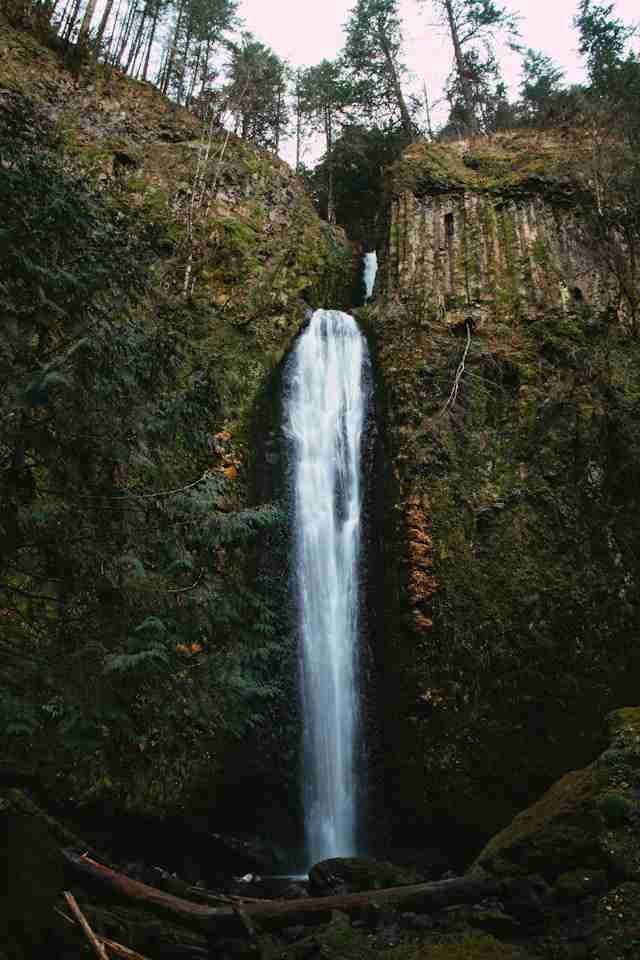
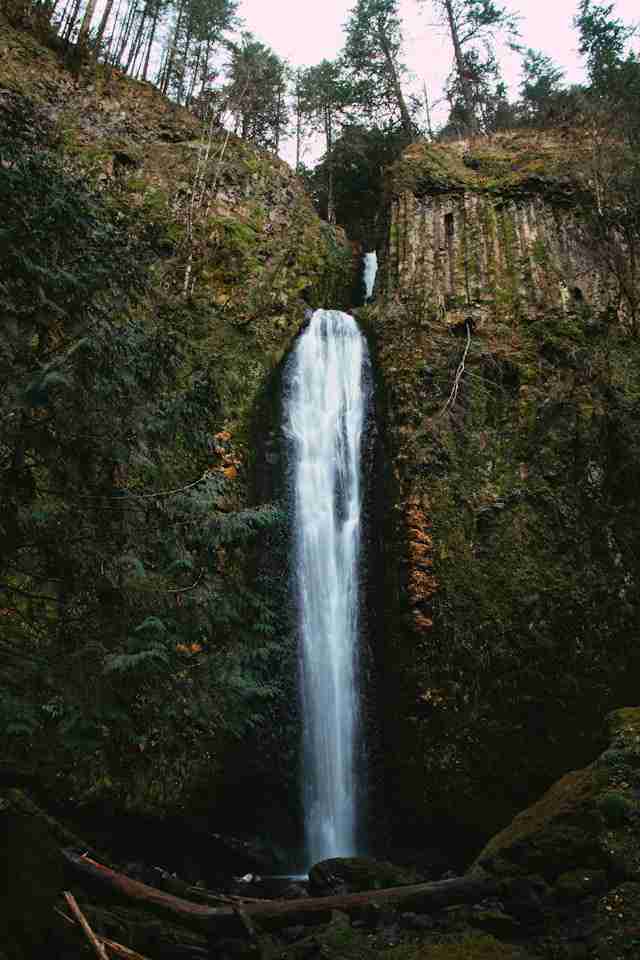
Deep in the Columbia River Gorge near Cascade Locks, Gorton Creek Falls rewards those willing to follow a less-traveled path into a world of moss, boulders, and flowing water. The falls are a two-tiered cascade totaling about 115 feet, with the upper drop plunging dramatically into a narrow gorge. Unlike some of the Gorge's more accessible waterfalls, Gorton Creek Falls requires photographers to scramble along a rocky streambed, adding to its sense of discovery and isolation. The reward is a lush, green setting where the constant mist supports moss-covered walls, ferns, and driftwood that transform the scene into a living tapestry. For photographers, this is a location that combines the power of falling water with the delicate detail of Pacific Northwest forest textures.
Best Photography Opportunities
• Full Waterfall Composition from the Base
The most classic view of Gorton Creek Falls comes from the boulder-filled base, where both tiers of the waterfall can be framed together. A wide-angle lens captures the vertical drama, while foreground rocks and stream details provide leading lines into the composition. Long exposures soften the water into a silky flow that contrasts beautifully with the rough textures of moss and stone. Shooting on overcast days avoids harsh highlights and ensures even exposure across the misty gorge. Including small plants or logs in the foreground adds a sense of scale and emphasizes the wild, untouched feel of the site.
• Stream and Boulder Foregrounds
Gorton Creek itself, which must be followed to reach the falls, offers endless opportunities for compositions before even arriving at the main cascade. The stream twists between moss-covered rocks, fallen logs, and small rapids, all of which make strong foregrounds for longer exposures. Neutral density filters are useful here for stretching shutter speeds to smooth the water, while a circular polarizer reduces glare on wet stones. Mid-range zoom lenses help isolate sections of the creek where water patterns and textures combine into abstract scenes. These stream shots make excellent companions to the grand waterfall images.
• Close Studies of Moss and Detail Textures
The sheer amount of moss and plant life at Gorton Creek Falls makes detail work as important as grand compositions. Macro lenses reveal the fine structure of moss, dripping water droplets, and ferns clinging to the rocks. Shallow depth of field isolates these textures, turning them into rich, abstract studies. Overcast light is again ideal, creating consistent illumination that brings out the lush greens without harsh shadows. These close-ups pair well with the waterfall's sweeping scale, offering variety in a portfolio from the site.
• Alternative Angles and Side Perspectives
While the main view from the base is the most dramatic, exploring slightly off-angle positions can create unique compositions. Shooting from the creek itself allows for low, ground-level perspectives where water leads directly toward the cascade. From the right side of the base, telephoto lenses isolate sections of the waterfall where water breaks into multiple streams against the mossy wall. These alternate views are particularly useful when the main base location is crowded, offering distinctive takes that highlight the falls' layered form. Careful footing and waterproof boots are essential for these angles.
• Seasonal and Weather-Driven Variations
Gorton Creek Falls changes dramatically with the seasons. In spring, snowmelt creates a roaring cascade surrounded by vibrant new growth, making it the most energetic time to visit. Summer brings lower flows, but the constant mist and deep shade keep the area lush, offering easier long exposures. Autumn adds golden leaves along the creek that contrast with the green moss and white water, creating colorful foreground opportunities. Winter, while more challenging to access, produces icicles and frozen textures that transform the gorge into a surreal, crystalline environment. Fog and rain add further atmosphere, softening the scene and emphasizing the Pacific Northwest's moody character.
Best Time to Visit
The falls are accessible year-round, though conditions and visual character vary widely. Spring is the most dramatic season, with high water volume and vibrant forest growth surrounding the gorge. Summer offers consistent access and reliable long-exposure opportunities, as tree canopy keeps light diffused even in midday. Autumn is highly photogenic, with colorful leaves accenting the greens and grays of the gorge, while fog is more common in the cooler air. Winter access depends on trail and weather conditions, but ice formations create unique photographic rewards for those who make the journey safely.
Lighting is best on overcast days, which are frequent in the Columbia River Gorge and provide ideal conditions for photographing both water and forest. Bright sunlight tends to blow out highlights on the falls and create uneven exposure across mossy surfaces. Early morning is especially rewarding for soft light and solitude, while late afternoon can bring deeper shadows into the gorge, enhancing contrast. Photographers should plan for slower shooting sessions, as long exposures are often the most effective way to capture both the waterfall and the creek below.
How to Get There
Gorton Creek Falls is located near Cascade Locks, Oregon, along the Columbia River Gorge. The hike begins at Wyeth Campground, where parking is available at the trailhead. From there, follow Gorton Creek Trail, which parallels the creek for just over a mile. The final approach to the falls requires scrambling directly along the streambed, hopping across boulders and navigating wet surfaces. Waterproof boots and careful footing are essential, particularly in high-water conditions.
There is no fee to access the trail, though parking regulations at Wyeth Campground should be checked in advance. The route is relatively short but requires balance and agility to reach the base of the waterfall safely. Facilities are minimal at the trailhead, so photographers should come prepared with water, food, and protective gear for equipment. Drones are not permitted within the Columbia River Gorge National Scenic Area, so all compositions must be ground-based. The reward is a secluded waterfall where the effort of access keeps visitor numbers lower than at nearby, more developed sites.
Recommended Photography Gear
A wide-angle lens in the 16 to 35 millimeter range is the most important tool for capturing the full waterfall and the gorge environment around it. A 24 to 70 millimeter zoom provides flexibility for framing sections of the cascade and creek, while a telephoto lens in the 70 to 200 millimeter range allows for isolating sections of the waterfall or compressing details along the mossy walls. A macro lens is highly useful for close studies of moss, ferns, and textures along the creek.
A sturdy tripod is essential for long exposures, as the gorge's shaded environment makes slower shutter speeds common even without filters. Neutral density filters extend exposure times for smoothing both waterfall and creek motion, while a circular polarizer reduces glare on wet stone and enhances greens. Waterproof boots and protective gear for cameras are essential due to spray and wet conditions near the base. Lens cloths should be kept on hand to manage water droplets on glass. For longer visits, carrying lightweight but durable gear helps balance the technical demands of the scramble approach.
Nearby Photography Locations
Located a short drive west along the Gorge, Elowah Falls is a tall, elegant waterfall framed by basalt cliffs. Its powerful plunge into a wide amphitheater creates dramatic compositions, especially at sunset when warm light grazes the rock walls.
Near Bonneville Dam, Wahclella Falls offers a two-tiered cascade surrounded by mossy cliffs and lush vegetation. The approach trail follows Tanner Creek, providing stream compositions that pair well with waterfall shots at the end.
This less-traveled trail features deep forest, side streams, and smaller cascades, offering photographers quieter woodland subjects. In autumn, the trail is particularly rewarding as colorful leaves carpet the mossy floor.
The most famous waterfall in the Columbia River Gorge, Multnomah Falls is a short drive away and provides grand, iconic views. Its upper and lower tiers are best photographed early in the morning to avoid crowds, when mist and soft light enhance the scene.
For a cultural and structural counterpoint, Cascade Locks offers strong compositions of the Bridge of the Gods spanning the Columbia River. Sunset provides dramatic skies above the river, while twilight brings the bridge's lights into play.
Gorton Creek Falls is a location that rewards those who prefer a little adventure with their photography. Its secluded setting, moss-covered gorge, and multi-tiered cascade create a subject that is both dramatic and intimate. By combining grand waterfall perspectives with stream studies and fine forest details, photographers can build a diverse portfolio from this one hidden corner of the Columbia River Gorge.
Comments
Loading comments…