
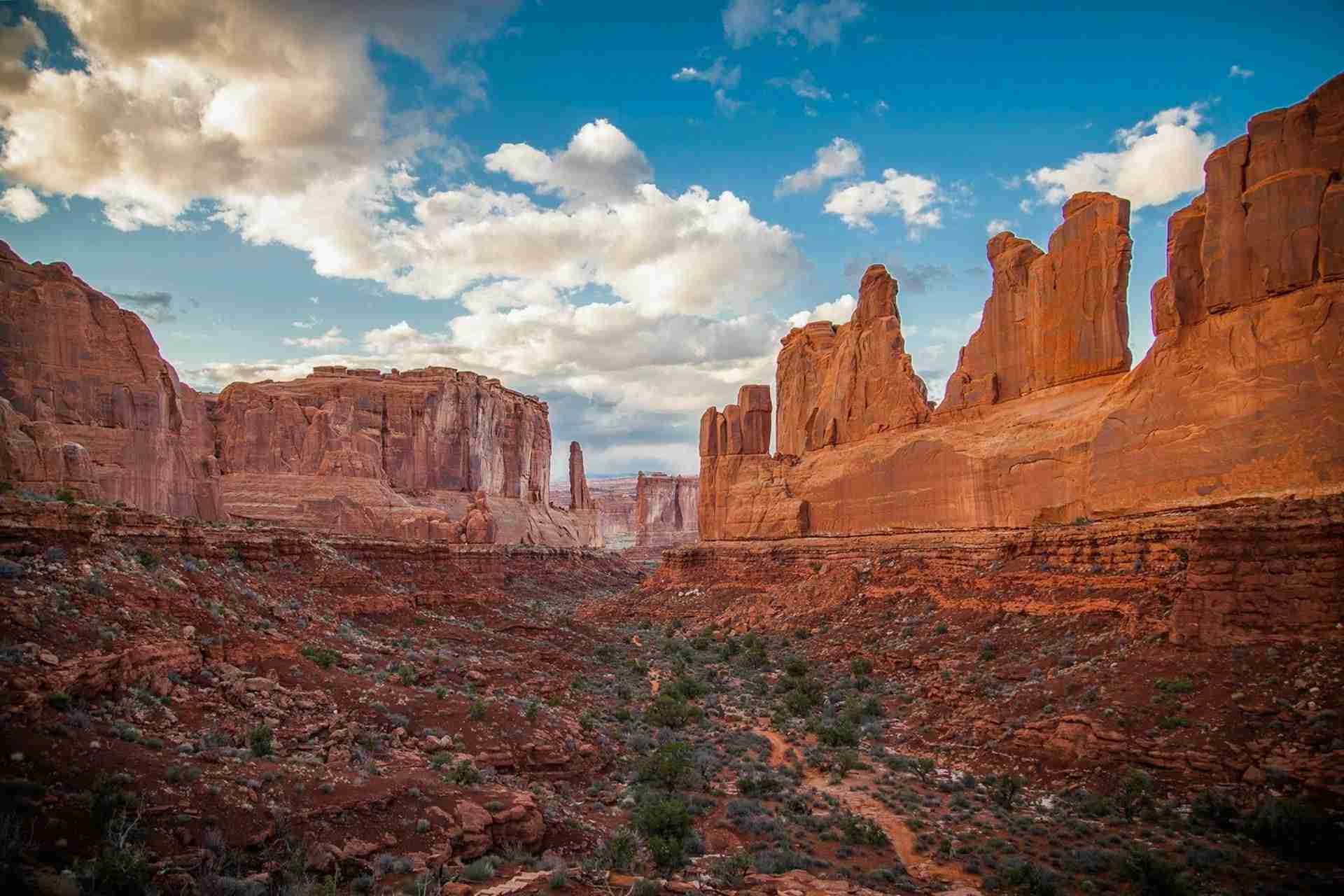
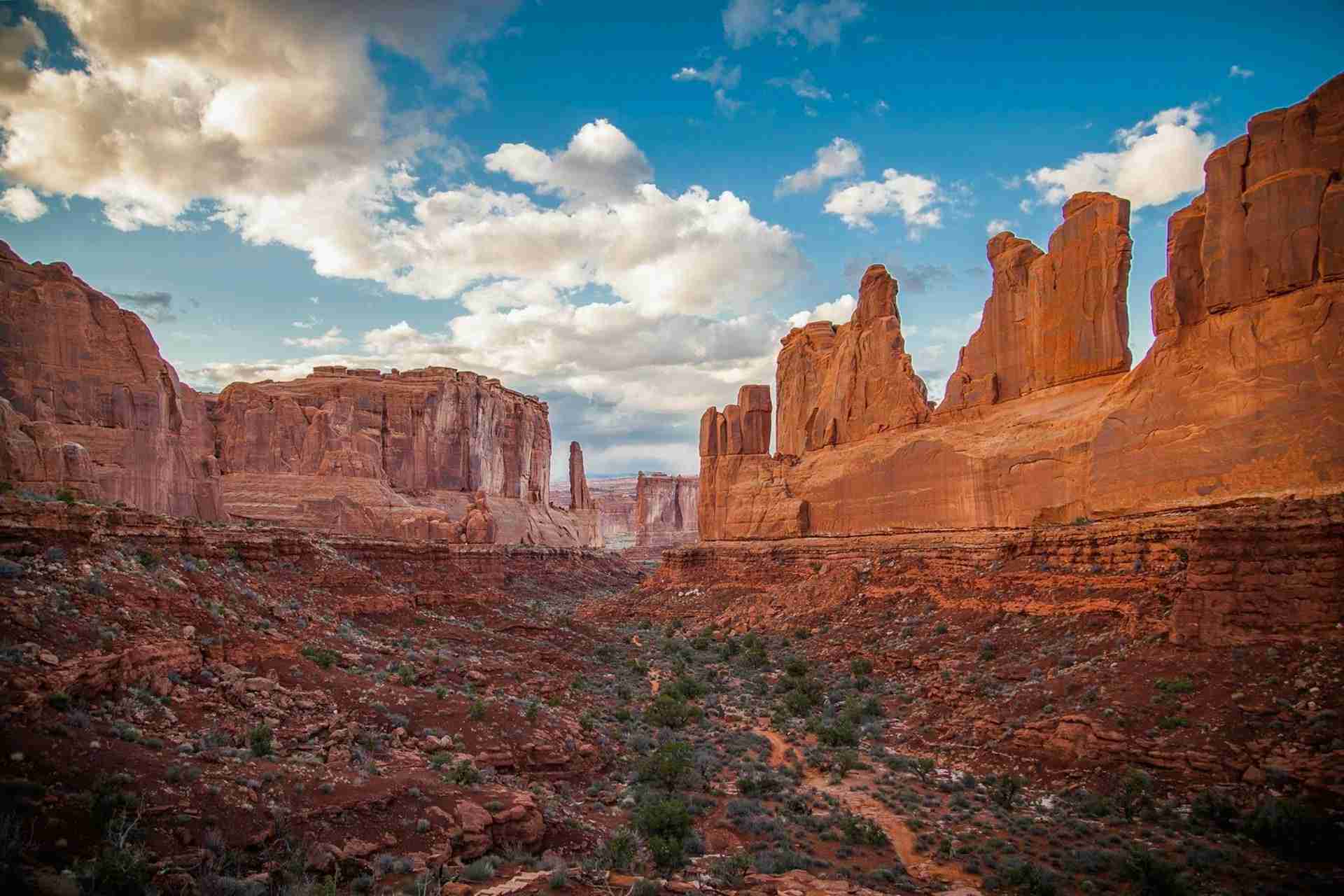
At the southern entrance of Arches National Park, just minutes from the visitor center, Park Avenue welcomes photographers with a striking corridor of towering red rock walls and sculpted monoliths. This dramatic sandstone canyon feels like a grand open-air cathedral, flanked by formations that rise hundreds of feet above the desert floor. Named for its resemblance to a city street lined with skyscrapers, Park Avenue is one of the park's most visually powerful locations, especially for those drawn to vertical scale, clean light, and deep desert shadow. With its straightforward trail access, open compositions, and shifting light throughout the day, Park Avenue offers a playground for landscape photographers who enjoy working with line, contrast, and monumental scale.
Best Photography Opportunities
• Grand Vistas from the Upper Trailhead Overlook
From the Park Avenue trailhead, a short walk leads to a raised platform that overlooks the entire canyon. This is the first and most iconic composition, where you can shoot straight down the corridor of sandstone with The Courthouse Towers in the distance and the massive rock faces of Queen Nefertiti and the Organ on either side. A wide-angle lens around 16 to 24 millimeters allows you to emphasize the towering verticals while incorporating the winding trail below. Early morning light brings out warm tones in the rock and creates a soft contrast between lit faces and the cool shadows cast by the canyon walls.
• In-Canyon Perspective Along the Park Avenue Trail
As you descend into the canyon, the sense of scale shifts. The rock walls feel increasingly massive, and the path becomes a natural leading line that draws the viewer into the depth of the scene. This is where a mid-range zoom lens, such as 24 to 70 millimeters, becomes valuable for composing tighter shots that emphasize texture, form, and color in the stone. Look for scenes where sunlit rock contrasts with shadowed walls or where the trail curves into the distance between formations. This perspective also gives you a chance to shoot vertical compositions that play with symmetry and depth.
• Backlit Monoliths in Late Afternoon Light
In the second half of the day, the angle of the sun shifts and begins to light the eastern faces of the monoliths. The Three Gossips and the Tower of Babel become especially compelling during golden hour, when their warm tones intensify and the shadows across the canyon floor stretch into dramatic diagonals. This is a time to explore the area just beyond the lower end of the trail, where you can position yourself to silhouette rock spires against the glowing western sky or capture sunbursts as light peeks over the top of the formations. Use smaller apertures such as f/16 to create strong star effects without lens flare.
• Detailed Studies of Stone Texture and Erosion Patterns
Park Avenue is not only about scale—it is also a rich location for abstract and close-up photography. The rock faces are covered in erosion marks, vertical striations, and subtle color shifts caused by mineral staining and oxidation. These features can be isolated with a telephoto lens or short zoom, allowing for a different kind of image that focuses on the story told by the stone itself. Look for interesting juxtapositions between smooth and jagged surfaces or between sunlit areas and shadowed crevices. Overcast conditions, though rare, are ideal for this kind of work because they soften the contrast and enhance surface detail.
• Seasonal Contrast with Storm Light or Desert Snow
While Park Avenue is stunning on a clear day, it takes on a whole new character during dramatic weather. Thunderstorms often build in the summer months, casting fast-moving shadows across the canyon floor and illuminating the monoliths with filtered light that seems to glow from within. In winter, occasional snowfall dusts the tops of the formations and collects in cracks and crevices, offering a visual contrast between the white snow and the deep red rock. These moments are fleeting but unforgettable, and they offer a rare chance to capture a familiar scene in a completely new way.
Best Time to Visit
Light is everything at Park Avenue, and timing your visit around the sun's position can make the difference between a flat image and one full of depth and tone. The best time to photograph this location is in the early morning, ideally within the first hour after sunrise. At this time, the eastern light strikes the western canyon walls, warming the stone and casting long shadows that give shape to the scene. Morning is also quieter, allowing you to work without crowds and footprints disturbing the foreground.
Late afternoon and golden hour bring a different look, as the sun begins to light the eastern walls and create backlit effects around spires and fins. This is the best time for working with silhouettes and for emphasizing contrast between sky and stone. Midday sun tends to flatten the scene, especially in summer when the overhead light is harsh and shadows become minimal. If you are visiting in winter, the sun stays low throughout the day, which allows for productive shooting even in the middle hours.
Seasonally, spring and fall are the most comfortable times for photography, with moderate temperatures and clear air that sharpens detail. Summer can be intensely hot and bright, so plan your shoot around the bookends of the day. Winter brings a slower pace, and though snow is rare, its presence transforms the scene into something altogether different.
How to Get There
Park Avenue is located inside Arches National Park, just north of Moab, Utah. After passing through the park entrance and visitor center, follow the main park road for approximately two miles until you see the well-marked sign for the Park Avenue trailhead. There is a dedicated parking lot on the right-hand side with ample space for cars and a short trail that leads to the main overlook.
Access to the trail and overlook is included with the park entrance fee, which is valid for seven days. If you are visiting during peak season between March and October, be aware that Arches requires a timed entry reservation, which should be secured in advance through the National Park Service website. From the parking area, the overlook is a short walk, while the trail itself descends about 320 feet into the canyon and runs roughly one mile before connecting with another parking area near Courthouse Towers. Most photographers choose to walk in and back from the same lot to keep compositions consistent and to avoid logistical complications.
The trail is well-maintained but can be slick in wet or icy conditions. Good hiking shoes, sun protection, and plenty of water are essential. There are no services at the overlook, so plan accordingly, especially if you intend to stay through sunrise or sunset.
Recommended Photography Gear
Because Park Avenue is a location that benefits from both wide and tight compositions, a two-lens setup is highly effective. A wide-angle zoom in the 16 to 35 millimeter range is your go-to for the grand scenes, especially when including the full breadth of the canyon or emphasizing foreground texture. A mid-range zoom such as 24 to 70 millimeters allows you to switch quickly between wide views and tighter scenes as the light shifts. For abstract compositions or compression of distance, a telephoto lens in the 70 to 200 millimeter range helps isolate shapes and textures on the monoliths.
A sturdy tripod is essential for low-light shooting, long exposures, or bracketed shots that require alignment. A circular polarizer can be helpful in managing glare off the stone and deepening the blue of the desert sky, particularly in the morning. Graduated neutral density filters may assist with balancing exposure between shadowed canyon walls and bright sky, though many photographers choose to blend exposures in post-processing.
Other essentials include extra batteries—especially in cold weather—a remote shutter release for hands-free shooting, and a lightweight backpack to carry your gear comfortably on the trail. Bring a lens cloth to manage dust and fine sand, which can easily collect on your equipment in the dry desert air.
Nearby Photography Locations
• Balanced Rock
Just a short drive beyond Park Avenue, Balanced Rock is one of the park's most famous formations. Rising nearly 130 feet above the ground, the massive boulder perched on a narrow column creates compelling silhouettes at sunset and strong side light at sunrise. The short trail loop around the base allows for multiple angles and compositions.
• Courthouse Towers and the Tower of Babel
Located at the lower end of the Park Avenue trail, these monoliths are striking in scale and ideal for shooting with a telephoto lens. The play of light and shadow across their faces creates strong abstract compositions, especially in late afternoon. The surrounding valley is also rich in layered views and long sightlines.
This overlook offers panoramic views of distant snow-capped peaks framed by red rock formations in the foreground. Best photographed in early morning or just after a storm, the viewpoint allows for expansive wide-angle shots and long exposures with dramatic skies.
About fifteen minutes farther into the park, this area features some of Arches' most accessible and photogenic arches. Turret Arch, North Window, and Double Arch all sit close to the road and are ideal for both sunrise and blue hour shooting. The combination of light filtering through stone openings and the sculptural shapes of the arches offers a different kind of composition from Park Avenue.
Park Avenue is one of those rare places where monumental scale and compositional clarity come together with very little effort. The rock formations stand in perfect alignment, the light enters the canyon in dramatic phases, and the landscape tells its story with confidence and simplicity. For photographers, it is a place to explore not just what the eye sees, but how shape, shadow, and light can be arranged into visual poetry. Whether you are walking the trail for the first time or returning with a refined vision, Park Avenue continues to offer new ways of seeing the timeless beauty of the high desert.
Comments
Loading comments…