
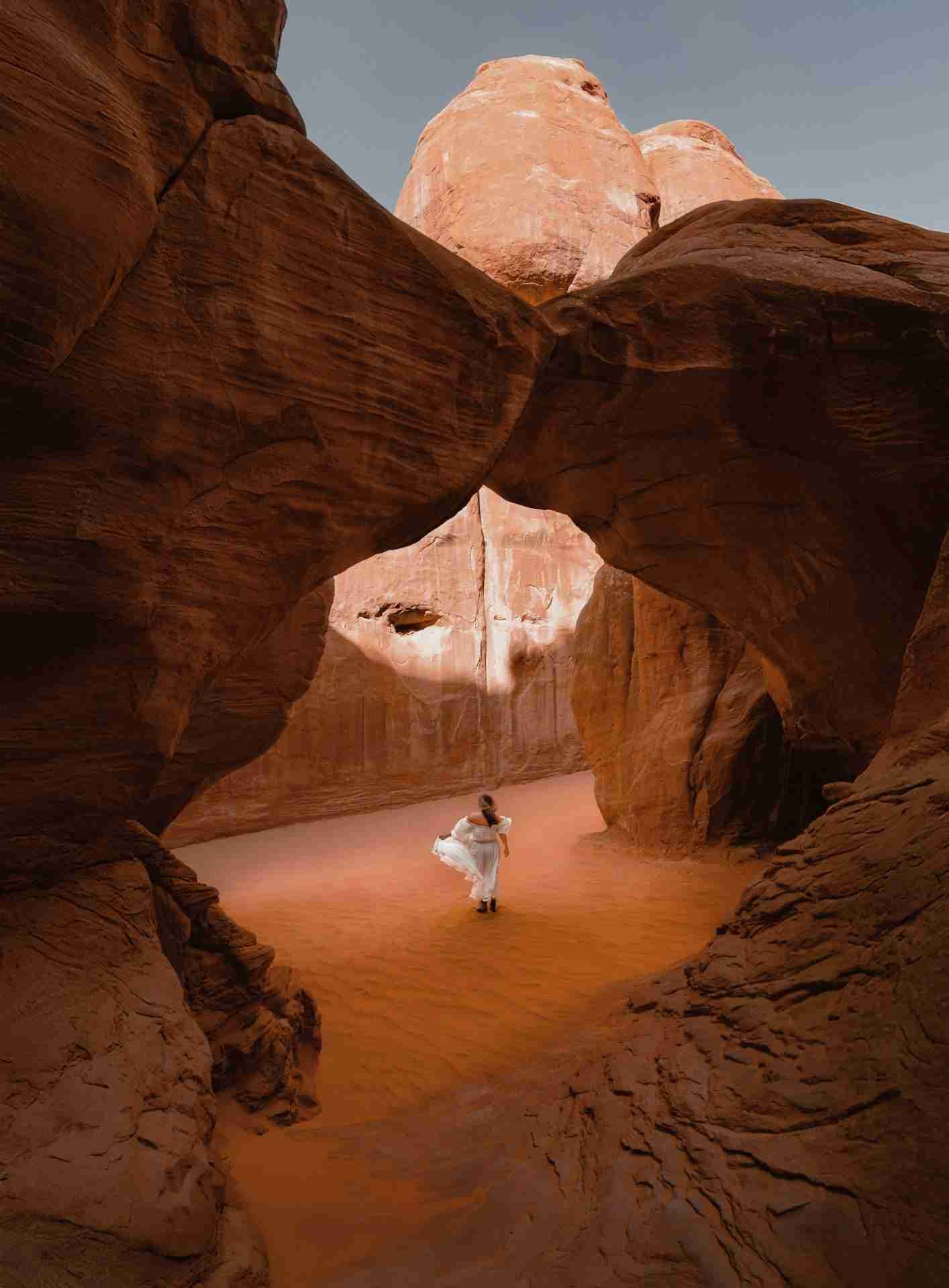
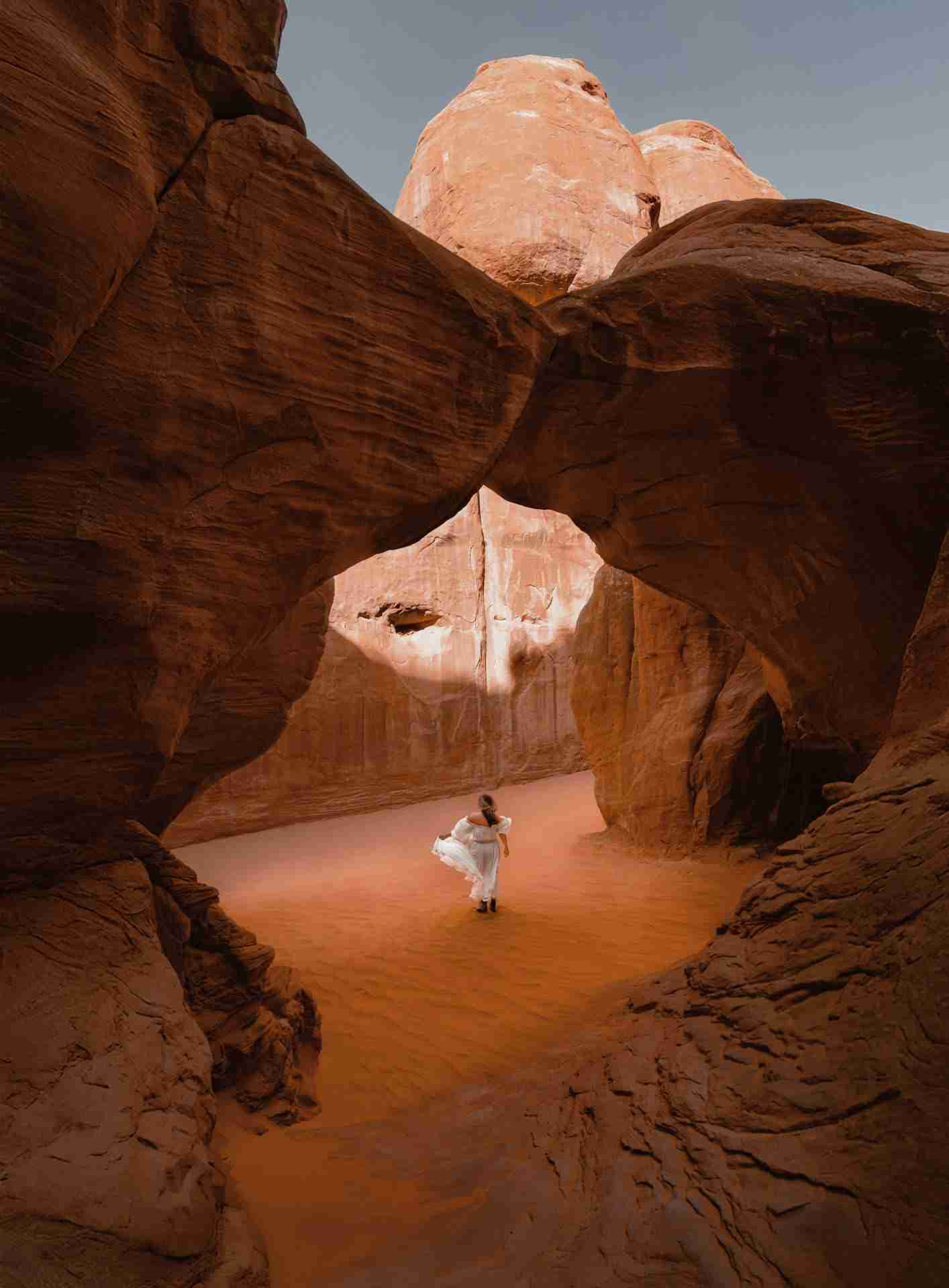
Tucked between tall, cool fins of Entrada sandstone, Sand Dune Arch offers one of the most intimate and atmospheric photographic experiences in Arches National Park. Unlike the wide-open grandeur of Delicate Arch or the towering mass of Landscape Arch, Sand Dune Arch invites a slower, more tactile approach. It's concealed within a narrow canyon near the Broken Arch trailhead, where golden desert light filters through high crevices and spills across soft, rust-colored sand. The contrast between soaring rock walls, narrow corridors, and the delicate natural arch itself makes this location ideal for photographers looking to explore form, light, and the subtle drama of desert solitude.
Best Photography Opportunities
• Framing the Arch from Within the Sandstone Corridor
: One of the most compelling compositions at Sand Dune Arch is the dramatic reveal as you move through the narrow canyon formed by massive vertical fins. These sandstone walls create a deep, natural frame that draws the eye directly to the arch nestled at the far end. Shooting from within this corridor requires careful positioning—drop low to emphasize the leading lines of the canyon floor, especially when early light spills in at a steep angle and hits the base of the arch. A wide-angle lens (14–24mm) allows you to exaggerate depth while capturing both the foreground textures and the luminous arch beyond. In the first hour after sunrise, the interplay between warm reflected light on one side and cool shadows on the opposite wall creates a striking duotone effect. This is one of the few moments each day when the space feels both enclosed and dramatically lit.
• Close-Quarter Textures Beneath the Arch
: The underside of Sand Dune Arch is a study in delicate erosion—swooping lines, scalloped indentations, and flowing curves that suggest movement frozen in stone. Here, the goal is not to capture the whole arch but to abstract its shapes and textures. Use a midrange zoom (24–70mm) or even a macro lens to isolate areas where light glances off ridges and pockets, creating luminous edges and shadows with organic rhythm. As the sun climbs, reflected light bounces up from the sand below, bathing the underside in a diffuse amber tone that softens details while enhancing contrast. These are high-reward images when shot at f/4–f/5.6, allowing selective focus that draws attention to texture while blurring the receding background. Pay special attention to where wind has deposited fine sand into natural grooves—these details are fragile and change day to day, adding a time-sensitive uniqueness to every shot.
• Foreground Sand Ripples Leading into the Arch
: Early morning is the only time to capture undisturbed sand at the base of the arch—before it's trampled by visitors. The fine, red-orange grains often form beautifully sculpted ripples, especially after a windy night. These patterns can act as leading lines that direct the viewer's eye toward the arch. Use a very low shooting position, nearly at ground level, and a wide-angle lens stopped down to f/11 or f/16 to achieve full front-to-back sharpness. Focus one-third into the scene for maximum depth of field, and wait for soft, warm light to hit the upper edge of the arch while the sand remains shaded, creating tonal contrast that adds dimension. Even subtle footprints or the trace of a plant can be composed to tell a story of scale and human presence within a fragile desert microclimate.
• Isolating Light and Shadow Along the Canyon Walls
: The narrow fin canyon surrounding the arch is a constantly changing study in light behavior. As the sun rises higher, beams of light begin to pour over the top of the fins and strike the opposite wall, creating patches of intense warmth that glow like molten copper against cool, shaded stone. These fleeting moments are perfect for minimalist compositions—use a telephoto lens (100–200mm) to isolate areas of rock face where the light shapes natural patterns. Expose for the highlights to maintain detail in the illuminated areas, and let the shadows fall into near-black to create contrast and depth. These shots often benefit from horizontal compositions that mimic the layering of strata and allow you to play with color gradation across the stone's surface. Patience is key here; the light changes every few minutes, and the most compelling frames may only last seconds.
• Atmospheric Twilight and Blue Hour Inside the Arch's Alcove
: As the park winds down and dusk sets in, Sand Dune Arch becomes one of the few locations where you can shoot during blue hour in relative solitude. The high canyon walls absorb light slowly, creating an even, cool-toned atmosphere that renders the red sandstone in deep violet and purple hues. This is a moment for long exposures—bring a tripod and shoot 15–30 second frames to gather what little ambient light remains. The arch's silhouette becomes a graphic curve against the soft textures of the surrounding rock, and subtle color gradients emerge in the sand under longer shutter times. At this hour, compositions shift from documentation to mood; experiment with negative space, off-center framing, and very shallow depth of field to create a quiet, contemplative image that contrasts starkly with the harsh light of midday desert shooting. If a clear sky remains, the upper crevices may reveal the first stars of evening—a rare blend of desert intimacy and celestial scale.
Best Time to Visit
Sand Dune Arch is best visited during early morning or late afternoon hours when the light is soft and the location remains uncrowded. Its orientation and position between high fins mean that direct sunlight doesn't reach the arch itself for much of the day, which preserves fine details and reduces harsh contrast.
From March through May and again from September through November, temperatures are mild and the light quality is ideal. These shoulder seasons also offer lower sun angles throughout the day, which enhances the quality of bounced light in the canyon. In summer, midday heat and crowds can make the area less photogenic and more difficult to access comfortably, though the arch still offers shade and relative cool.
Winter months provide a quiet, minimalist palette—especially if light snowfall contrasts with the warm tones of the rock and sand. Morning frost or a thin layer of snow on the canyon floor adds rare texture and tonal variety, though trail access may be icy or partially obstructed depending on recent weather.
Wind is always a consideration here. After strong gusts, the sand beneath the arch may be sculpted into clean ridges, making for striking foregrounds. Conversely, windy conditions also introduce blowing dust and make tripod use more difficult. Check forecasts and aim for calmer days if shooting long exposures or working close to the ground.
How to Get There
Sand Dune Arch is located in the central section of Arches National Park, just north of the Devils Garden turnoff and directly off the main park road. From the park entrance, drive approximately 17 miles until you see the signed parking area on the right-hand side, between Skyline Arch and Broken Arch.
The trail to Sand Dune Arch is short—less than 0.3 miles one way—and well-marked. It begins as a sandy path through low desert scrub before narrowing dramatically between vertical fins of Entrada sandstone. The shaded corridor and the softness of the sand make this one of the most accessible and family-friendly arches in the park.
There is no additional fee beyond the standard park entrance, and the area is open year-round, though weather may limit access during winter storms or summer monsoons. The trail sees moderate foot traffic in peak seasons, so arriving early ensures both better light and fewer footprints in the sand. Drones are prohibited anywhere in the park, and tripods are allowed but should be used with care in tight quarters to avoid obstructing others.
Gear for Sculpted Light and Close Quarter Composition
Because Sand Dune Arch is enclosed and atmospheric, gear choices should prioritize control in low-light environments and flexibility for shooting tight angles. A wide-angle lens (14–30mm) is essential for capturing the arch itself from within the narrow passage and for including dramatic foregrounds such as sand textures or overhanging fins.
A fast prime (35mm or 50mm f/1.8 or faster) is useful for handheld work in shaded conditions, as well as for shallow depth of field compositions focusing on textures or plant details. A mid-telephoto (70–200mm) gives you the ability to compress patterns and isolate abstract shapes in the stone surfaces.
A lightweight tripod is highly recommended, especially for long exposures in the twilight hour or when bracketing for HDR to manage high dynamic range. Bring a lens cloth and blower—fine red sand gets everywhere. A polarizing filter can reduce unwanted reflections on the rock walls but should be used with caution in tight spaces where uneven polarization can occur.
Wear closed-toe shoes for traction in the soft sand, and consider kneepads or a ground mat if you plan to shoot low-angle perspectives extensively. Since there's no cell service and little visibility from the road, bring sufficient water and a flashlight or headlamp if staying for blue hour or late-day shooting.
Nearby Photography Locations
: Just east of Sand Dune Arch, Broken Arch is accessible via a sandy trail through open desert and scattered rock formations. Its asymmetrical shape and eroded flanks make for strong compositions during sunrise or moonrise.
: This small but well-positioned arch sits high in a sandstone wall and glows dramatically in evening light. It's a great place for silhouette work or shooting stars through the arch during a clear night.
: A longer, more rugged trail that offers access to several arches, including Tunnel Arch, Pine Tree Arch, and the famed Landscape Arch. The variety of geological features makes this a full-day photographic outing.
: Though entry into the Fiery Furnace requires a permit or guided tour, the overlook provides a sweeping view of its complex maze of fins and shadows—particularly powerful in low sidelight.
• The Windows Section
: For more expansive views and larger formations, the Windows area includes North and South Window Arches, Turret Arch, and sweeping desert backdrops. Best at sunrise for warm, golden glow on the rock.
Sand Dune Arch may not tower or stretch across a vast expanse, but its intimacy is its strength. This is a place where shadow and light define shape, where sand softens sound, and where every curve in the rock tells a quiet story of wind, time, and erosion. In a park full of grandeur, it offers something rarer—a space to slow down, observe closely, and photograph the stillness between the monumental.
Comments
Loading comments…