
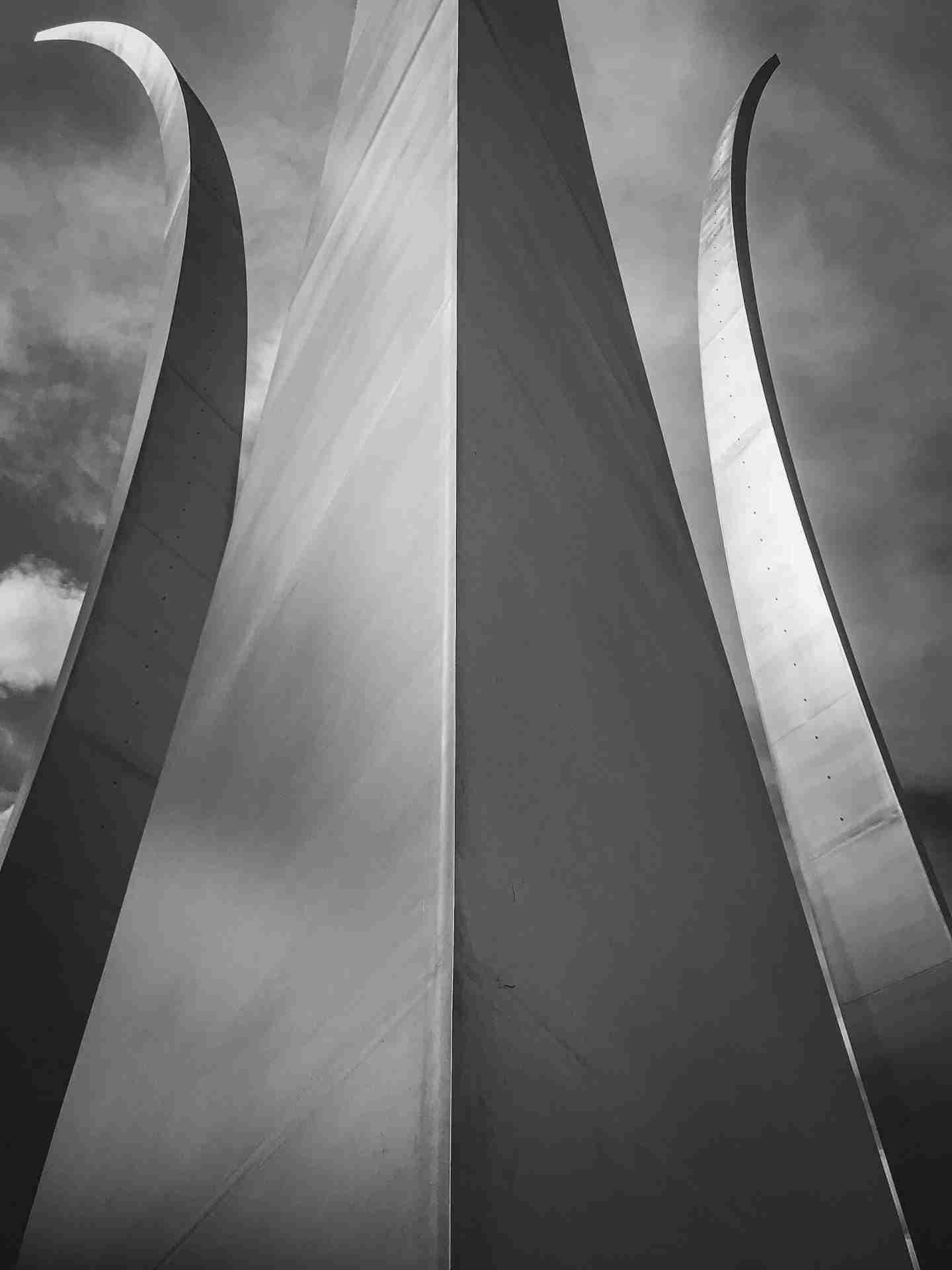
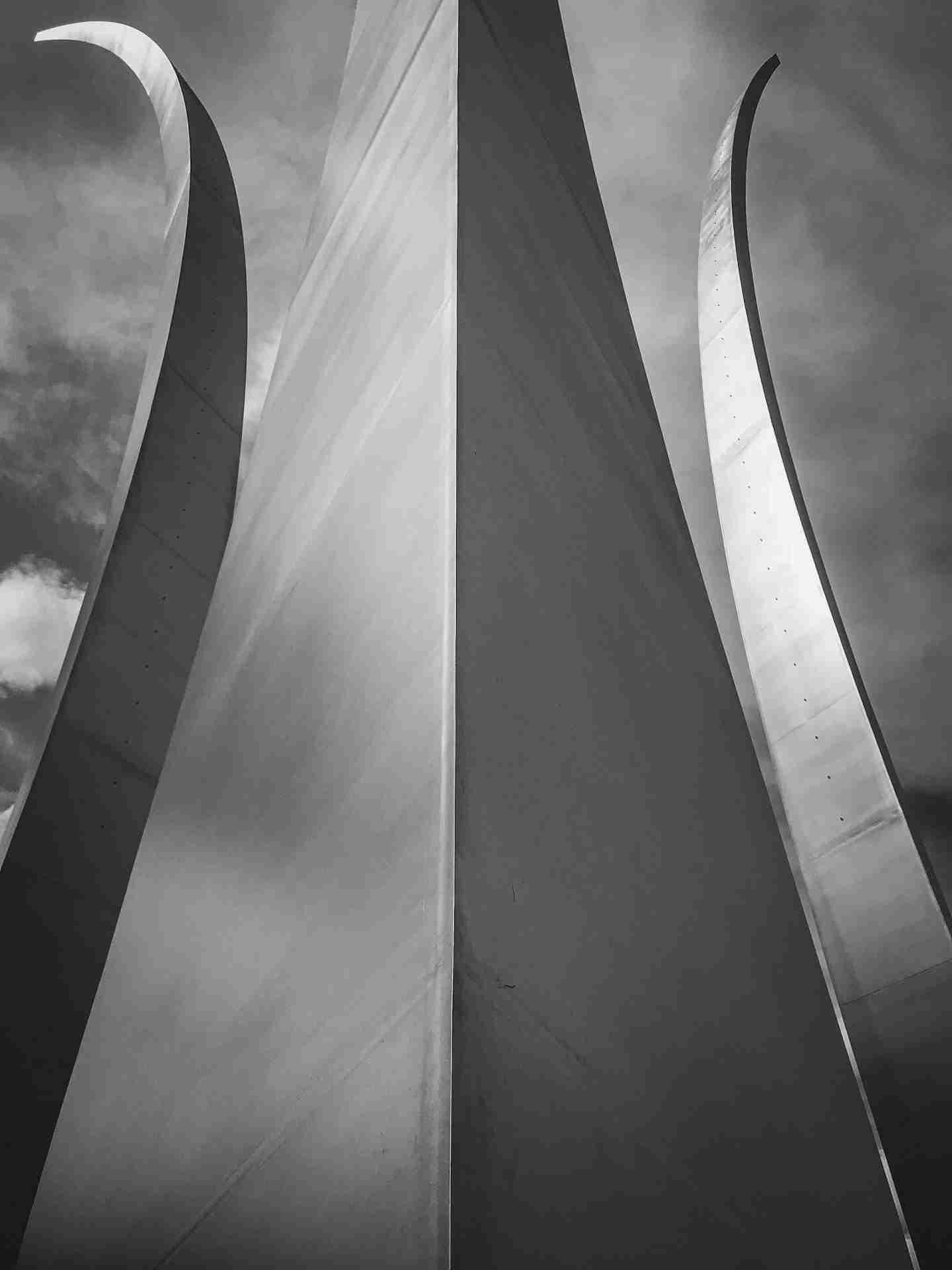
Soaring above the hills of Arlington, Virginia, the United States Air Force Memorial is a powerful and graceful tribute to the service and sacrifice of airmen. Its design is simple yet deeply symbolic with three stainless steel spires curve skyward in a sweeping arc that mimics the flight path of the Air Force Thunderbirds and the spirit of flight itself. Positioned on high ground just outside Washington, D.C., the memorial offers commanding views of the capital's skyline, including the Washington Monument, the Capitol dome, and the Pentagon nearby. For photographers, it is a location that combines modern sculpture, open space, and meaningful views. The changing light plays constantly on the brushed metal surfaces, and the shape of the spires shifts dramatically depending on your perspective. Whether you're capturing symmetry at sunrise or reflections at dusk, this is a site that rewards attention to line, light, and context.
Best Photography Opportunities
Symmetry from the Central Plaza
The memorial's three soaring spires are positioned in a triangular formation, which creates strong lines and symmetry when viewed from the circular plaza at their base. Standing beneath them with a wide-angle lens allows you to capture the full sense of scale as the arcs seem to stretch endlessly into the sky. During sunrise, the steel surfaces glow softly, reflecting the pink and blue tones of early light. Overhead clouds often frame the spires beautifully, making it an ideal time for long exposures that blur sky movement and emphasize structure. Even a standard zoom lens can work if you focus on symmetry and use the circular paving to anchor your composition.
Framing the Washington Skyline
The memorial's position on an elevated slope offers unobstructed views across the Potomac River into the heart of the capital. By moving to the northern or eastern side of the site, you can frame the memorial's sweeping arcs alongside major landmarks such as the Washington Monument, Lincoln Memorial, and even the distant dome of the Capitol. In late afternoon, sunlight floods the skyline, giving the monuments a warm glow that contrasts nicely with the cool steel of the spires. A 24 to 70 millimeter lens gives you flexibility for including more sky or tightening your frame around specific buildings.
Reflective Ground Details and Abstract Forms
At ground level, polished granite walkways and shallow inclines mirror the spires from below, providing subtle reflections that shift with your movement. After rainfall, small puddles form that reflect the arcs perfectly, creating layered compositions that play with light and perspective. These opportunities reward close observation and work well with a standard or short telephoto lens. By changing your height, crouching low or climbing a nearby incline, you can shape different visual stories from the same spot.
Twilight and Blue Hour Illumination
As daylight fades, the Air Force Memorial becomes quietly radiant. Soft white lighting illuminates the base of the spires, casting a gentle glow that brings out the shape of each arc against the deepening blue sky. The city lights below begin to twinkle, and the sky shifts through tones of violet and navy. A tripod is essential at this time, allowing for longer exposures that capture both ambient light and the peaceful stillness of the scene. Blue hour also brings out texture in the clouds and helps balance the brightness of the memorial against the fading natural light. This is the best time for clean, quiet compositions that emphasize space and calm.
Inscriptions, Symbols, and Commemorative Walls
Around the site are engraved walls, Air Force insignia, and meaningful quotes that deepen the narrative of the memorial. These design elements, while subtle, offer strong photographic subjects when isolated in soft light or framed with shallow depth of field. Look for shadows cast by nearby trees or visitors that add emotional resonance. These quieter details are best explored with a 50 millimeter or 85 millimeter lens, focusing on texture and meaning rather than scale.
Best Time to Visit
The Air Force Memorial is accessible year-round and offers changing photographic potential with each season. In spring, soft sunlight and blooming trees surrounding the site add gentle color to your compositions. The air tends to be crisp and clear, ideal for sharp skyline shots with strong depth. Mornings are usually calm, with fewer visitors and quiet light that reflects subtly on the steel spires.
Summer brings long golden hours and frequent cloud displays that create dramatic backdrops during sunrise and sunset. While midday can be overly bright with harsh reflections, the morning and evening windows are long and offer excellent light for architectural and landscape work alike. Just be prepared for increased foot traffic and stronger heat during the day.
Autumn is one of the best times to visit. The air is cooler, visibility is high, and the surrounding trees take on warm colors that contrast beautifully with the silvery structure. Afternoon sun rakes across the memorial's curved surfaces, emphasizing depth and tone. Sunset during this season often brings fiery skies behind the arcs, especially when clouds gather in the west.
Winter has its own charm. Although the trees are bare, the low angle of the sun throughout the day offers long, soft shadows and ideal conditions for minimalist compositions. Occasional snowfall creates a blank canvas that highlights the clean lines of the spires. Blue hour scenes become especially atmospheric, with a quiet hush settling over the site as night falls.
Photographically, the best times of day are early morning when the structure glows with color and the city behind is gently lit, and just after sunset when artificial and natural light balance perfectly for long exposures. These are also the quietest times, giving you more freedom to move around and shoot from different angles without obstruction.
How to Get There
The Air Force Memorial is located at One Air Force Memorial Drive in Arlington, Virginia, just a few miles from downtown Washington, D.C. If arriving by car, the memorial is accessible from Columbia Pike and South Joyce Street. A small free parking area is available near the base of the site. Spaces are limited, so arriving early, particularly during peak hours, is recommended.
Public transportation is a reliable option as well. The nearest Metro station is Pentagon City, served by the Blue and Yellow lines. From there, it is roughly a fifteen-minute walk. Exit the station and head west along Army Navy Drive before turning onto South Joyce Street. The memorial's spires are clearly visible from a distance and make navigation easy on foot.
There is no entrance fee to visit the site, and it remains open from dawn until well after dusk. The grounds are fully accessible, with smooth paths and ramps designed for visitors of all mobility levels. While there are no restrooms or water fountains directly on site, both are available in nearby parks or shopping areas. If you are visiting around sunset or after dark, consider bringing a small flashlight or headlamp for safety on the walk back.
Recommended Photography Gear
A visit to the Air Force Memorial benefits from a small but versatile kit that allows you to adapt to the site's changing light and expansive space. Start with a wide-angle lens, ideally 14 to 24 millimeters or 16 to 35 millimeters, to capture the full height of the spires from the ground. This is particularly helpful when composing upward shots from directly beneath the arcs or capturing the monument in context with the surrounding skyline.
A standard zoom such as 24 to 70 millimeters is the most useful all-around lens for this location. It gives you flexibility to photograph architectural details, reflective surfaces, and skyline elements without the need to switch lenses frequently. If you plan to shoot portraits or focus on smaller commemorative features, a fast 85 millimeter or even a 135 millimeter lens will allow for tight framing with smooth background blur.
For twilight and evening photography, bring a sturdy tripod and a remote shutter release. Long exposures are especially effective during blue hour, and the contrast between the illuminated spires and the fading sky creates stunning results. A polarizing filter can help reduce glare during midday, and a lens hood is useful for avoiding sun flare during sunrise or sunset. A microfiber cloth is also handy to clean off any fingerprints or moisture from reflective surfaces.
Pack water, a hat, and sunscreen if visiting in summer, as the site is fully exposed with limited shade. A small backpack is sufficient to carry your gear and any accessories you will need during your visit.
Nearby Photography Locations
Just a short walk from the Air Force Memorial, the Pentagon Memorial honors the 184 people who lost their lives in the September 11 attack. Each victim is remembered with a stainless steel bench and individual reflecting pool, arranged by age and orientation to the Pentagon. The site is especially moving during early morning or twilight, when soft light plays across the benches and water. The minimal design and deep personal meaning make this a powerful place for contemplative photography.
A few minutes away, Arlington National Cemetery offers visual and emotional depth for photographers. With its sweeping hills, rows of white headstones, and historic monuments like the Tomb of the Unknown Soldier, the site provides both grand and intimate compositions. Early morning light enhances the rows of markers, while mist or snowfall adds a quiet mood that strengthens the visual story. Respect for the location is essential, and a quiet, unobtrusive approach works best.
Also known as the Iwo Jima Memorial, this sculpture is an iconic image of World War II, depicting six Marines raising the American flag on Mount Suribachi. The dynamic angles and human form of the statue are striking at any time of day, but particularly powerful at sunrise and sunset. From the surrounding lawn, you also have clear views of the National Mall, which work well as background elements in wide compositions.
Netherlands Carillon and Observation Lawn
Situated near the Iwo Jima Memorial, this tall bell tower was a gift from the Netherlands and is surrounded by landscaped grounds that bloom with tulips each spring. The carillon and its open setting provide elevated views across the Potomac River to the National Mall. Whether you are photographing city views or the modern vertical structure of the tower itself, the location adds variety to any photography outing near the memorial.
Located beside Reagan National Airport, Gravelly Point offers a completely different kind of photography. From this grassy open space, aircraft fly directly overhead during takeoff and landing, sometimes just a few hundred feet above. It is a popular place for aviation photographers, especially in late afternoon when planes appear against glowing skies. Wide-angle lenses are useful here, and the backdrop of Washington across the river adds context and depth to your compositions.
The Air Force Memorial is more than a monument. It is a space where movement, light, and purpose are built into every curve and corner. For photographers, it offers a balance between simplicity and strength, with compositions that range from the abstract to the expansive. With each change in light or season, the spires take on a new presence. Whether you are visiting for the first time or returning to see it in different conditions, the memorial remains a rewarding place to capture both beauty and meaning.
Comments
Loading comments…