
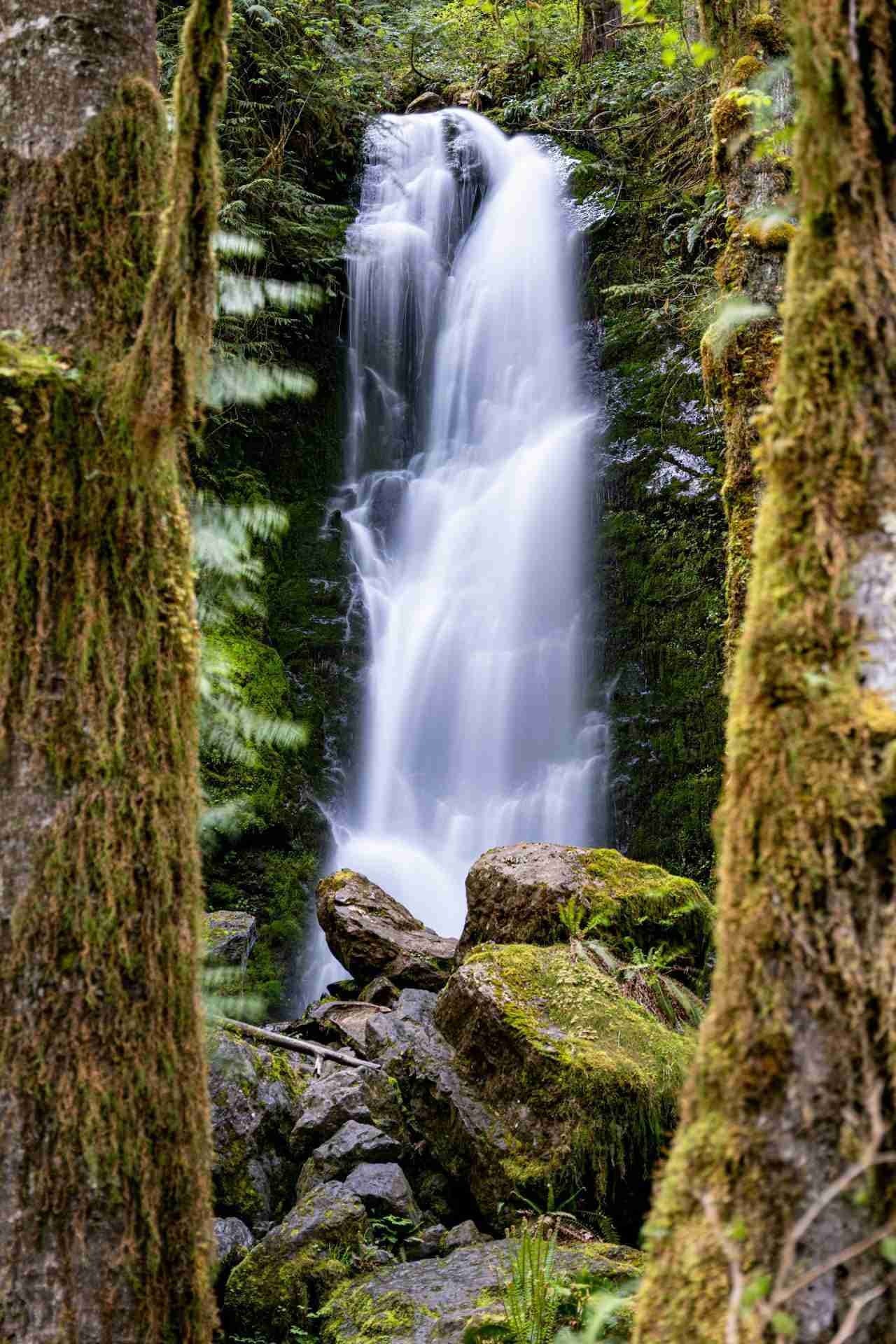
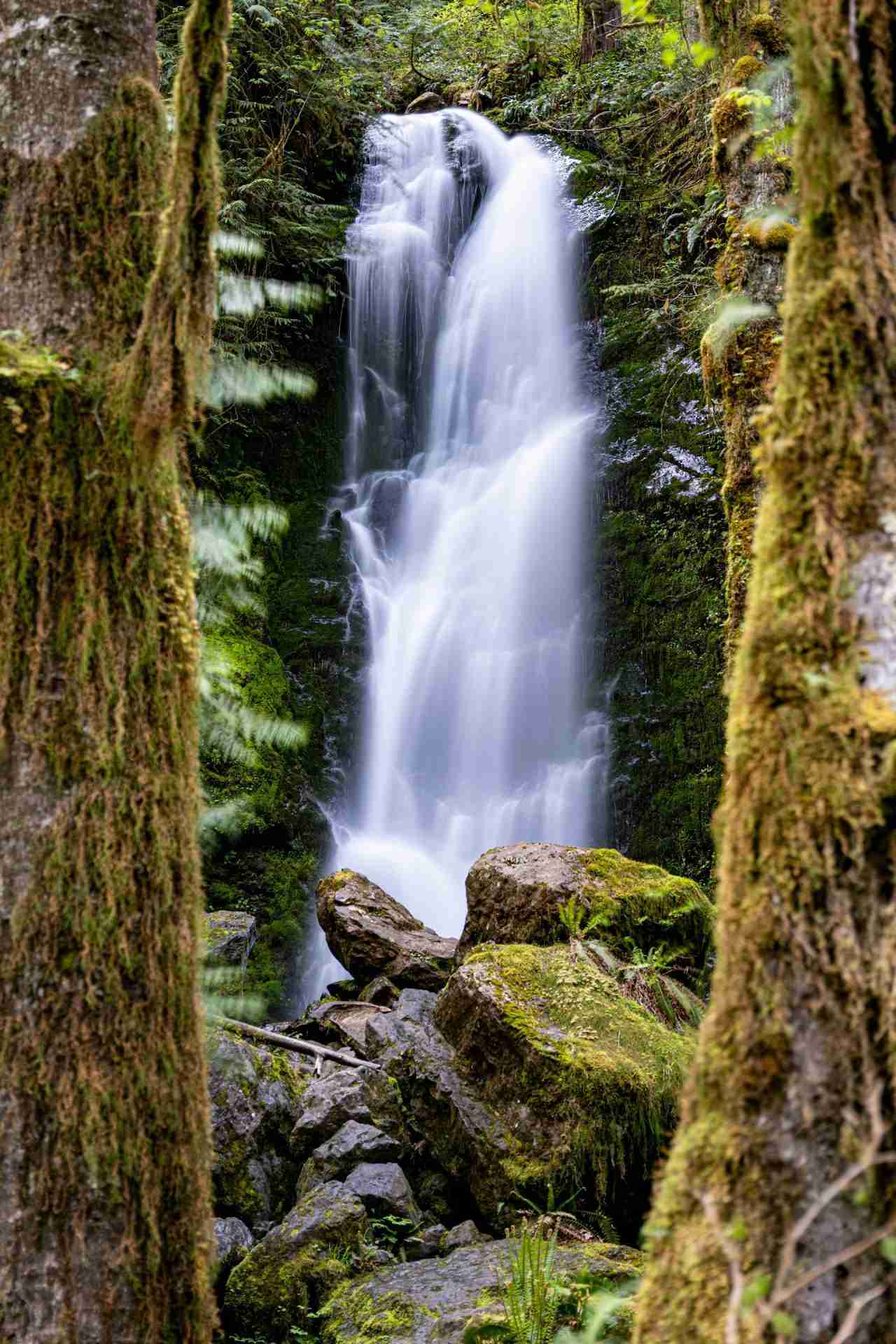
Merriman Falls is a compact but powerful waterfall tucked deep in the Quinault Rainforest along Washington's Olympic Peninsula. With a height of around 40 feet, it may not be one of the tallest in the region, but its consistent year round flow, surrounding moss covered boulders, and filtered canopy light make it a reliable spot for waterfall photography in almost any condition. The falls cascade down a rock face into a cluttered forest floor, where fallen logs, ferns, and saturated textures provide built in foreground structure without the need to move far. The setting is deeply shaded, damp, and green nearly every day of the year. For photographers working with long exposures, diffused light, and composition through chaos, Merriman Falls is a rewarding place to slow down and fine tune the details.
Best Photography Opportunities
• Long Exposure of the Main Fall
The core subject is the waterfall itself, which flows down a steep rock face before dispersing across logs and boulders. A mid length exposure of one to two seconds captures the motion of the water without losing texture, and the natural curve of the flow helps build strong vertical compositions. The base of the fall has just enough room to position a tripod without being too close, making it easy to frame from a low or eye level position. Because the surrounding forest is so dense, the lighting is often soft, even at midday, which allows for slower shutter speeds without needing heavy filters. Mist from the falls tends to hang in the air, so lens wipes and a hood are useful for keeping front elements clear between frames.
• Foreground of Moss and Logs
The forest floor at Merriman Falls is filled with fallen wood, slick boulders, and layered green textures that add immediate depth to the frame. These elements work well as foreground anchors in wide angle compositions, especially when leading toward the main cascade. Positioning your frame to include a moss covered log or water path in the foreground can help create a strong visual flow through the image. These compositions work best when light is flat and detail is evenly lit, which is common under the heavy forest canopy. Use of a tripod and precise manual focus is important here, as the dense environment can confuse autofocus systems.
• Detail of Texture and Water Flow
Because the waterfall is not overly tall, it is possible to shoot in closer and isolate sections of the cascade using a medium telephoto lens. These detail shots often highlight the way water folds and splits across individual rock ledges or moss patches. In soft light, this approach works especially well to build contrast between white water and the saturated greens of the rainforest. Zooming in also allows you to shoot through small openings in the forest, creating natural frames and partial obstructions that add visual interest without overpowering the subject.
• Framing Through the Forest
Stepping back slightly from the main falls gives you the chance to frame it within the trees and use the natural density of the forest as a compositional tool. Branches, trunks, and ferns can act as framing devices that shape the image and help focus the viewer's eye toward the falls. Shooting from a slightly elevated position helps avoid over clutter in the bottom third of the image, especially during wet seasons when runoff spreads across the forest floor. These scenes work well with a small aperture to maintain depth of field through the layers.
• Creative Angles and Abstract Water Forms
Because the setting is compact, Merriman Falls gives you the chance to experiment with unconventional angles. Shooting from the side, at the base, or using ultra wide lenses to exaggerate depth can give new perspectives on what is otherwise a very fixed subject. You can also focus in on abstract water motion where the flow breaks around a rock or splashes over a ledge. These images tend to work best with shutter speeds just long enough to blur motion but short enough to retain shape. The more time you spend here, the more small details begin to stand out as subjects in their own right.
Best Time to Visit
Merriman Falls is accessible and photogenic year round, but certain seasons offer specific advantages. Spring brings peak water flow with snowmelt from the nearby hills, giving the falls a stronger presence and more volume through the cascade. Summer months offer easier access and dry footing, but the falls can be thinner and the forest floor less saturated. Fall brings leaf litter and richer tones across the green palette, while winter brings high contrast between bare branches and moss. Lighting at the falls is nearly always diffused due to dense canopy coverage and narrow valley walls, which means you can shoot throughout the day without harsh shadows. Overcast or misty weather is ideal, and a light rain often enhances saturation without making the area too difficult to work in. Because the site is close to the road, you can return at different times of day without a long hike, giving you flexibility if light or conditions change.
How to Get There
Merriman Falls is located just off South Shore Road in the Quinault area of Olympic National Park. The falls are directly visible from the roadside, with a small pull off for parking on the right if approaching from the west. There is no hike required and no permits or entry fees for access. The road is paved and generally passable year round, although snow or ice may occasionally limit access in winter. There are no facilities at the site, so plan accordingly, especially if combining this stop with longer routes through the Quinault Valley or up into the rainforest trail system.
Recommended Photography Gear
A sturdy tripod is essential for shooting long exposures and working with precise focus in the low light of the rainforest. A wide angle lens is useful for capturing the entire waterfall along with foreground elements, while a medium telephoto helps isolate sections of the flow or frame tighter forest scenes. A circular polarizer is very effective at Merriman Falls, helping reduce glare on wet surfaces and enhancing color saturation without heavy post processing. Bring a microfiber cloth or lens wipes, as mist from the falls can quickly build up on the front element, especially when working close. A small pack towel or mat can be helpful for setting gear down on wet logs or rocks while composing your shot. Because there is little open light, higher ISO settings may be needed if shooting handheld, but a tripod allows you to shoot at low ISO without compromise.
Nearby Photography Locations
Located further along South Shore Road, Bunch Falls is a broader cascade with multiple tiers and a similar forest setting. It offers more space to move and wider compositions that include the surrounding foliage. Early morning light here filters through the trees and adds depth without overpowering the scene.
This short trail near the Quinault Ranger Station provides classic rainforest subjects including moss-draped trees, hanging lichen, and slow moving creeks. The filtered light and constant humidity make it a great place for texture studies and layered forest compositions.
The lake itself is a strong landscape subject during sunrise or sunset, when light breaks through the surrounding hills and reflects on the surface. Boat docks, driftwood, and calm water provide foreground interest, while fog is common in the early morning hours.
This flat, looped trail near the Quinault River is excellent for intimate forest scenes, with close views of hanging moss, saturated undergrowth, and reflective water in wet months. Overcast light here holds detail in the shadows and lets you shoot handheld or slow without harsh contrast.
• Willaby Creek and Falls Creek Areas
These lesser-visited creek corridors near the lake offer a mix of small cascades, boulder fields, and shaded trails that feel more isolated. They are good locations for building quieter images with close details, and work well in any lighting condition typical to the region.
Merriman Falls is a compact but rewarding location that holds up in nearly any weather and requires very little effort to reach. Its strength lies in how much visual material it offers within such a small area, making it ideal for photographers who enjoy working with texture, motion, and natural framing. Whether you are building a series of images across nearby sites or looking for a reliable stop between other locations, this is a waterfall that supports a slow, detailed approach without the need for perfect conditions.
Comments
Loading comments…