
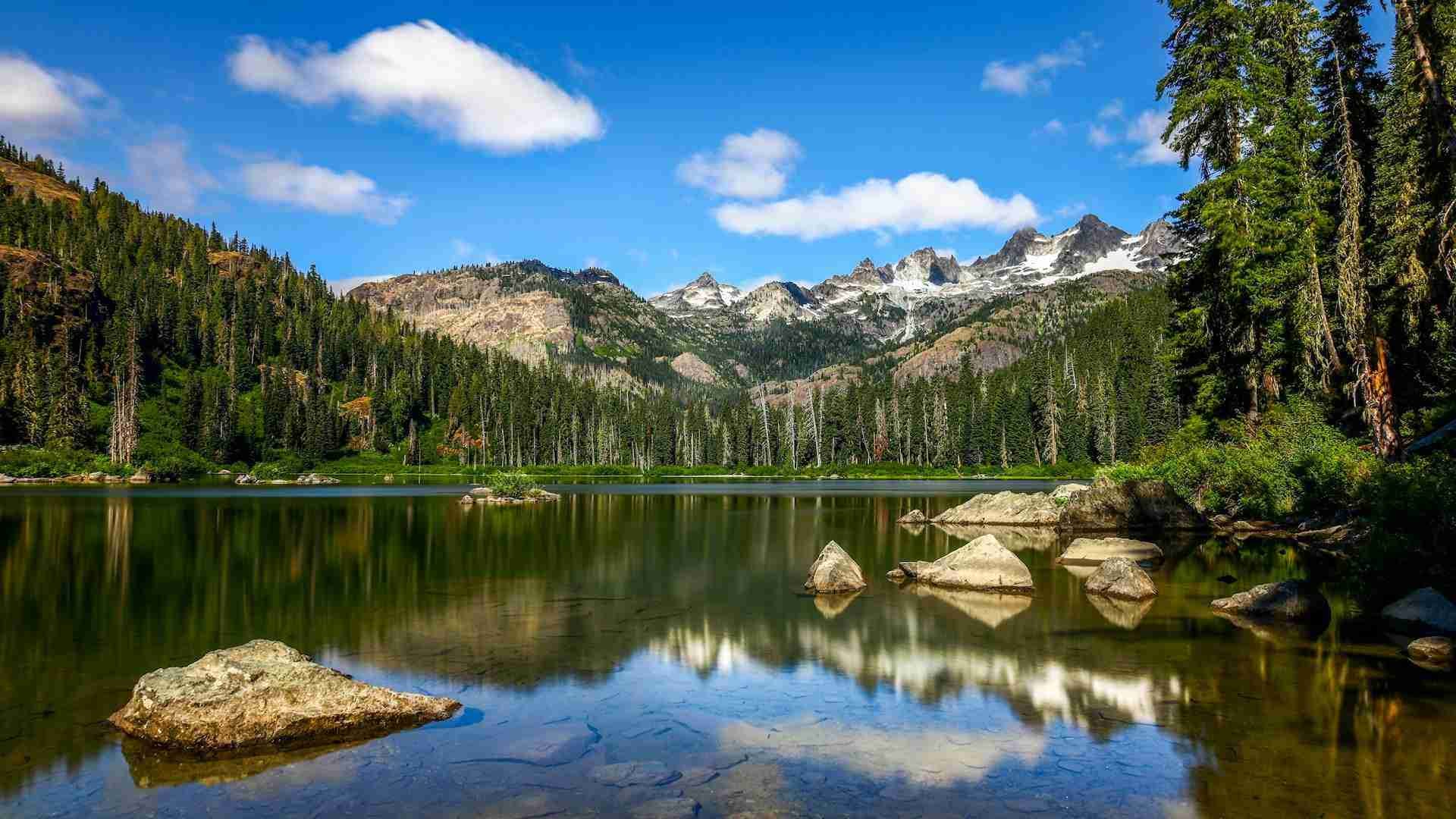
Pete Lake sits within Washington's Alpine Lakes Wilderness, surrounded by dense evergreen forest and backed by rugged ridgelines. The approach trail winds gently through woodland and crosses cool mountain streams before opening up to a quiet lake edged with grasses, driftwood, and scattered boulders. On calm days, the lake surface acts like a mirror, doubling the sky and distant peaks in perfect symmetry. The shoreline offers many spots to set up without crowding, and its stillness encourages thoughtful, unhurried shooting. Whether you are chasing early light on the water or working the textures of shoreline details, Pete Lake offers simple, rewarding compositions for photographers who appreciate quiet, natural balance.
Best Photography Opportunities
• Reflections of Chikamin Peak from the Northeast Shore
One of the strongest compositions at Pete Lake is from the northeast edge, where you can frame the lake with foreground grasses and driftwood while including the reflection of Chikamin Peak across the water. In calm morning conditions, the mirrored ridge appears almost uninterrupted, with only the faintest movement on the surface. A wide lens allows you to work in nearby details like rocks or small logs, giving depth to the image and grounding the mountain in its setting. Try shooting from a low perspective to maximize the symmetry between sky and reflection. If clouds are present, they often stretch cleanly across the water, adding texture and layering to the shot.
• Forest Light and Stream Crossings on the Trail In
The trail to Pete Lake is about four and a half miles each way, with most of it passing through shaded forest. Several small stream crossings and glades open up to let in pockets of light, offering excellent opportunities for capturing light beams through branches or close-up detail of moss and water. These trail shots are best handled with a standard zoom or short telephoto lens to control depth and isolate small scenes. Early morning is ideal for soft contrast, and a tripod can be helpful in lower light sections where slower shutter speeds allow moving water to blur gently. These images can be especially useful for storytelling or building a sequence around the approach to the lake.
• Campsite Views Framed Through Trees
The eastern edge of Pete Lake offers several dispersed campsites, and many have views through the trees that open to the water beyond. These natural frames work well for creating a sense of place, especially when shot with a slightly wider lens. During the morning, filtered light creates patterns on the water, while in the evening the trees form silhouettes against a glowing sky. Including elements of the campsite in the foreground, like a fire ring or log bench, can help tell a more personal or narrative story. Watch for lens flare when shooting into the light and adjust your position to manage highlights carefully.
• Shoreline Details and Calm Water Studies
Around much of the lake, especially on the east and south sides, the shoreline is lined with interesting detail: driftwood, fallen branches, rock groupings, and patches of reeds. These areas are ideal for close studies of texture, pattern, and reflection. Look for still water near the shore that reflects tree trunks or clouds, then work in small foreground elements to break the symmetry slightly and create depth. Overcast days can be helpful here, as they reduce harsh contrast and allow for richer tonal range in the scene. A polarizing filter can help manage reflections, but consider taking shots both with and without it to compare how light moves through the surface.
• Evening Color and Soft Light on the Lake
Although Pete Lake is best known for its morning light, evenings can be quietly beautiful, especially in late summer and early fall. As the sun sets behind the ridgeline, the last light sweeps across the tops of the trees and catches on any lingering mist above the water. The reflection of the sky can take on soft purples, yellows, and pale blue tones that look especially good in long exposure. A tripod is necessary for these shots, and exposure times will increase quickly as the light fades. Try isolating a single log or rock in the foreground with a wide composition to balance the frame and lead the viewer's eye through the scene.
Best Time to Visit
The best time to photograph Pete Lake is between late June and early October, after the snowmelt and before weather becomes unstable in the fall. During this window, the trail is accessible, and the lake reaches peak calm and clarity. Mornings are typically the best time to shoot, especially during the first hour after sunrise when the lake is still and the light touches the distant peaks with soft warmth. Mist occasionally rises from the water during early hours, adding atmosphere to wide views and enhancing separation between trees and reflections.
Afternoons tend to flatten out the light, especially when skies are clear, but the forest trail and shaded campsites offer good opportunities for softer images even during brighter parts of the day. In late summer and early autumn, the lower brush along the trail begins to change color, adding rich warm tones to forest scenes. Mosquitoes are present in early summer, so later season visits are more comfortable for longer shoots. Smoke from regional wildfires can affect visibility from August onward, but it may also diffuse sunset light in useful ways if air quality is acceptable. Evenings are best suited for long exposures and reflection work once wind calms down.
How to Get There
Pete Lake is accessed from the Pete Lake Trailhead in the Okanogan-Wenatchee National Forest. From Interstate 90, take the Cle Elum River Road (Forest Road 46) north, then turn onto Forest Road 4616, which ends at the trailhead parking area. The trail is about four and a half miles long, with minimal elevation gain, making it a manageable hike even with camera gear. The route is well marked, and while it is popular with hikers and families, it rarely feels overcrowded except on peak summer weekends.
There are no entrance fees for the trail or lake area, though a Northwest Forest Pass is typically required for trailhead parking. There are no restrooms or facilities beyond the trailhead, so bring everything you need with you and pack out all waste. Water is available from creeks and the lake, but should be filtered. If you plan to camp, sites are available informally along the eastern shore. The trail is suitable for tripods and backpacks, and most of the route is shaded, which helps reduce heat even during warm days.
Recommended Photography Gear
A wide angle lens in the 16 to 35 millimeter range is ideal for capturing the lake's full reflections, large sky scenes, and foreground interest. Pair this with a standard 24 to 70 millimeter zoom for trail compositions, stream crossings, and tighter shoreline work. A short telephoto, such as a 70 to 200 millimeter lens, is useful for compressing tree layers or isolating distant ridges in early light. A tripod is strongly recommended, especially for dawn and dusk shooting when light levels are low and exposures may be long.
A circular polarizer will help with glare on the water, particularly in mid-morning or early afternoon. A neutral density filter is useful if you want to smooth water or capture motion blur in clouds during longer exposures. Extra batteries and a microfiber cloth are essential due to changing light and damp conditions near the lake and stream areas. A lightweight but supportive camera bag with a waist strap will help with the hike, and a small headlamp is a must if you plan to shoot before sunrise or return after sunset. Bring insect repellent and water filtration to stay comfortable during longer stays.
Nearby Photography Locations
Just a short drive from the Pete Lake trailhead, Cooper Lake is larger, with excellent reflections, shoreline trees, and accessible angles from the roadside. It is a great location for sunset, especially when low light hits the distant tree lines.
A more challenging hike beyond Pete Lake, Spectacle Lake offers high elevation views, jagged peaks, and bright alpine water. For those willing to continue the ascent, it provides dramatic wide shots and opportunities for overnight wilderness photography.
The river corridor on the approach to the trailhead has several stops where you can photograph fast flowing water, river stones, and forest edges. Late afternoon light in these spots can produce warm highlights and deep green contrast.
Branching off nearby, this lesser known trail system provides quiet forest settings, clearings with open views, and shallow water crossings perfect for capturing motion blur and leading lines with natural symmetry.
An easy roadside stop on the way in or out, this area has wide views of the forest and mountain foothills. It works well for scouting quick compositions or catching golden hour light if your main shoot wraps early.
Pete Lake is not a dramatic or overwhelming destination, but that is part of its charm. It gives photographers room to slow down, consider the shapes of light and water, and find satisfying balance in nature's quiet details. Whether you're building a longer wilderness trip or just want a peaceful place to shoot for a morning, this lake offers a reliable, grounded experience.
Comments
Loading comments…