
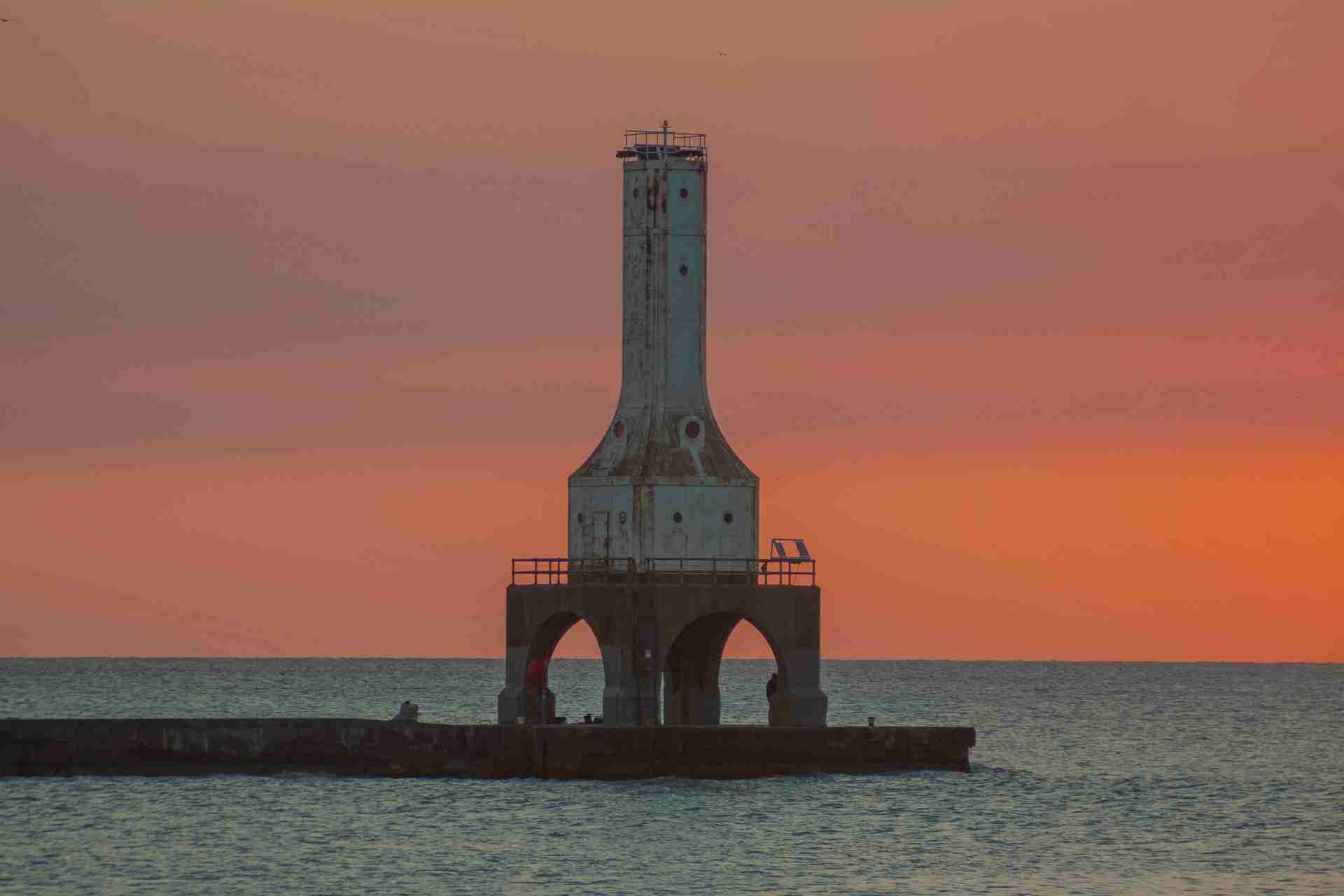
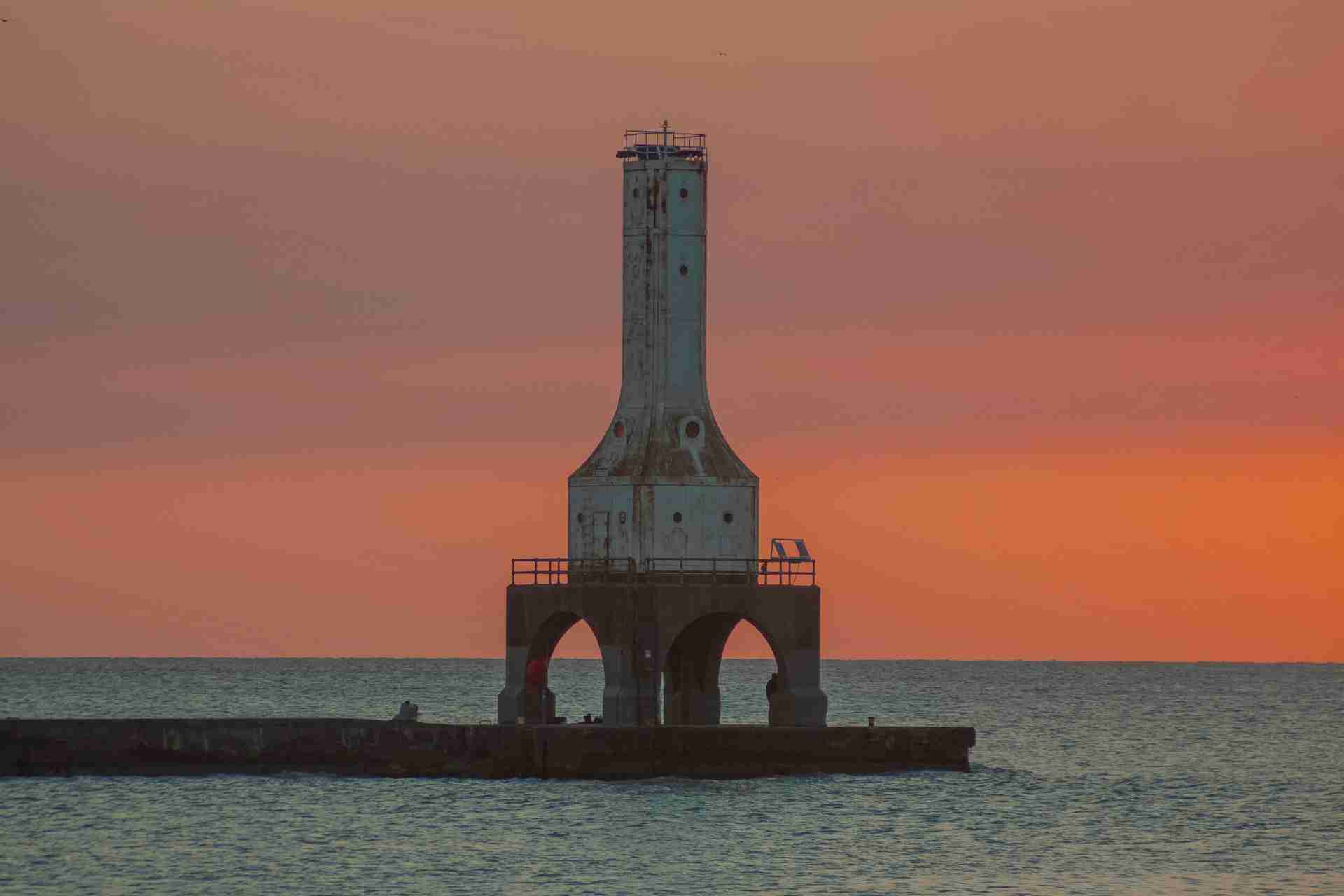
Jutting into the vast expanse of Lake Michigan, the Port Washington Breakwater Light stands like a sentinel at the edge of the continent—angular, industrial, and undeniably photogenic. Built in 1935, this Art Deco lighthouse rises from a massive concrete platform and transitions into a slender, riveted steel tower topped with a modest lantern room. Unlike more romantic lighthouses with classic curves and stripes, this one is all clean lines and maritime grit, and that's exactly what makes it so visually compelling. Set against dramatic Midwestern skies and mirrored in Lake Michigan's shifting waters, the breakwater light lends itself to both minimalist and atmospheric photography, whether you're chasing long exposures at sunrise or silhouettes in winter mist.
Best Photography Opportunities
• Head-On View from the Breakwater Pier
: For the most immersive composition, walk the length of the breakwater itself. The concrete path stretches out toward the lighthouse in a strong visual line, guiding the eye directly into the scene. Use a wide-angle lens (16–24mm) to exaggerate this vanishing-point effect, placing the lighthouse either centered for symmetry or slightly off-axis for tension. Shoot during golden hour or blue hour to catch the structure bathed in soft, angular light, or after rain when wet concrete enhances reflections. Long exposures (10–30 seconds) smooth the water and create a dreamlike contrast to the hard geometry of the pier. Caution is essential here—the breakwater can be slippery, and conditions are often windy, so pack light and tread carefully.
• Marina View with Framing Elements
: From the safety of the Port Washington Marina, you can frame the lighthouse across the harbor, often with foreground elements like docked boats, pilings, or weathered ropes. Use a mid-range zoom (24–70mm) to compress the scene slightly and layer these elements to create depth. Early morning is ideal when the lake is calm and the light has a soft amber tone. Fog or haze can add mood, and reflections in the harbor are often better here than along the breakwater. This angle is also excellent during twilight, when the lighthouse beacon may be visible against the deepening sky, creating a small but poignant point of light.
• Sunrise Silhouettes from Rotary Park
: For a dramatic silhouette, set up in Rotary Park or along the shoreline path near the harbor entrance. From this position, the lighthouse stands between you and the rising sun, creating sharp, graphic compositions. A longer lens (70–200mm) helps isolate the structure against the glowing horizon. Use spot metering to expose for the sky and let the lighthouse fall into shadow. This setup is particularly striking when the lake is calm and faint reflections stretch toward the camera. On partly cloudy mornings, the light beams breaking through can add powerful compositional accents. Bring a tripod for stability, especially during pre-dawn light levels.
• Icy Minimalism in Winter
: During the colder months, the breakwater and lighthouse transform into a stark, frozen tableau. Ice rimes the tower, snow blankets the pier, and the surrounding lake may freeze into abstract patterns. This is the time for minimalist, high-contrast compositions. A mid-range or telephoto lens (50–135mm) allows you to frame the lighthouse tightly against the icy void. Look for strong shapes and leading lines—the white tower against a grey lake, the jagged crack of ice leading toward the structure, or the geometric shadow it casts on the snow. Overcast skies emphasize the mood. Be extremely cautious if approaching via the breakwater in winter—it can be dangerously slick.
• Golden Hour Reflections from the South Bluff
: For a more elevated and contemplative view, climb the south bluff trail behind Upper Lake Park, where you can look down on the harbor and lighthouse from a distance. Use a telephoto lens (100–200mm) to compress the layers of lake, lighthouse, and sky. During golden hour, the structure glows against the reflective water, with the pier acting as a diagonal anchor line across the frame. This vantage point is excellent for capturing seasonal variation—spring sunrises, autumn color edging the horizon, or ice floes drifting through the harbor. It's also a good location for time-lapse sequences as the light evolves across the lake.
Best Time to Visit
The Port Washington Breakwater Light is a year-round destination, but the season and time of day dramatically shape its character. Spring and autumn offer the richest lighting conditions—low-angle sun, calm lake surfaces, and color-rich skies. These seasons also bring shifting weather patterns that create dynamic conditions for light beams, fog banks, and storm clouds, which all enhance photographic mood.
Summer mornings provide warm tones and smooth reflections, especially before lake breezes pick up. Sunrises during this season are early but often spectacular, with a clear view of the sun emerging directly behind the lighthouse from east-facing spots. Sunset is less direct from most land-based angles but can still cast beautiful side light across the tower and breakwater.
Winter transforms the scene entirely. Snow, ice, and low sun angles strip the palette to near-monochrome, allowing photographers to explore high-contrast and minimalist themes. Blue hour lasts longer in winter, and the crisp air often produces extraordinary color gradients over the lake. However, safety becomes a serious concern—the pier may be coated in ice, and waves can crash over the sides even on calm days. When conditions are too harsh, shoot from protected areas like Rotary Park or the marina.
Regardless of the season, early morning offers the best balance of light, atmosphere, and tranquility. Wind is usually lower, providing clearer reflections and fewer surface ripples on the water.
How to Get There
The Port Washington Breakwater Light is located in the harbor of Port Washington, Wisconsin, roughly 30 miles north of Milwaukee along Interstate 43. Take Exit 100 (Highway 32) into downtown Port Washington, then follow signs to the marina and lakefront. Parking is available near the Port Washington Marina, Rotary Park, and along East Jackson Street.
To access the lighthouse directly, walk the breakwater starting from the marina's eastern end. The concrete path is exposed and narrow in sections, with no guardrails—proceed with extreme caution, especially during wind, rain, or icy conditions. There is no entrance fee to access the pier or surrounding parks, and photography is unrestricted for non-commercial use.
For alternate vantage points, head to Rotary Park at the harbor entrance or to Upper Lake Park for elevated views from the south bluff. Both areas have parking and are safe, stable shooting platforms even in inclement weather.
Recommended Photography Gear
A wide-angle lens (16–35mm) is ideal for breakwater compositions that emphasize leading lines and foreground textures. Use it to exaggerate the length of the pier and heighten the visual tension as it draws toward the lighthouse. A mid-range zoom (24–70mm) offers flexibility when moving between close- and medium-range compositions from the marina or shoreline.
Bring a telephoto lens (70–200mm or longer) to isolate the lighthouse in minimalist frames, capture sunrise silhouettes, or compress layers from the bluff. For early morning or twilight sessions, a tripod is essential—especially when shooting long exposures or working with filters.
Use a circular polarizer to cut glare off the lake's surface and bring out color in the sky and water. A 6- or 10-stop ND filter is invaluable for smoothing waves and clouds during golden hour. In winter, lens cloths and weather-sealed protection are a must. Consider microspikes for your boots if you plan to walk the breakwater in icy conditions.
A remote shutter release or intervalometer is useful for long exposure and time-lapse sequences, particularly at blue hour. And always carry extra batteries—cold lakefront air can drain them quickly, especially in late fall and winter.
Nearby Photography Locations
• South Beach and Coal Dock Park
: Located just south of the breakwater, these spots provide sweeping shoreline views with the lighthouse set against sunrise skies or reflected in wet sand at low tide. They're also great for capturing local birdlife and moody weather rolling in from the east.
• Upper Lake Park Overlook
: This bluff-top location provides one of the most comprehensive views of Port Washington, including the harbor, marina, and breakwater light. Perfect for wide-angle sunrise scenes or tight telephoto studies of the lake and sky.
• Port Washington Marina
: Beyond offering foreground elements for lighthouse compositions, the marina itself is full of photographic detail—weathered boats, reflections, and shifting light patterns make it a worthwhile subject in its own right.
• Downtown Port Washington
: Just a few blocks from the harbor, the historic downtown offers early 20th-century storefronts, cobblestone details, and vintage signage. It's ideal for architectural studies, street photography, or environmental portraits.
: About 15 minutes south along the lake, this park offers natural shoreline compositions, forest paths, and another chance to shoot Lake Michigan in a quieter, more undeveloped setting. It's especially good for misty mornings and textured water shots from the bluffs.
The Port Washington Breakwater Light is a structure that thrives on simplicity—line, shape, and light. Whether silhouetted against a burning sunrise or standing solitary in snow and fog, it rewards photographers who are willing to wait, watch, and see how Lake Michigan reshapes the scene from moment to moment.
Comments
Loading comments…