
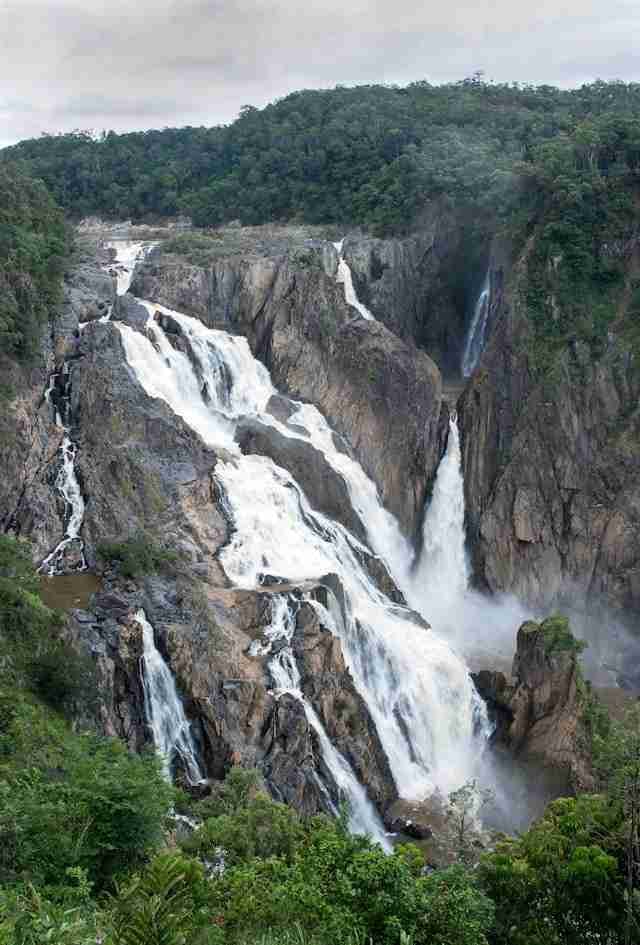
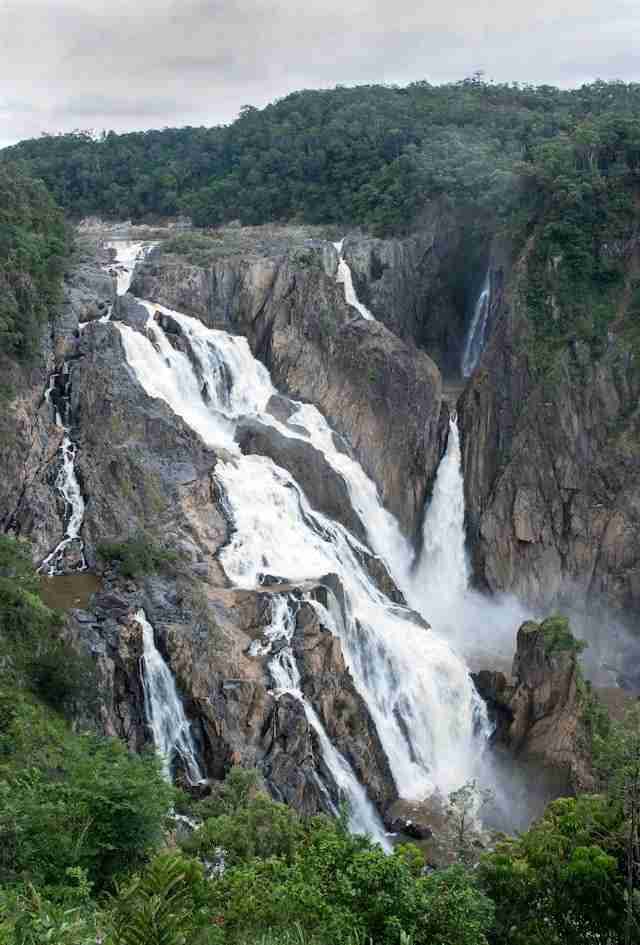
Tumbling through the dense rainforest of Queensland's Wet Tropics, Barron Falls is one of Australia's most powerful and visually commanding waterfalls—especially during the wet season, when it roars down the jagged gorge like a white torrent framed in jungle green. Located near the village of Kuranda and accessible via road, rail, or sky gondola, Barron Falls offers a dramatic meeting of vertical geology, rushing water, and lush subtropical forest. For photographers, it presents a compositionally rich environment with multiple viewing angles, moody lighting conditions, and constantly shifting mist that adds depth and atmosphere to every frame
Best Photography Opportunities
• Panoramic Vista from the Din Din Boardwalk Lookout
: This is the premier spot for capturing the full magnitude of Barron Falls as it tears down the escarpment into the gorge below. The wide platform provides an unobstructed, symmetrical view of the main cascade and its surrounding cliffs, allowing photographers to frame the waterfall as part of a larger rainforest scene. A wide-angle lens will let you include the steep, dark rock faces and dense green canopy that cradle the falls. During the wet season, the visual impact is intensified by cloud plumes, rising mist, and saturated colors. Early morning light from the east strikes the cascade at a gentle angle, revealing water textures and enhancing tonal variation in the rock and vegetation.
• Telephoto Compression from Elevated Viewing Platforms
: Photographers looking for more graphic compositions can use a telephoto lens to compress layers of mist, water, and cliff into a tight, abstract frame. This approach highlights the raw power and sculptural geometry of the cascade, especially when the waterfall divides into dozens of smaller streams during high flow. The contrasting textures between water streaks, wet stone, and moss create a painterly effect—especially effective in overcast or misty light. From certain angles, it's also possible to isolate the uppermost drop or a section of foaming spray and let the surrounding cliffs fade into shadow, creating high-contrast, atmospheric compositions.
• Aerial Perspectives from the Skyrail Rainforest Cableway
: The gondola ride above the rainforest canopy provides rare top-down views of Barron Gorge, offering compositions that would be impossible from ground level. As the gondola drifts across open spans, photographers can shoot the falls and the river carving its way through the lush landscape. These fleeting views require quick adjustments and fast shutter speeds, so shooting with a mid-range zoom provides the necessary flexibility. Light changes rapidly as the gondola moves, which can lead to striking pockets of light illuminating the forest or slanting rays catching the mist just above the falls—perfect for adding drama to otherwise distant scenes.
• Rainforest-Framed Shots Along the Din Din Boardwalk
: Before reaching the main viewing platform, photographers will encounter several partial views of the gorge framed by towering ferns, vines, and tree trunks. These moments present excellent opportunities for layered compositions where foliage acts as a natural vignette. The contrast between the intricate, wet greenery and the rushing water in the background can be striking, especially when soft light filters through the canopy. These shots excel in vertical format, drawing attention to the verticality of both the plant life and the falls themselves. Slower shutter speeds can blur the falls into a soft ribbon while maintaining sharp detail in the surrounding leaves.
• Wet Season Drama and Low-Light Texture Studies
: Barron Falls transforms dramatically during the monsoon period, becoming a roaring, muddy torrent that surges across its terraced rock face. In these conditions, close-up shots become a study in force and texture. Use a long lens to isolate one segment of the waterfall—where spray rebounds off stone or where brown water curls into eddies at the base. The light during this time is often diffused through cloud cover, which reduces harsh contrast and allows for greater retention of detail in highlights and shadows. Raindrops on nearby foliage or on your lens can create interesting visual layering, adding to the chaotic, immersive feel of the scene.
Best Time to Visit
The optimal time to photograph Barron Falls is during the wet season, which spans from December to March. During this period, heavy tropical rains swell the Barron River, and the falls explode into a thunderous, multi-stream cascade that plunges into the gorge with unmatched force. This is when the falls are at their most photogenic, framed by mist, rising fog, and intensely saturated rainforest greens. Early morning visits are especially rewarding in the wet season, as overnight moisture and cooler temperatures often generate atmospheric fog banks that hover over the gorge, softening distant details and diffusing sunlight into a glowing haze.
April and May, as well as October and November, are shoulder months that still provide impressive flow but with greater accessibility and more stable weather conditions. The falls retain much of their wet-season power, but with clearer skies and reduced humidity, allowing for greater clarity and potentially golden hour light. These months are also ideal for capturing transitional landscapes where the rainforest shifts between wet and dry seasonal hues, offering a broader palette of greens, browns, and golds.
The dry season (June to September) sees the falls reduced to a trickle, which can still yield worthwhile compositions—particularly for photographers interested in geological detail, leading lines in exposed rock terraces, and minimalist imagery. During this time, the sky is often clear, and the light is stronger and more directional, which suits high-contrast black-and-white work. Though the power is diminished, the structure of the gorge becomes more visible, making it possible to explore compositions that are otherwise hidden during the wet season.
Regardless of the season, overcast skies offer the best lighting for forest photography, softening shadows and preserving highlight detail in both water and foliage. Post-storm conditions are particularly photogenic, often revealing dappled light, mist movement, and reflections across wet rock surfaces. Flexibility is key, as conditions can shift rapidly even within a single shoot.
How to Get There
Barron Falls is located just outside the village of Kuranda, approximately 30 kilometers northwest of Cairns in Far North Queensland. The most direct route is via Barron Falls Road, which ends at a large parking area adjacent to the Din Din boardwalk. The walk to the lookout is short, paved, and wheelchair-accessible, making it suitable for any level of photographer.
Visitors can also access the falls via the Kuranda Scenic Railway, a heritage train journey from Cairns that includes a brief photo stop at a dedicated overlook with a side-on view of the falls. The Skyrail Rainforest Cableway offers another scenic approach, with a mid-point stop at Barron Falls Station. From here, raised walkways and smaller viewing decks provide alternative angles and immersive rainforest access.
There is no fee to enter the lookout area from the road, though the train and Skyrail require separate ticketed fares. Tripods are allowed but may be cumbersome during peak hours when the viewing platform becomes crowded. Arriving early ensures better placement, cleaner sightlines, and the chance to work undisturbed for long exposures or multi-frame panoramas.
Recommended Photography Gear
A wide-angle zoom (16–35mm) is essential for the main lookout platform and boardwalk compositions, allowing you to include the full span of the waterfall along with foreground forest and dramatic sky when conditions align.
A mid-range zoom (24–70mm) offers flexibility when working handheld from the Skyrail gondola or when framing tighter shots of the gorge from elevated positions. Its range is ideal for capturing both layered landscapes and partial views framed by foliage.
A telephoto lens (70–200mm) excels for isolating dynamic segments of the falls, compressing misty gorge walls, and capturing atmospheric depth when shooting across the valley. This is the lens of choice for abstract studies of water texture and rock.
Sturdy tripods are recommended for long exposure shots, particularly in early morning or when softening water movement. In the wet season, lens cloths, rain sleeves, and weatherproof bags are critical. A circular polarizer is useful for enhancing leaf color, taming glare, and revealing subtle detail in wet surfaces. An ND filter can help extend shutter speed during brighter conditions.
Footwear with good grip is a must on damp walkways, and lightweight, breathable clothing will help you stay comfortable in the humid conditions. Bring a small towel or absorbent cloth to regularly wipe down gear, especially lenses and filters that will collect condensation or mist quickly in the rainforest climate.
Nearby Photography Locations
: This historic train route offers dynamic compositions as it weaves through mountain tunnels and over forested ravines. Photo stops and open windows provide great opportunities for motion blur, layered jungle shots, and environmental storytelling.
: Beyond the main lookout, a network of trails leads deeper into the park's dense rainforest. These quieter paths are ideal for macro work, textural studies of plant life, and alternate perspectives of the gorge itself.
• Stoney Creek Falls
: Situated along the railway route, this smaller cascade offers intimate waterfall compositions and excellent scenes when trains pass overhead. The juxtaposition of human engineering and rainforest power creates compelling visual contrast.
: Located in drier eucalyptus country southwest of Kuranda, this tiered waterfall offers wide granite ledges, open horizons, and completely different foliage. It's especially photogenic during golden hour when side light warms the entire landscape.
: If you're interested in close-up botanical photography, these gardens feature lush tropical flora in a more controlled setting. Winding forest paths and shaded canopies mimic natural rainforest conditions and offer another layer of image-making potential.
Barron Falls rewards photographers who are ready to work with shifting weather, challenging terrain, and dramatic natural contrasts. Its ever-changing moods—from foggy dawns to thundering wet season afternoons—make every shoot different, and every image a testament to the raw energy of Australia's tropical highlands.
Comments
Loading comments…