
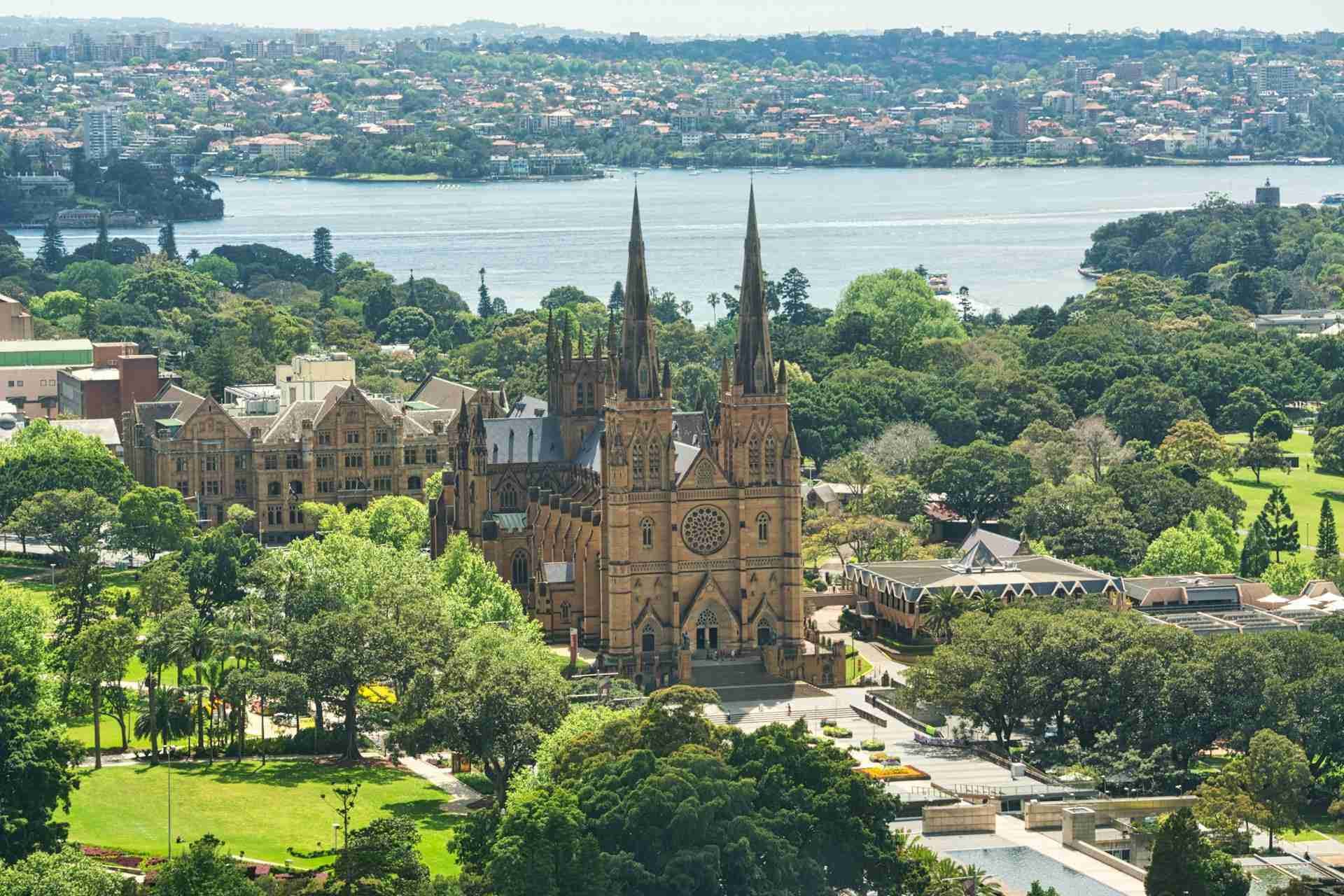
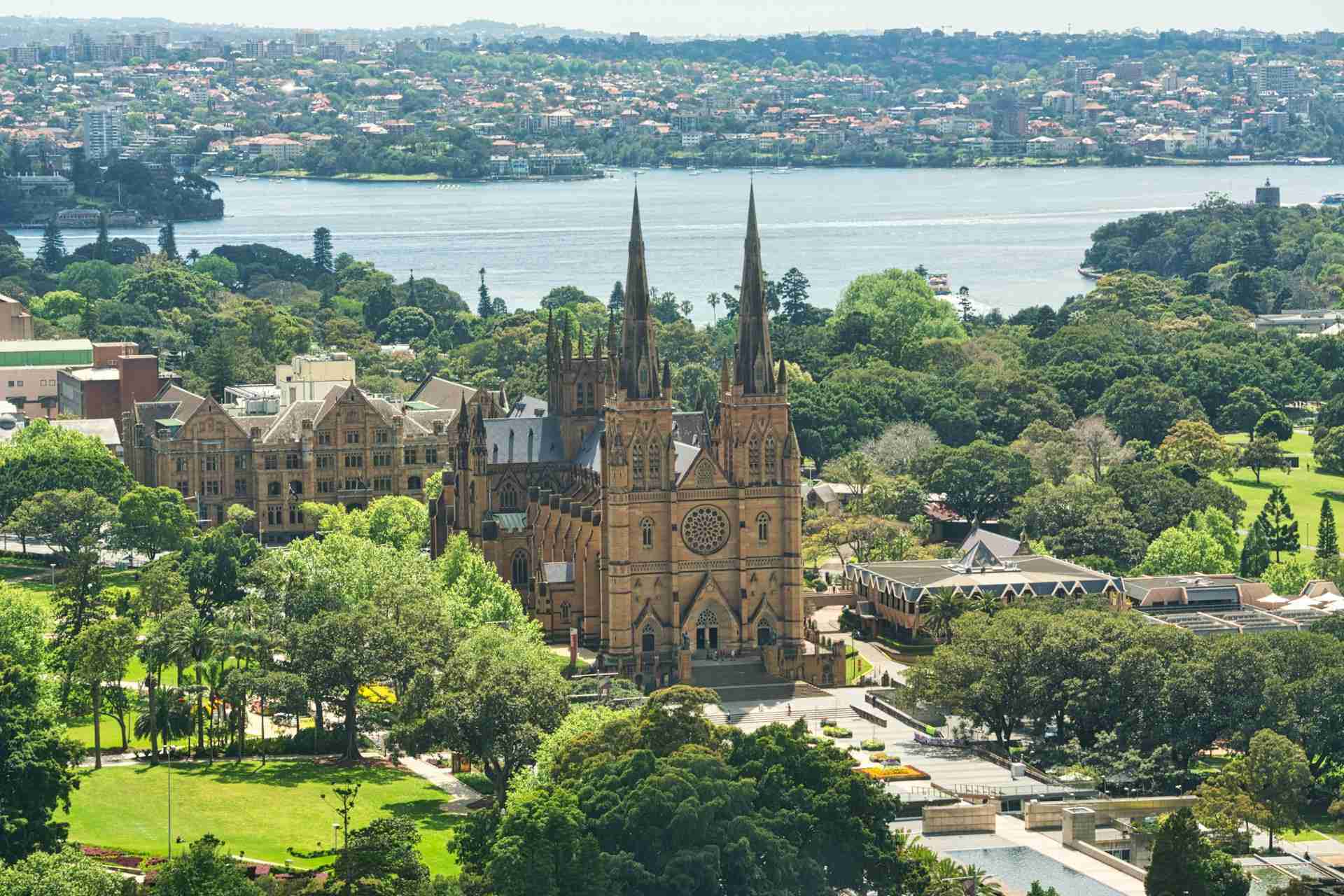
Standing at the eastern edge of Hyde Park, St Mary's Cathedral is one of Sydney's most imposing and photogenic landmarks. Built in Gothic Revival style using locally quarried sandstone, its twin spires and intricate detailing command attention within the urban landscape. The cathedral sits within a unique visual environment: surrounded by gardens, facing a large reflective pool, and framed by modern city buildings. This balance of architectural grandeur and green space makes it a versatile and rewarding subject for photographers. Whether capturing dramatic golden-hour light on the façade, intricate stone carvings, or long-exposure twilight compositions, St Mary's offers timeless beauty in a setting that remains constantly accessible.
Best Photography Opportunities
• Reflected façade compositions from the Hyde Park pool
The most well-known and arguably most powerful vantage point lies across College Street from the cathedral, where a long rectangular reflection pool runs parallel to the western façade. From this low, centered position, photographers can capture the full symmetry of the cathedral mirrored in the water. Using a wide-angle lens allows you to include foreground paving or clouds reflected in the pool, creating a multilayered composition. Early morning offers the calmest water surface and soft side lighting that brings out the golden tones in the sandstone. On rainy days, puddles and surface textures add secondary reflections that can be incorporated for visual interest.
• Detailed studies of stonework, sculpture, and Gothic ornamentation
Walking around the cathedral, you'll encounter a wide variety of carved stone features, including flying buttresses, pointed arches, gargoyles, and religious statuary. These are best photographed with a mid-range zoom or fast prime lens to isolate textures and details without distortion. Light falling from an angle—especially in early morning or late afternoon—adds dimension and contrast, enhancing the visual depth of each element. Photographers can spend an hour or more focusing purely on architectural details, capturing the artistry that often gets lost in wide compositions.
• Interior compositions of the nave and stained glass
With permission and proper discretion, the cathedral's interior opens up even more photographic opportunities. Its vaulted ceiling, marble columns, and glowing stained glass windows offer moody, reverent scenes filled with subtle light. Using a fast wide-angle lens and high ISO, you can shoot handheld, or bring a tripod to work with longer exposures in lower light if permitted. The long central aisle toward the altar provides a natural leading line, while the stained glass—especially around the clerestory and transept—adds bursts of color and symbolism. Photographers must be respectful and avoid shooting during services or when parishioners are at prayer.
• Framing the cathedral with Hyde Park's greenery
On the east side of Hyde Park, there are opportunities to frame the cathedral from a distance, integrating it with natural elements like trees, footpaths, or park benches. These scenes work well as environmental compositions, placing the cathedral within its urban park context. Using a slightly longer focal length compresses space and brings the building closer to the surrounding trees. This angle is especially rich in afternoon light, when the sandstone glows and the foreground is bathed in dappled sunlight. Human figures walking along the paths can add scale and narrative to these wider shots.
• Twilight and night photography with architectural lighting
As day transitions into night, the cathedral is illuminated by carefully placed lighting that highlights its towers, buttresses, and front entry. Blue hour compositions taken from across the reflection pool or along College Street capture this illumination beautifully, especially when the sky retains some color. A tripod is essential for long exposures, allowing you to include light trails from passing traffic or soft glows in surrounding buildings. Compositions from a lower angle exaggerate the vertical scale of the towers, and reflections in wet surfaces enhance the mood and drama of the scene.
Best Time to Visit
The cathedral is photogenic throughout the day, but certain times offer distinct advantages depending on your goals. Early morning is best for symmetry-focused compositions from the reflection pool, as the light is soft and the site is relatively quiet. This light also casts subtle shadows across the stonework, revealing texture and depth without harsh contrast. Morning also tends to bring less pedestrian and vehicle traffic, allowing for cleaner foregrounds and uninterrupted views.
Late afternoon and golden hour are ideal for environmental and side-lit compositions. The western façade glows in the warm light, and shadows from the surrounding park add dimensionality to the setting. As blue hour arrives, the building's lighting system activates, creating new opportunities for night photography that balances artificial and ambient light. The transition from twilight to full dark is particularly rewarding when working with long exposures and reflections.
Overcast days soften the entire scene and are well-suited for detail shots and architectural textures. The stone's warm hues still show through, and flat light reduces distracting contrast. After rain, the surface of the pool and surrounding pavement becomes more reflective, offering new angles and moodier compositions. The site is active year-round, but the winter months tend to offer clearer air and lower sun angles for more directional light, while summer provides longer shooting windows and the possibility of early morning fog or atmospheric haze.
How to Get There
St Mary's Cathedral is located at 2 St Mary's Road, Sydney NSW, directly across from Hyde Park and within walking distance of many major attractions. The nearest train stations are St James and Museum, both less than a five-minute walk away. Numerous bus lines also stop nearby along Elizabeth and College Streets. The cathedral is a natural part of a walking route through the central city, connecting sites such as the Royal Botanic Garden, the Art Gallery of New South Wales, and the Australian Museum.
If arriving by car, public parking is available at nearby lots such as the Domain Car Park, with pedestrian access to the cathedral via a short walk through Hyde Park. The site is open daily, with exterior access unrestricted at all times. Interior access may be limited during services or special events, and photographers should always check posted visiting hours and guidelines before entering. No photography permit is required for non-commercial shooting outside the building.
Recommended Photography Gear
A wide-angle zoom (16–35mm) is key for capturing the cathedral's height and width in tight urban settings, especially when working from across the reflection pool or within interior spaces. It allows for sweeping vertical compositions and architectural perspectives that emphasize symmetry or grandeur. A mid-range zoom (24–70mm) provides versatility for architectural details, side views from Hyde Park, and general walk-around shooting throughout the site.
For close-up studies of carvings, statues, or stained glass, a fast prime lens (35mm or 50mm) is an excellent option. It delivers crisp rendering with shallow depth of field, particularly useful for isolating features or working handheld in lower light. Interior photography benefits from lenses with wide apertures and strong low-light performance, and a lightweight tripod is ideal for long exposures—particularly at twilight or in dimly lit interior sections.
Filters such as a circular polarizer are helpful when shooting through stained glass or working in midday glare. ND filters are useful if attempting long exposures at the reflecting pool during the day. Always bring a microfiber cloth, especially if shooting near the pool or on damp mornings, and carry a weather-sealed bag to protect gear from unpredictable Sydney conditions.
Nearby Photography Locations
• Hyde Park and the Archibald Fountain
Located directly in front of the cathedral, this green space offers symmetrical paths, tree-lined avenues, and the ornate Archibald Fountain—all excellent foregrounds for wider environmental compositions that feature St Mary's in context.
Just east of the cathedral, these gardens provide lush foliage, sculptural elements, and distant views of the skyline. Golden hour light here is particularly effective for shooting back toward the cathedral with layers of vegetation in the foreground.
This classical sandstone building sits just across the Domain and pairs well architecturally with the cathedral. Strong lines, colonnades, and sculptures make it ideal for formal composition work, especially under diffused light.
A large open park space connecting St Mary's with the harbor, The Domain offers skyline views, sculpture gardens, and long perspectives that can be used to frame the cathedral from unusual angles, particularly with a telephoto lens.
For a dramatic overhead view, the Sydney Tower Eye observation deck offers a bird's-eye vantage point over Hyde Park, with St Mary's clearly visible in the park's eastern corner. This is ideal for compressed cityscapes and wide skyline compositions at sunset.
St Mary's Cathedral stands not just as a spiritual center, but as a towering piece of architectural expression that rewards careful observation and thoughtful framing. Whether you're capturing its symmetrical grandeur reflected in the still morning pool or its illuminated spires against the deep blue of night, the cathedral offers compositions that are timeless, textured, and deeply rooted in Sydney's visual identity.
Comments
Loading comments…