
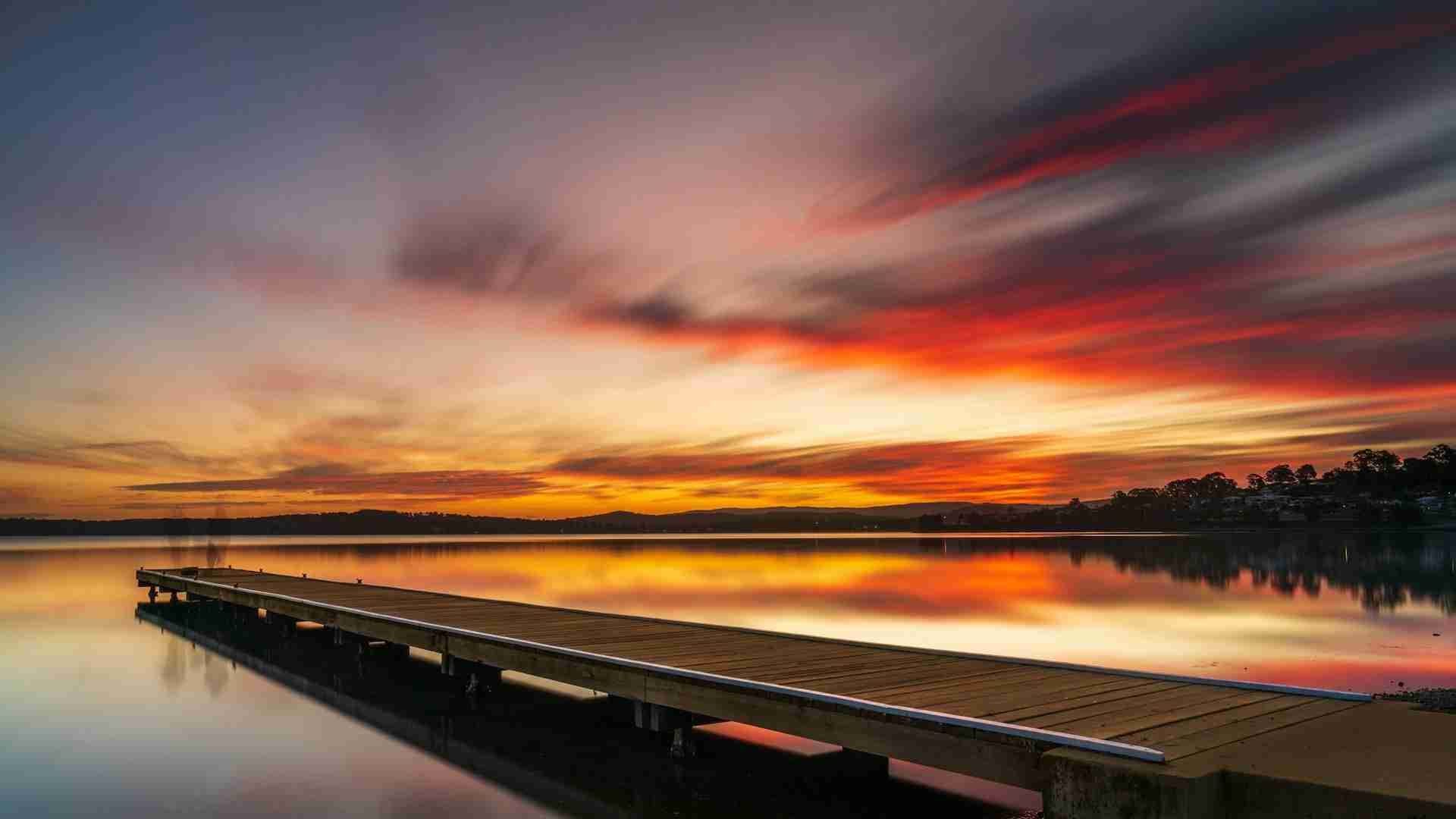
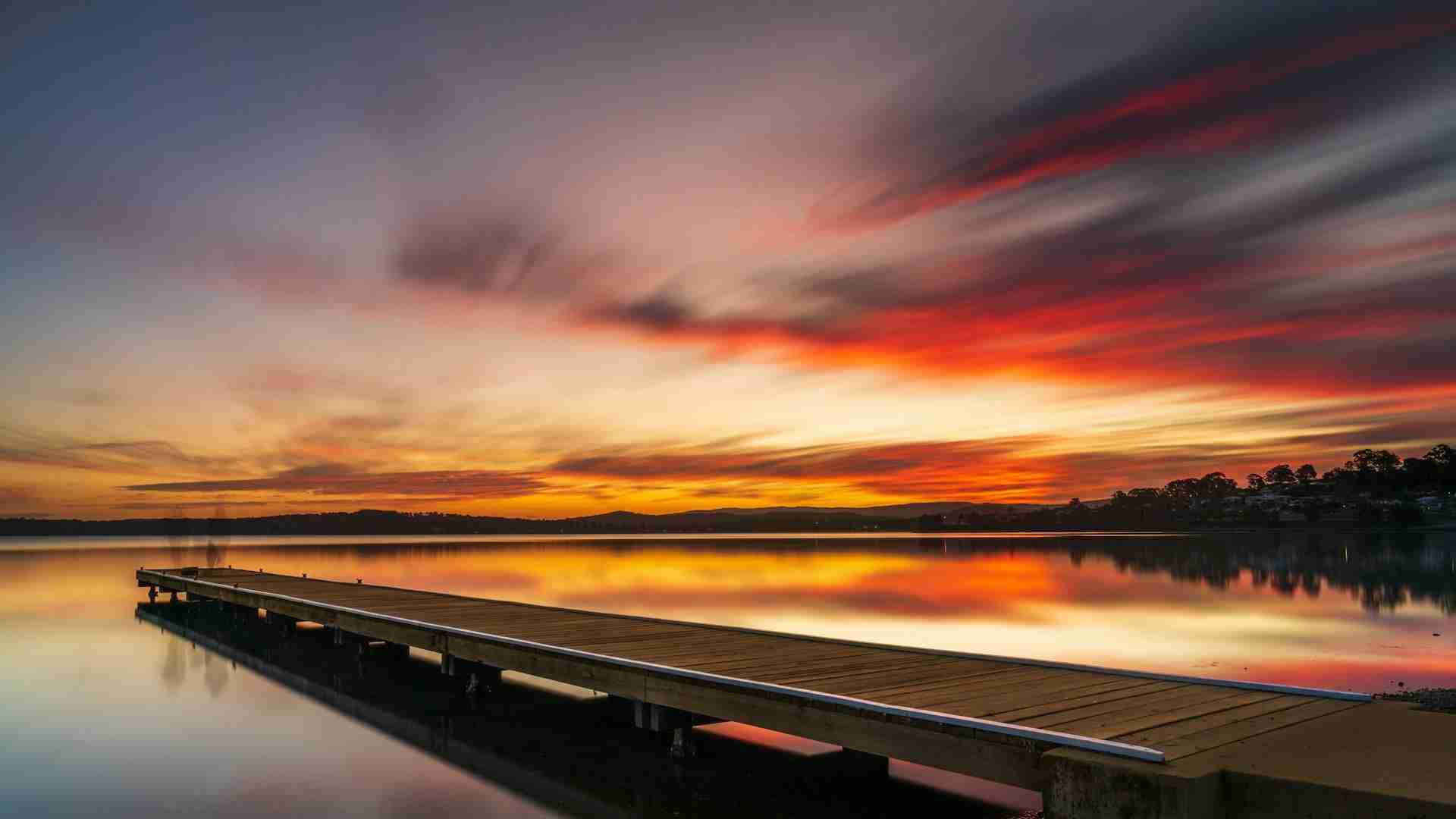
Stretching along the northeastern shore of Lake Macquarie, the Warners Bay Foreshore Reserve offers a mix of modern waterfront infrastructure, natural shoreline, and expansive lake views. It's a place where pedestrian boardwalks, subtle wetlands, and calm water converge, creating a versatile location for both early morning and golden hour photography. While the area is well-developed and family-friendly, it still holds plenty of opportunities for landscape and nature photographers who appreciate reflections, layered skies, and access to water-level compositions. The foreshore offers room to work with long exposures, sunrise color, and even abstract details among the weathered docks and smooth rocks. With minimal elevation and a consistent western-facing aspect, it's a location that is easy to explore but still offers moments of visual surprise when the light cooperates.
Best Photography Opportunities
• Sunrise Over Lake Macquarie
Warners Bay faces roughly east to southeast across the lake, which makes sunrise the most rewarding time for landscape work. On clear or lightly clouded mornings, light spills across the water, illuminating the foreshore walk and casting long shadows on the still lake surface. Use a tripod and a wide-angle lens to frame the sunrise with the distant shoreline or the boardwalk as a lead-in. Calm conditions often produce clean reflections that stretch from the lake's edge to the sky. Cloud cover adds depth and is particularly effective when low-lying fog drifts in over the lake.
• Boardwalk and Jetty Compositions
The public boardwalk and small jetties along the reserve offer excellent structural lines and symmetry. These elements make strong subjects for vanishing point compositions or as anchors for minimalist shots. Use a 24 to 70mm lens for flexibility in tight spaces and experiment with long exposures to smooth the water. Early morning or evening light casts soft directional shadows that emphasize the clean geometry of the piers. Incorporating human figures, such as walkers or cyclists, adds scale and a subtle narrative if timed carefully.
• Reflections and Weather Patterns Across the Water
Lake Macquarie's size and relatively protected shape often produce smooth water that mirrors the sky, especially at sunrise or after passing storms. Set up along the stone or grass shoreline and use a mid-telephoto lens to isolate sections of the lake where cloud reflections or tree lines form symmetrical patterns. The light here shifts quickly, so bracket exposures when needed to maintain sky and water detail. Neutral color palettes in the morning hours work well for high-key or black and white conversions.
• Birdlife and Waterfront Activity
The foreshore reserve is frequented by native bird species, including pelicans, cormorants, and black swans. A 100 to 400mm lens will allow you to isolate birds in motion or resting along the waterline. Early morning is the most active time, especially near the small wetland areas just south of the central reserve path. If you're patient, the light reflecting off the water can create interesting high-contrast frames, especially when birds pass through backlit spray or ripples. Shoreline vegetation also offers framing material and depth for more naturalistic scenes.
• Golden Hour and Blue Hour Cityscape Frames
As the sun sets behind the lake, the foreshore lights up with warm tones across the water and toward the developed edge of Warners Bay. The transition from golden hour to blue hour is especially effective if shooting toward the waterfront dining and retail strip. The lights from the buildings begin to reflect in the water, creating dynamic compositions that blend natural and built environments. Use a sturdy tripod and expose for highlights to prevent overexposing artificial light sources. Blue hour here lasts longer due to the wide-open sky and low surrounding terrain.
Best Time to Visit
Warners Bay offers year-round photographic potential, but the best light and conditions occur from late autumn through early spring when the air is cooler and skies are clearer. During these months, mornings often begin with fog drifting across the lake, especially after a cold night. This adds atmosphere and helps separate background layers, especially when shooting from the water's edge toward the horizon. Sunrise light is cooler and softer, making it ideal for color transitions and subtle tonal work.
Summer brings longer shooting windows and more active scenes, though haze and midday glare can reduce detail. Early morning remains the best option for water reflections and birdlife. In the evening, the foreshore becomes busier with people, but this can add life and scale to compositions if used intentionally.
Wind conditions on the lake are generally calm at dawn, which is ideal for mirror-like reflections and slow shutter work. Stormy weather systems often move in from the southwest, bringing dramatic clouds that drift across the open sky. Shooting immediately after a storm clears often produces the most intense color gradients and sky-to-water contrast. Tides are not a major factor, but higher water levels after rainfall will shift the shoreline slightly, which may affect low-angle framing near the edge.
How to Get There
Warners Bay is located in New South Wales, roughly 20 minutes southwest of Newcastle by car and easily accessible via the Pacific Motorway. If arriving from Sydney, the drive takes about two hours depending on traffic. From Newcastle, public transportation options include train service to Cardiff Station, followed by a short bus ride or taxi to the foreshore area.
The Warners Bay Foreshore Reserve sits at the center of town and is well marked with signage and walking paths. Multiple parking areas are available along The Esplanade and in nearby public lots. Parking is free in most areas, though time limits may apply in high-traffic zones during weekends. There are no access fees or restrictions for photographers.
The entire reserve is flat and fully walkable, with paved trails, rest areas, and benches along the water. Tripods can be set up along the path without issue, and low angles can be achieved easily from the grass or sand beside the lake. Lighting remains available into the evening along the main path, though darker conditions develop quickly after blue hour when moving farther south or north along the shoreline.
Recommended Photography Gear
A well-balanced, lightweight kit will cover everything from sunrise landscapes to long exposures and wildlife. Start with a full-frame or crop-sensor camera body that performs well in low light and can handle subtle tonal transitions in water and sky. A 24 to 70mm lens is your best general-purpose option for framing the jetties, boardwalks, and lake scenes. For wide open compositions with reflections and sky, a 16 to 35mm wide-angle lens is ideal, especially when shooting from low perspectives.
To capture birds or isolate details across the lake, bring a 70 to 200mm or longer telephoto lens. Autofocus speed and image stabilization are helpful here, particularly when photographing birds in flight or skimming the water. If weight is a concern, consider a 70 to 300mm variable aperture lens for flexibility without bulk.
A tripod is essential for long exposure and low-light work. Choose one with stable legs that handle uneven shoreline terrain and damp grass. For smoothing water or capturing motion blur, a 6-stop ND filter is effective in daylight, while a polarizer can cut glare and deepen sky tones during sunrise or sunset. Graduated ND filters help balance exposure when shooting directly into early light.
Also consider bringing a lens cloth to handle moisture and a waterproof ground sheet if you plan to shoot from low angles near the water. Comfortable shoes with good grip are helpful, especially in early morning when surfaces may be damp. Since much of the shooting can happen in public areas, a smaller, quieter kit will help you move unnoticed and capture candid moments along the path.
Nearby Photography Locations
Just south of Warners Bay, Speers Point Park offers wide views across Lake Macquarie and a long shoreline for sunrise compositions. The open lawns, docks, and tall trees provide a strong foreground, and the park's higher elevation adds a subtle sense of scale to your lake shots.
Roughly 20 minutes northeast, Redhead Beach offers dramatic rock formations, golden dunes, and a well-known wooden shark tower. It's excellent for early morning surf photography and long exposures of wave movement against dark volcanic rocks.
To the west, Mount Sugarloaf provides panoramic views back toward Newcastle and the Lake Macquarie region. This is an ideal spot for sunset photography and compressed landscape shots with a telephoto lens. The lookout is easily accessible by car.
South of Warners Bay, Belmont Lagoon offers calm water, wildlife, and interesting reed-lined textures. It's a quiet location perfect for slow-paced nature photography or birdwatching with a long lens, especially in the early morning hours.
Tucked between forest and ocean, Dudley Beach is great for moody coastal compositions, rock pools, and elevated viewpoints. It's often less crowded than nearby beaches and works well in stormy or overcast conditions.
Warners Bay Foreshore Reserve is a location that rewards consistency and familiarity. The light is subtle, the water is calm, and the scenes shift gradually throughout the day. It's a place where the difference between an average frame and a memorable one often comes down to timing, patience, and your ability to recognize good light when it arrives. With easy access and room to explore, it's well worth revisiting—especially when the sky begins to change.
Comments
Loading comments…