
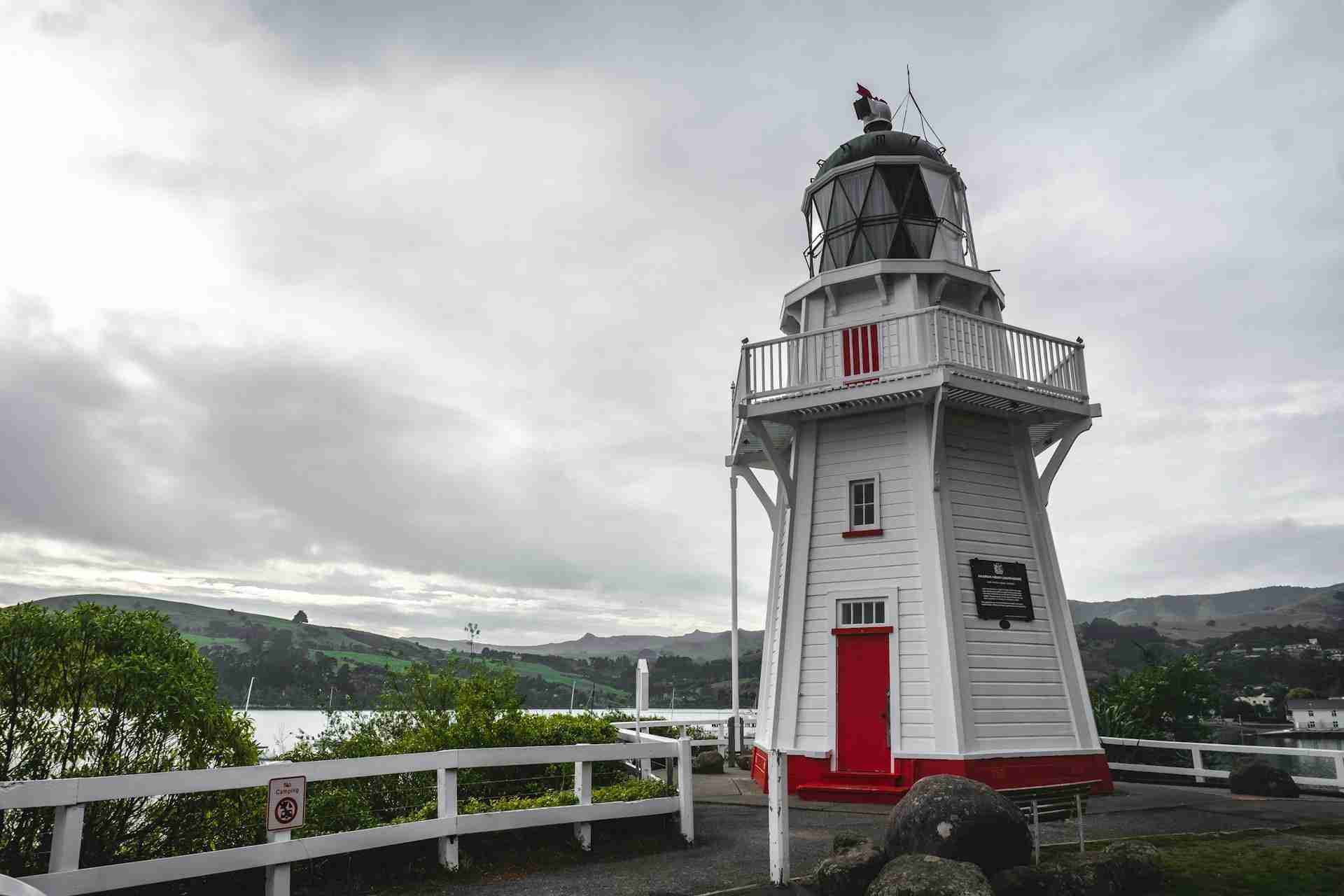
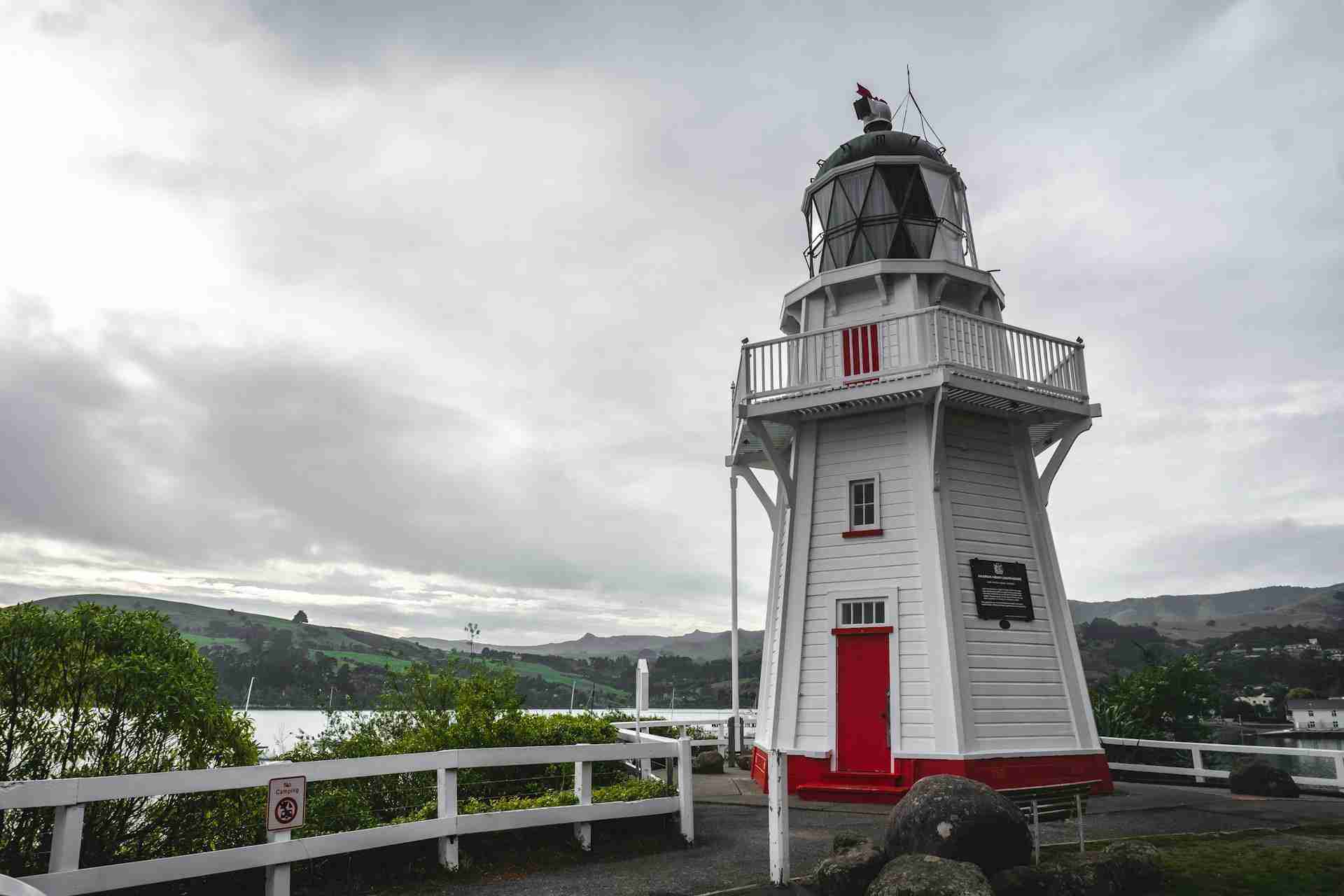
Perched on a bluff above Akaroa Harbor, the Akaroa Lighthouse is a perfectly preserved maritime relic from the late 19th century, offering photographers a picturesque subject with historical character and a backdrop of coastal serenity. Originally located at the entrance to the harbor, the lighthouse was relocated to its current site in 1980 to preserve it as a heritage landmark. With its distinctive white wooden tower, red lantern housing, and prime position overlooking the turquoise waters of the Banks Peninsula, the Akaroa Lighthouse is a rewarding subject for photographers seeking quiet compositions that blend architectural charm with natural beauty. Whether you're working in soft morning mist or under golden afternoon light, the setting provides countless ways to experiment with angles, textures, and atmosphere.
Best Photography Opportunities
• Frontal Composition with Harbor Backdrop
: The most straightforward yet rewarding angle is from the path directly in front of the lighthouse, where you can shoot slightly upward to showcase the tower's full verticality. From this position, the lighthouse stands prominently against the backdrop of Akaroa Harbor and the volcanic ridgelines beyond. A wide-angle lens (16–24mm) allows you to include the stone steps and low grasses that border the bluff, drawing the viewer's eye up toward the structure. Early morning light is especially flattering, casting even illumination across the white clapboard and enhancing the cool tones of the water behind. If the sky holds scattered clouds, they often reflect in the harbor, creating symmetry between the horizon and the red lantern atop the tower. It's also a solid position for minimalistic compositions with strong geometric balance.
• Three-Quarter Side View with Peninsula Context
: From the walking trail as it curves around the lighthouse, you can access a dynamic three-quarter angle that reveals the depth of the structure while integrating the sweeping arc of the harbor behind it. This position is ideal for showing how the lighthouse relates to the landscape—set against rolling hills, anchored into the bluff, and visually connected to the sea below. Shooting with a mid-range zoom (24–70mm) allows you to adjust your framing to either isolate the lighthouse against open sky or incorporate additional landscape features like distant boats or headlands. In late afternoon, side light enhances texture in the siding and warms the tones of the grass and path, creating layered images with a strong sense of place and time.
• Close-Up Details of Maritime Craftsmanship
: The Akaroa Lighthouse is rich in tactile detail—from the weathered wooden boards to the original nameplate and red metal lantern cap. These details reward slow, intentional shooting with a telephoto lens (85–135mm), particularly in flat or diffused light. By focusing on elements such as the curved gallery railing, stair hardware, or the transition between the red and white paint, you can capture abstract compositions or storytelling fragments that highlight the lighthouse's age and preservation. Textural studies work well in black and white, especially when emphasizing chipped paint, moss growth, or natural wear patterns on the structure.
• Framed Composition with Vegetation or Fencing
: One of the more immersive compositions involves partially obscuring the lighthouse with the surrounding environment—whether that's through native shrubs, old fencing, or flowering plants along the trail. This technique creates natural framing devices that enhance depth and context. By positioning yourself just off-trail or using foreground blur creatively with a telephoto lens, you can evoke a sense of arrival or discovery. In spring and early summer, blooming wildflowers add natural color accents that complement the red-and-white paint scheme. Golden hour softens everything into warm tones, and even on cloudy days, the vegetation maintains its contrast and vibrancy, especially after rain.
• Silhouette and Blue Hour Scenes
: As daylight fades, the Akaroa Lighthouse takes on a different character—its crisp geometry silhouetted against the layered gradients of twilight. From the harbor side or the uphill trail, you can capture it standing alone against the soft purples and blues of a fading sky. Use a tripod and long exposures (10–30 seconds) to draw out ambient light, especially when working with a smaller aperture to keep the tower sharp. On clear evenings, the last light often hits the dome while the lower body falls into shadow, creating strong vertical contrasts. If shooting after sunset, consider light-painting the structure subtly with a headlamp or low-powered LED for a controlled highlight that preserves the mood.
Best Time to Visit
The most favorable time to photograph Akaroa Lighthouse is during early morning or late afternoon, when sunlight strikes the structure from a low angle, revealing the textures of the wooden siding and adding dimensionality to its form. In the morning, light comes from the east over the harbor, bathing the lighthouse in a soft glow and illuminating the surrounding vegetation. This is also when the water is usually calmest, allowing for cleaner horizon lines and occasional mist rolling over the hills.
Late afternoon brings a warmer, richer palette to the scene, with golden light touching the upper dome and often creating long shadows that stretch across the grass. This is an ideal time for side and three-quarter views of the lighthouse, as well as blue hour compositions where the warm tones of sunset contrast with the coolening hues of the harbor.
Seasonally, spring (September to November) and early summer (December) offer lush vegetation and wildflowers around the lighthouse grounds, which enhance foreground interest and color variety. Autumn (March to May) brings clearer skies, cooler air, and more stable weather patterns, often producing crisp light and stronger sunset colorations over the harbor.
While clear days provide brilliant lighting on the structure itself, overcast and foggy conditions lend an ethereal mood that pairs well with detail-focused compositions. These conditions are especially suited for storytelling shots or soft monochrome studies that focus on form and silhouette. Regardless of the season, the weather in Akaroa can shift quickly—come prepared for changing skies and seize the brief light transitions that often create the most memorable images.
How to Get There
Akaroa Lighthouse is located at Cemetery Point, a short distance from the center of Akaroa on the Banks Peninsula in Canterbury, New Zealand. From Akaroa's main wharf or waterfront, it's a 5-minute drive or a leisurely 15-minute walk along Beach Road and up Lighthouse Road. The route follows the harbor's curve and offers occasional views of the water, making the walk itself a pleasant prelude to shooting.
Once on Lighthouse Road, you'll see signage for a small gravel parking area at the base of the trail leading to the lighthouse. The footpath is short, well-graded, and passes through native bush and low brush before opening up to the lighthouse grounds. The site is freely accessible year-round, though the interior is only open to visitors on selected weekends or through tours organized by the Akaroa Lighthouse Preservation Society.
There is no cost to access the lighthouse grounds or photograph the exterior, and the location is generally quiet, especially in the early morning or late evening. Tripods are welcome, and there is ample space to explore compositions from multiple elevations and angles without obstructing pathways or visitors.
Recommended Photography Gear
A wide-angle zoom (16–35mm) is essential for capturing full-body shots of the lighthouse in its setting, especially from lower angles or when including foreground textures like stone, plants, or the walking path. For tighter compositions or compressing the tower against its background, a mid-range zoom (24–70mm) offers excellent versatility.
To isolate architectural details, consider a short telephoto (85–135mm) or a macro lens for extremely close shots of painted wood, metal fastenings, or signage. These lenses are ideal for capturing the craftsmanship of the structure and adding variety to your portfolio.
Bring a sturdy but compact tripod for twilight or long exposure work, particularly when shooting during blue hour or working with narrow apertures. A circular polarizer helps manage glare from the white paint and enhances foliage and sky contrast. An ND filter (6–10 stops) may be helpful for smoothing motion in clouds or softening background elements during daylight.
Coastal wind and spray can appear quickly, so protective gear for your camera bag and a microfiber cloth to wipe lenses are always recommended. Comfortable shoes and a weather-resistant jacket will keep you mobile and protected as you explore the area in changing light conditions.
Nearby Photography Locations
• Akaroa Wharf and Waterfront
: Just minutes from the lighthouse, the wharf and surrounding waterfront offer classic harbor compositions with boats, reflections, and colonial-style buildings set against steep hills. This area is particularly beautiful during sunrise and sunset, when the sky mirrors in the water and the town lights begin to glow.
• Ōnuku Church and Marae
: A few kilometers southwest of Akaroa, this historic church sits near the shore with expansive views of the harbor and surrounding farmland. It's a striking subject for minimalist compositions, especially at dawn when mist hugs the ground and the horizon glows behind the silhouette of the cross.
• French Bay Gardens
: Located in central Akaroa, the waterfront gardens feature carefully manicured flower beds, ornamental paths, and harbor views that provide a softer, more cultivated aesthetic compared to the rugged setting of the lighthouse. Ideal for handheld walkabout photography and close-up floral studies.
: Just a short drive from town, this large ecological restoration area features hiking trails, native bush, and occasional panoramic views over the sea. Early morning hikes through this reserve offer opportunities for misty, forested landscapes and birdlife photography.
• Summit Road Lookouts
: High above the harbor, Summit Road offers multiple pullover points where photographers can capture sweeping views across Akaroa's volcanic caldera. These views are ideal in the hour after sunrise or just before sunset, when the landforms cast long shadows and the light deepens in hue.
Photographing the Akaroa Lighthouse isn't just about documenting a structure—it's about working with the light, the sea, and the timelessness of coastal New Zealand. For photographers who appreciate historic subjects framed by elemental beauty, it offers an endlessly rewarding and meditative place to work.
Comments
Loading comments…