
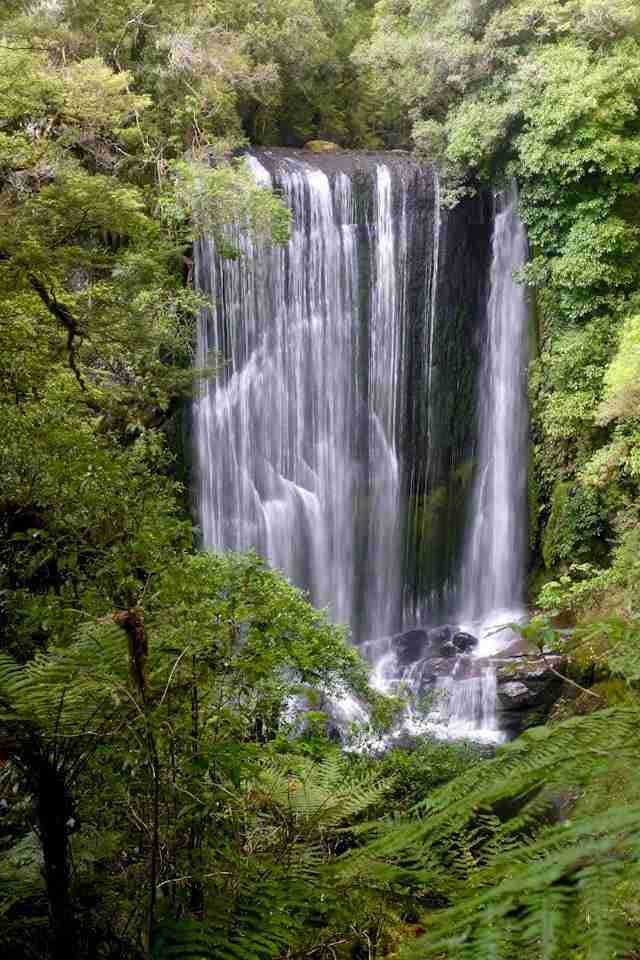
Hidden deep within the primeval rainforest of Te Urewera on New Zealand's North Island, Korokoro Falls offers photographers a rare chance to capture cascading water framed by untouched native bush. Tucked away in a secluded valley near Lake Waikaremoana, this waterfall tumbles in a singular ribbon over a moss-laced cliff into a shaded rock pool below. It's not grand in scale, but what it lacks in height or volume it more than makes up for in atmosphere. Surrounded by dense tree ferns, beech, and lichen-covered trunks, Korokoro Falls feels like a step into another world—where mist drifts through silence and every leaf glistens in the filtered light. For those willing to make the journey, this location offers one of the most immersive and moody forest waterfall scenes in New Zealand.
Best Photography Opportunities
• Frontal Composition from the Pool Edge
The most direct and classic shot of Korokoro Falls comes from the base of the plunge pool, where the waterfall drops in a clean vertical line framed by dense foliage. A wide-angle lens (14–24mm or equivalent) allows you to fit the entire falls within the frame while including surrounding ferns, rocks, or fallen logs for foreground texture. Long exposures of 1 to 3 seconds soften the water into a luminous veil, while the dark forest backdrop enhances the waterfall's shape. Overcast conditions are ideal for reducing glare and maintaining even exposure across shadowed vegetation and bright water.
• Side Angle with Fern Framing
Just to the right of the falls, a narrow side trail provides a more intimate perspective. From here, the fall's line appears more diagonal, and you can use overhanging ponga fronds or mossy trunks to create natural frames. Shooting at mid-range focal lengths (35–70mm) helps compress the foliage layers and direct the eye toward the falls. This is an ideal spot for low-light compositions using high ISO, particularly if you want to preserve handheld agility without a tripod in damp terrain.
• Mist and Rain Detail Studies
The Te Urewera rainforest is one of the wettest regions in New Zealand, and the high humidity often means the falls are surrounded by mist, especially in the early morning or after rainfall. Rather than fighting the moisture, embrace it—mist offers a dreamlike quality that softens edges and reveals shafts of filtered light. A standard prime (50mm) is perfect for detail studies: droplets on leaves, light playing on moss, or the swirl of foam at the pool's base. Focus stacking or shallow depth-of-field compositions work well here to convey intimacy and texture.
• Trail Compositions Along Korokoro Stream
The track to the falls follows Korokoro Stream through varied forest terrain. Along the way, small cascades, boulders, and patches of filtered sunlight provide excellent opportunities for forest landscape photography. These scenes reward slow walking and patient observation. Incorporate leading lines from the path, tree roots, or water flow to guide the eye through compositions. A mid-range zoom is particularly effective for adjusting quickly to varied distances and subjects in low, shifting light.
• Black and White Conversions of Water and Texture
Korokoro Falls excels in monochrome. The high contrast between bright water and dark forest, combined with the abundance of texture—wet rock, moss, tree bark, and swirling mist—make it a superb candidate for black and white work. Shoot in RAW and expose for the highlights in the waterfall to maintain recoverable shadow detail. Long exposures of 5 to 10 seconds introduce elegant blur and tonal gradation that pairs beautifully with the dense verticality of the bush.
Best Time to Visit
Korokoro Falls is photographable year-round, but different seasons and conditions bring out unique characteristics. Late spring through early summer (October to December) delivers lush foliage, vibrant greens, and strong water flow from seasonal rain. This is one of the best periods for color-rich compositions, though humidity can be high, and the trail may be muddy.
Mid to late summer (January to March) brings drier conditions, and while the falls may lose some volume, the light filtering through the canopy is often more pronounced. This creates dancing highlights on the forest floor and moments of sunbeam drama through the mist—excellent for high ISO handheld shooting. Morning and late afternoon offer the best light angles; midday sun is often blocked by the surrounding cliffs and foliage.
Autumn (April to May) introduces subtle golden tones to the bush and cooler morning air, which increases the chance of lingering mist. The track is quieter, and the falls are less frequented, making it ideal for longer compositions and unhurried exploration.
Winter (June to August) is the wettest and most atmospheric season. Expect saturated color, thick fog, and a deep, brooding tone to the entire scene. Access can be more difficult due to trail conditions, but the visual rewards are significant—especially for black and white work or moody landscape studies.
Regardless of season, light rain or overcast skies provide the best soft lighting conditions. Avoid sunny midday hours if possible, as harsh contrast and blown highlights can be difficult to control in the dense bush.
How to Get There
Korokoro Falls is accessed via the Korokoro Falls Track in Te Urewera, near the eastern edge of Lake Waikaremoana. The starting point is from the Korokoro Campsite, which lies along the Lake Waikaremoana Great Walk. To reach the falls, visitors must first hike a portion of this trail, which is one of the Department of Conservation's designated multi-day routes.
If you're not thru-hiking the entire Great Walk, the most efficient approach is to start from Onepoto or Hopuruahine and plan a one- or two-night trip, with the falls as a dedicated side excursion. The walk to the falls from the Korokoro Campsite is approximately 45 minutes one way, following a gently undulating track along the stream. The final approach includes roots, rocks, and some steep footing, especially in wet weather, so sturdy hiking boots and waterproof protection for gear are essential.
There is no vehicle access directly to the falls. Photographers should plan for at least an overnight stay at one of the DOC campsites or huts along the route. There are no amenities at the falls themselves, and cell reception is limited to nonexistent in the region. Carry paper maps, plenty of food and water, and all-weather clothing. Te Urewera is remote and sacred to the local Tūhoe people—travel respectfully and tread lightly.
Recommended Photography Gear
Photographing Korokoro Falls demands lightweight, weather-ready gear that performs well in low light and wet environments. A full-frame camera with strong ISO handling and good weather sealing is ideal. A wide-angle zoom (16–35mm) will serve you best at the base of the falls and along the forest trail. For detail shots and tighter compositions, a 24–70mm or fast prime in the 50mm to 85mm range is highly effective, especially for handheld work in dim forest conditions.
A compact but stable tripod is essential for long exposures and careful compositions. Choose one with rubber feet for grip on wet rock and forest floor. A waterproof tripod bag or sling can help during short bushwhacks or river crossings. Circular polarizers are particularly useful here—not only to cut glare from wet foliage and rock, but also to enhance the saturation of the surrounding bush without overprocessing in post.
Bring a lens cloth or chamois, as mist and spray are constant companions. A rain cover for your camera and backpack is essential in any season. If you're planning long exposure work in or near water, consider ND filters (6- to 10-stop) for silky waterfall blur. Spare batteries should be stored in waterproof pouches, and a dry bag or hard case will protect gear in the event of unexpected downpours.
Because this is a remote and physically demanding location, pare down to essentials—every extra item adds weight to your pack over rugged terrain. Carry a headlamp, first-aid kit, emergency shelter, and food regardless of weather forecast or duration.
Nearby Photography Locations
The lake itself offers excellent dawn and dusk compositions, particularly from the shores near Onepoto or the Whanganuioparua Inlet. Calm water, low fog, and silhouetted ridgelines create mirror-like reflections in the early morning, while driftwood and boulders add foreground interest.
Accessible from the southern end of the Great Walk, the Panekire Bluff provides dramatic elevated views over the lake and distant ranges. It's a powerful location for sunrise, especially when low clouds drift across the valley below. Use a telephoto lens to compress layers of light, mist, and water.
• Papakorito Falls
Near the road-accessible side of Lake Waikaremoana, Papakorito Falls is a broader, more forceful cascade located in a mossy glade. While more accessible than Korokoro, it still offers an immersive forest waterfall experience, best captured on overcast days or in post-rain mist.
Korokoro Falls is not for the rushed photographer. It asks for time, effort, and quiet presence. But for those willing to make the journey, the reward is a rare convergence of place and mood—where water and forest speak in the same breath, and the camera becomes a witness to something deeply alive.
Comments
Loading comments…