
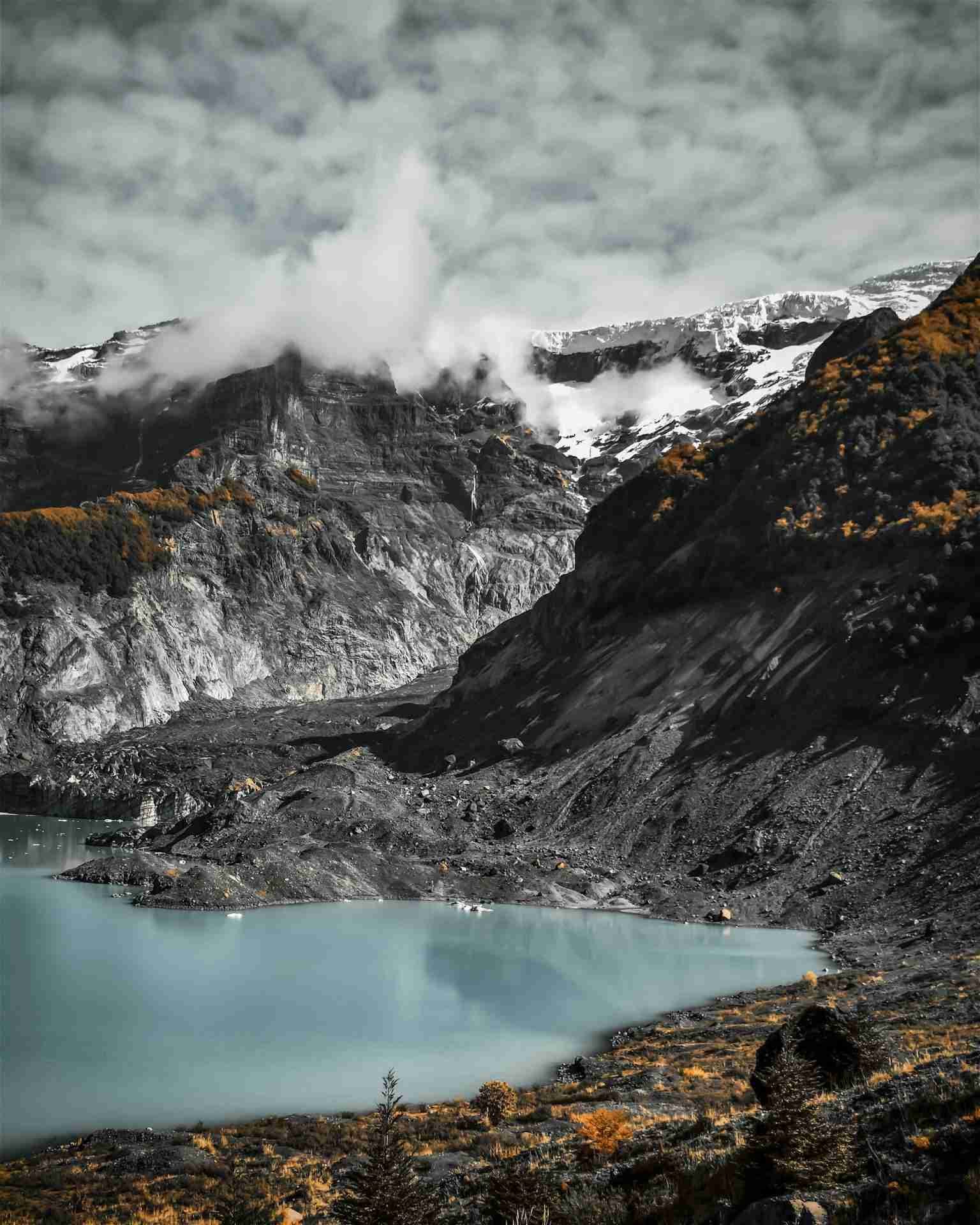
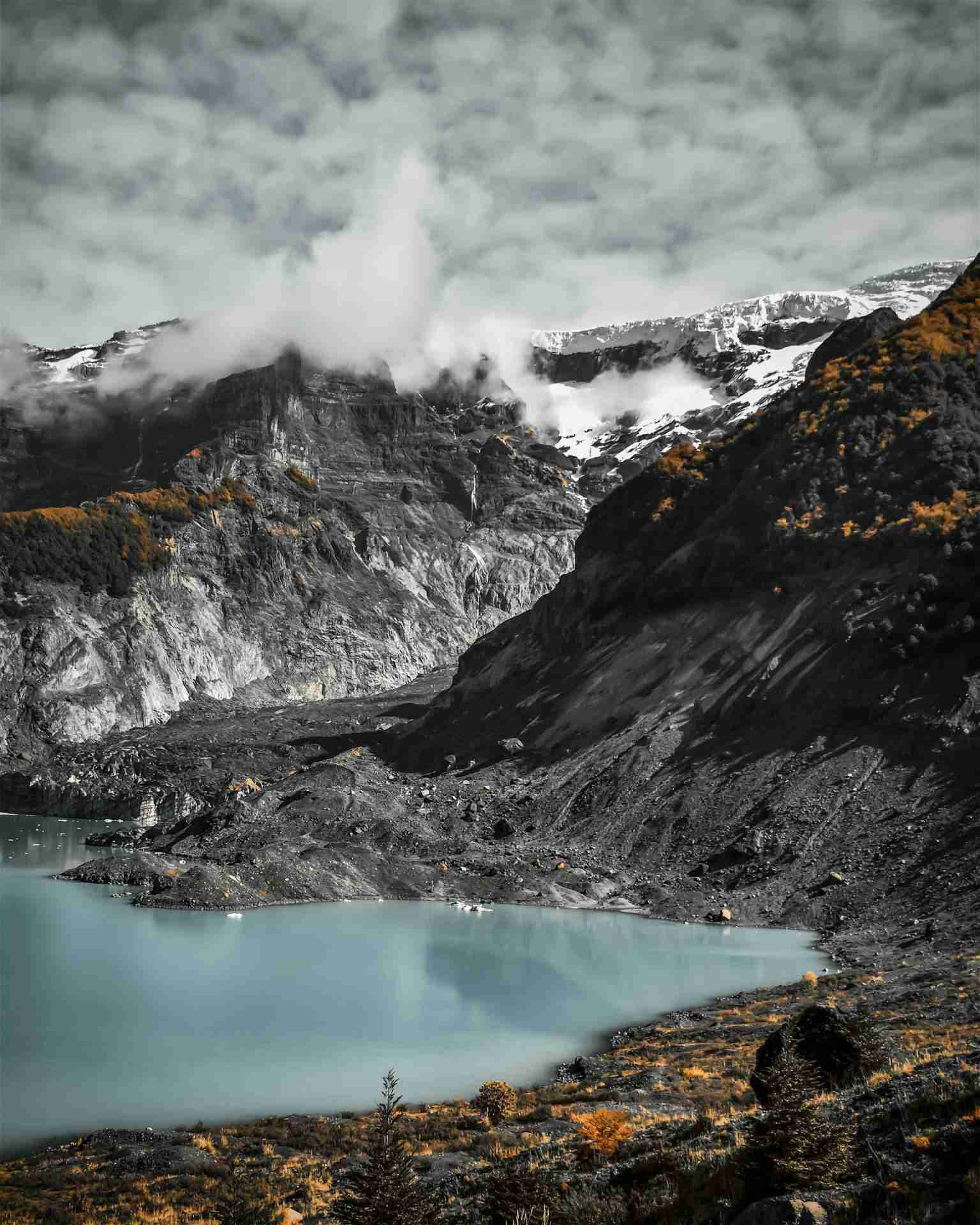
Hidden deep in the Andean wilderness of northern Patagonia, Ventisquero Negro is one of the most unusual glaciers in South America. Its name, meaning "Black Glacier," comes from its striking appearance: a mass of dark, debris-covered ice that creeps down from the southeastern face of Mount Tronador. At its base lies Lago Ventisquero Negro, a silt-filled glacial lake that mirrors the weight and texture of the glacier above it. The contrast between dark sediment, jagged ice, and sheer rock walls makes this a compelling location for photographers interested in geological drama and tonal complexity. Within Nahuel Huapi National Park, this location offers visual intensity without relying on cliché glacier views. It is a destination defined by mood, movement, and sharp contrasts in light and terrain.
Best Photography Opportunities
• The Black Glacier's Textural Surface
Ventisquero Negro's defining characteristic is its blackened, sediment-rich surface. Rather than the clean white or deep blue seen in other glaciers, this one appears almost volcanic. The result is a layered, gritty texture that demands close attention. Telephoto compositions can isolate crumbling crevasses, angular ridges, and the scattered boulders resting on the ice. Side lighting enhances these surface patterns, creating a play of light and shadow that reveals the glacier's complex movement. In early morning, the shadows are especially deep and allow for high-contrast monochrome interpretations that highlight both structure and erosion.
• Reflections in Lago Ventisquero Negro
The lake below the glacier is a dense greenish-black color due to the high concentration of suspended glacial silt. On calm days, its surface becomes a perfect mirror for the distorted lines of the glacier and the cliffs above. Wide-angle lenses capture this symmetry from the eastern side of the lake, especially just after sunrise when light begins to brush the valley rim. When the wind picks up, the water becomes a textured surface of ripples, which can be softened with long exposure to create a minimalist base for the glacier's jagged profile. Using boulders in the foreground helps anchor reflections and bring scale to compositions.
• Mount Tronador as a Backdrop
Towering above both lake and glacier, Mount Tronador provides a dramatic vertical element that expands the scale of any frame. Its snow-covered summit often remains lit long after the valley falls into shadow. Including the peak in mid-range compositions adds height and contrast, especially when framed with the glacier in the foreground and the sky clearing after a storm. During autumn, a dusting of snow on the upper slopes sharpens the outline and adds depth to twilight shots. Light raking across the ridges from the west or south helps define the mountain's structure against changing skies.
• Low-Cloud Drama and Atmospheric Conditions
The microclimate around the glacier is highly changeable, and photographers often find themselves shooting through rolling mist or low cloud layers. These conditions can transform the scene entirely. When the glacier appears briefly through breaks in the fog, it gains a sense of mystery and motion. Overcast skies mute the contrast between glacier and rock, allowing subtle textures and tonal shifts to come forward. In these conditions, working slowly and waiting for light transitions is often more productive than chasing a fully clear scene. A strong composition in flat light often becomes the most enduring.
• Seasonal Flow and Melting Patterns
During the melt season, water flows visibly across the ice and through carved channels, feeding the lake in a network of streams and small cascades. These flows provide opportunities for dynamic compositions that include motion and lead the eye toward the main mass of the glacier. Short exposures capture the water's force, while longer ones can turn thin streams into ribbons of light. Shooting in the shoulder seasons of spring or early fall offers the best balance between flow activity and stable weather, with fewer harsh midday shadows to complicate exposure.
Best Time to Visit
The best time to visit Ventisquero Negro for photography is from late October through April, during the warmer months when road access is reliable and light conditions are varied. Spring offers strong meltwater flow and lush vegetation, while autumn provides warm tones in the surrounding forest and cooler air for clearer views. Summer offers the longest days, but midday sun can flatten contrast unless softened by partial cloud cover.
Early mornings provide the most stable light, and the glacier often remains in shadow long enough for controlled exposures. Afternoon light adds warmth and occasionally touches the summit of Mount Tronador while leaving the glacier in cooler tones, creating a natural duality in the frame. The area is prone to cloud build-up, especially in the late afternoon, so it is wise to arrive early and wait through changing conditions. Overcast or misty weather is not a deterrent but rather an opportunity to shift into a more abstract or tonal shooting approach.
How to Get There
Ventisquero Negro is located within Nahuel Huapi National Park, approximately 60 kilometers southwest of San Carlos de Bariloche. From Bariloche, take Ruta Nacional 40 south toward Villa Mascardi, then turn west onto Ruta Provincial 82. This gravel road leads through forested terrain to the small outpost of Pampa Linda, which serves as a base for accessing Mount Tronador and its glaciers. The road is seasonal and usually open from late spring through early autumn, depending on snowfall and weather.
From Pampa Linda, the trail to the glacier viewpoint is a short walk that takes less than thirty minutes and is suitable for most fitness levels. The official viewpoint is situated above the lake, offering a clear view of the glacier's terminus and surrounding terrain. Access to the glacier itself is restricted due to safety concerns, but the vantage point provides excellent compositional angles. There is a general park entrance fee, but no additional permit is needed for photography. A high-clearance vehicle is recommended for the final portion of the access road, especially after heavy rain.
Recommended Photography Gear
A well-rounded setup is important for making the most of this location's varied features. A wide-angle lens such as a 16 to 35 millimeter zoom is useful for capturing both the glacier and the lake together. A 24 to 70 millimeter lens offers flexibility when including Mount Tronador or isolating layers of rock, ice, and water. For detail work on the glacier's surface or compression of mountain elements, a telephoto lens between 70 and 200 millimeters is ideal.
A sturdy tripod is essential for long exposures of water movement or low-light conditions at dawn and dusk. A circular polarizer helps manage reflections on the lake and enhances color separation in the glacier and forested slopes. Neutral density filters in the six to ten stop range are recommended for softening moving water and shifting clouds. Weather in the area is unpredictable, so bring a rain cover for your gear, a microfiber cloth, and a dry bag insert for your pack. Footwear should be waterproof and offer good grip on rock and damp trail sections.
Nearby Photography Locations
From Pampa Linda, hiking trails lead to higher elevations with expanded views of Tronador and its surrounding glaciers. These locations offer panoramic shooting conditions and a higher perspective on the entire glacial system, especially in the early morning.
Closer to Bariloche, this accessible peak offers views over Lake Nahuel Huapi and surrounding ridges. Sunrise and sunset sessions here produce soft light on open water and mist rolling through the valleys.
Located on the route to Pampa Linda, this powerful waterfall is a rewarding stop for long exposure work. Surrounded by mature forest and mossy boulders, it pairs well with overcast conditions and diffused light.
Just east of the glacier access road, this lake offers clear water, forested edges, and opportunities for shoreline compositions. Calm conditions in the morning often produce clean reflections and soft light.
For those looking to extend their stay, this multi-day trekking route includes alpine valleys, glacial rivers, and remote passes. It offers unique vantage points on the landscape around Mount Tronador and is well suited to photographers with lightweight gear and time for deeper exploration.
Ventisquero Negro is unlike any other glacier in the region. Its layered textures, dark palette, and stark contrasts demand a different visual approach than the typical bright blue ice of Patagonia. With patience, adaptable technique, and careful attention to light and weather, photographers can create work that feels both elemental and uniquely tied to this complex, shadowed corner of the Andes.
Comments
Loading comments…