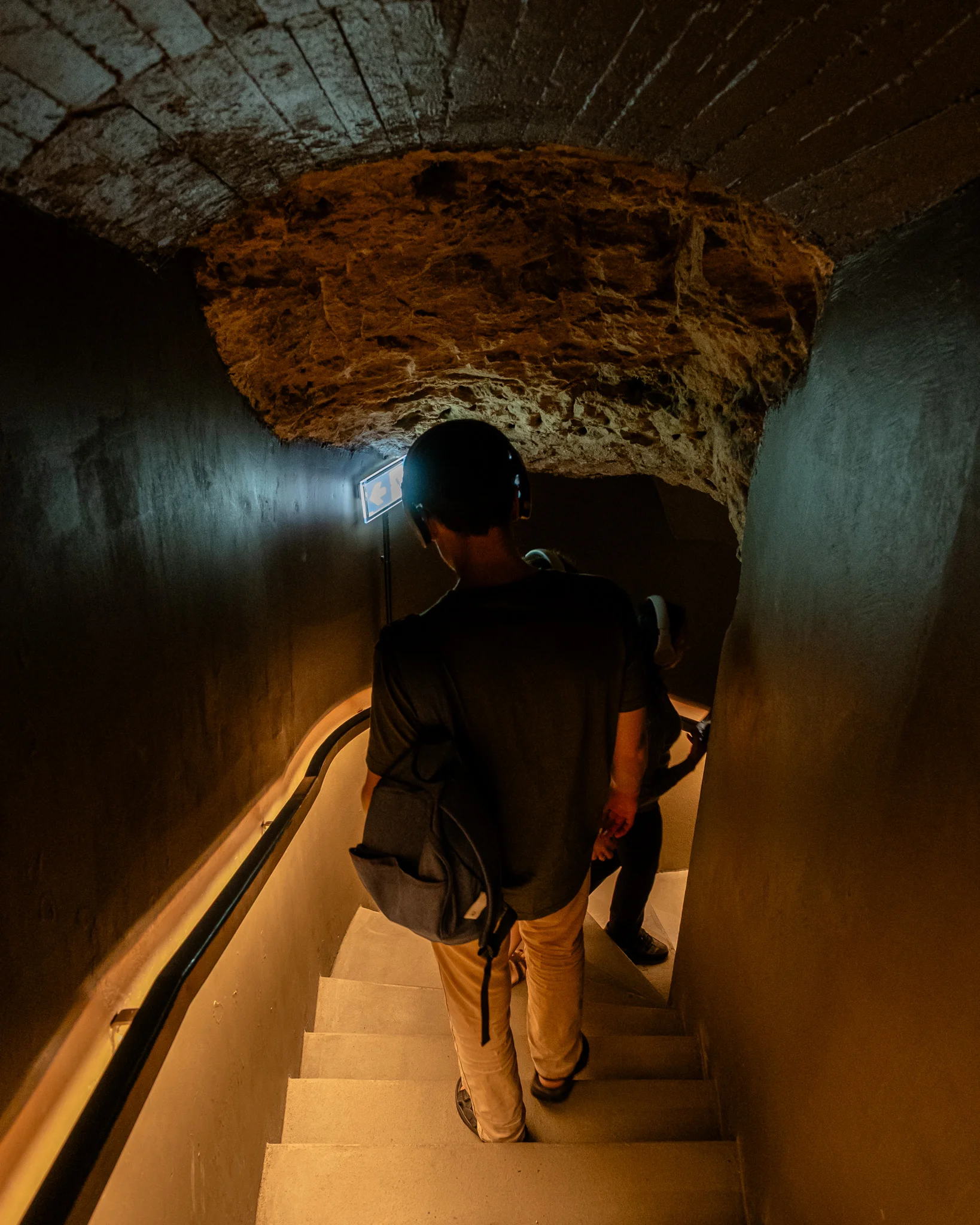
It begins with a descent into darkness. Well, that's not quite true. The spiral staircase that takes you below the streets of Paris is reasonably well lit, enough that you won't fall. But it does let you know just how far down you're going and that there’s no light down there except for what they’ve been kind enough to provide you. You pass the level of the sewers, then the metro, then keep going. The stairs seem to go on forever. The staircase sets the tone for everything that follows: ominous, solemn, and a little unnerving....131 steps.....all the way down.
Past the sewers, past the metro, still going. This is where the visit starts setting its tone. (16 mm, f/3.2, 1/60 s, ISO 3200)
This descent was the first step into a location that has been on my bucket list for years, and if I'm honest, the part of our family's Paris trip I was looking forward to most. At the bottom is a photo spot that is unique in the world and speaks directly to my love of the interesting and macabre.
When you finally finish the stairs, it's time to walk. A long, narrow tunnel with a low ceiling comes next, and it can be a bit unnerving, since the walls are bare earth and stone that don't look as solid as one might hope. Eventually you reach a small underground lobby with a narrow passage leading to another hallway. But this hallway is different. In this hallway, the walls are made of people.
What follows is my guide to photographing the Catacombs of Paris, which my family and I visited in August 2026. We went in on a standard entry ticket with nothing but a camera and a small belt bag. This is what I learned about shooting one of the most solemn places I have ever pointed a lens at.
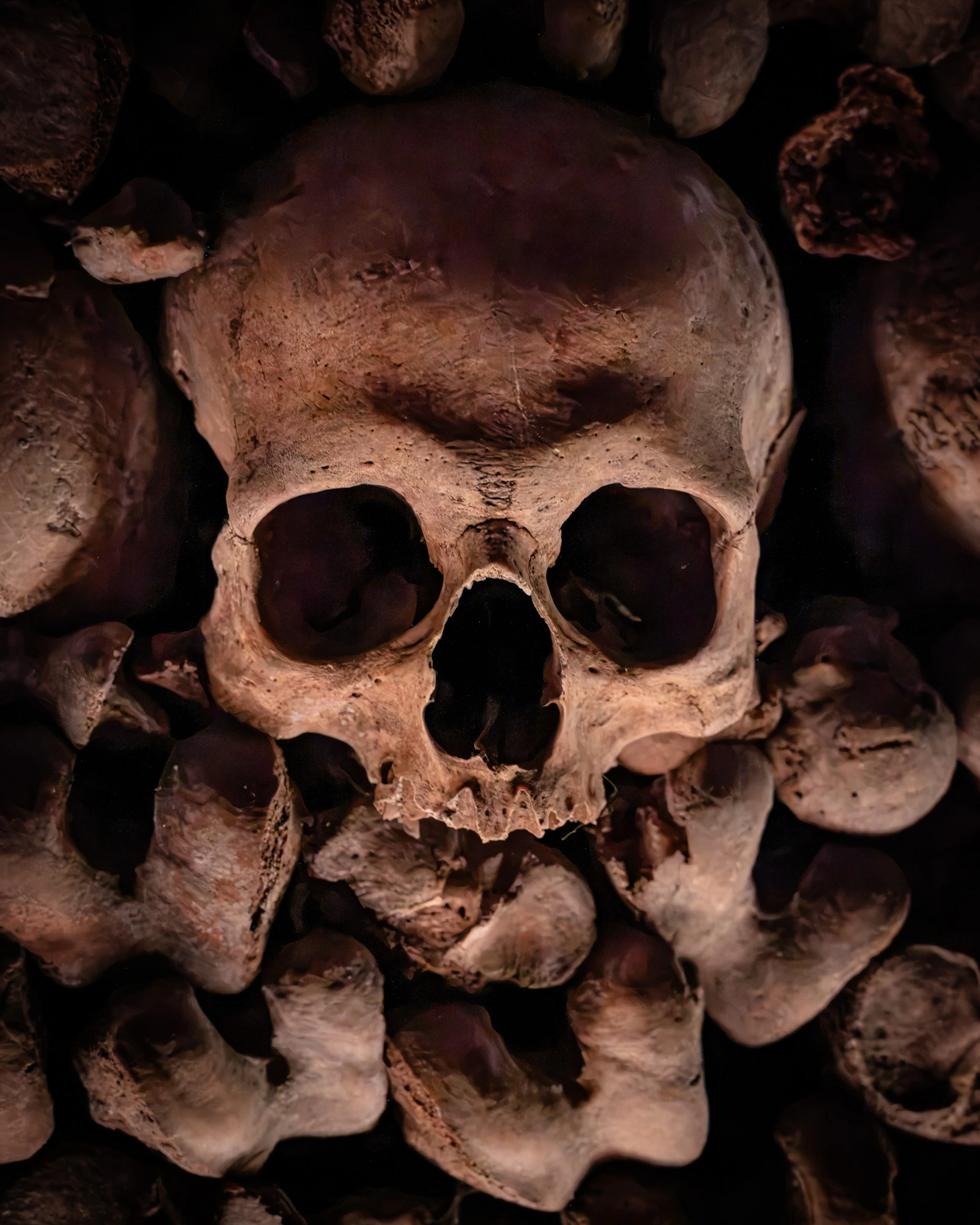
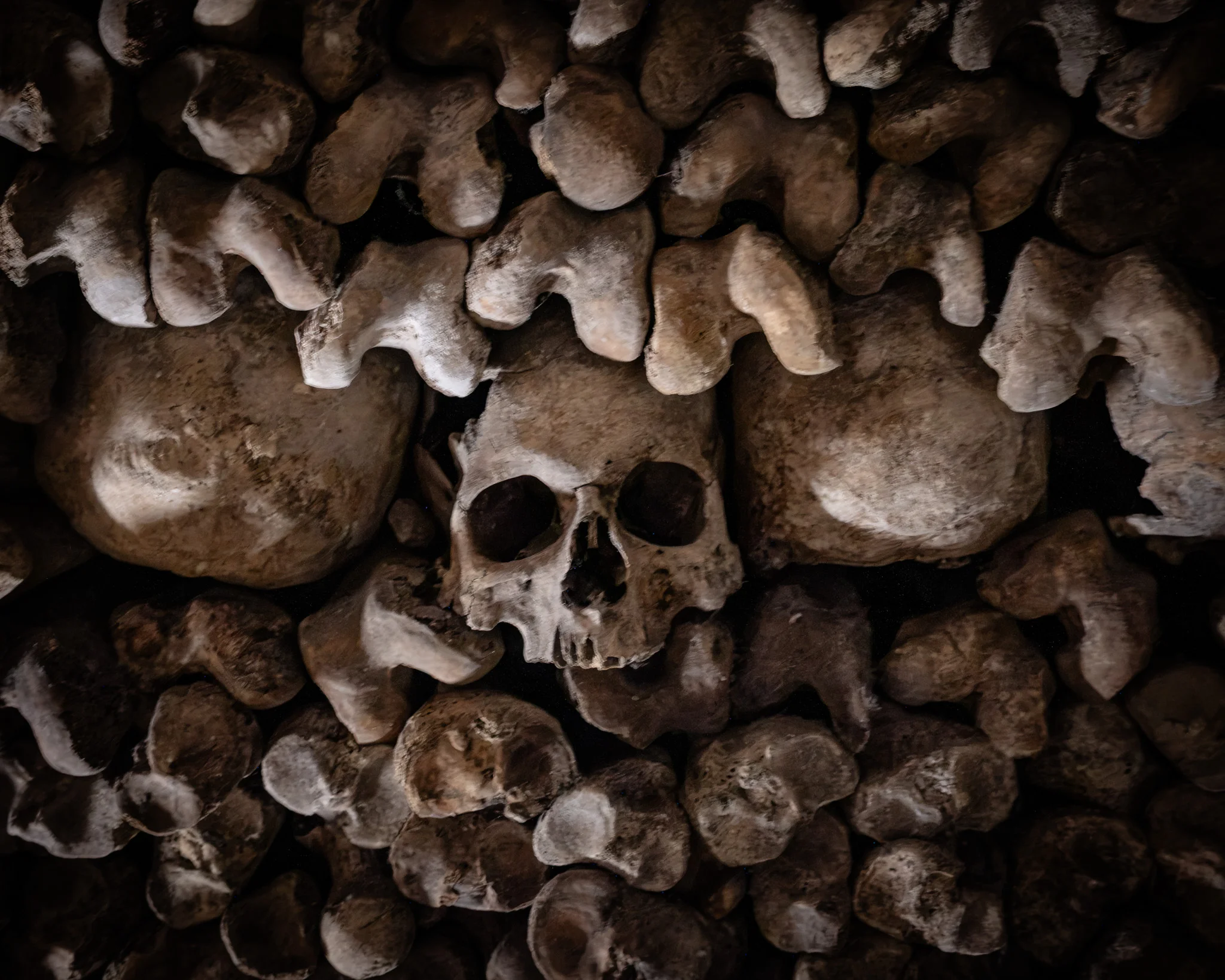
Nobody knows who this was. Someone's whole life, now the most photographed face in the room. (28 mm, f/3.6, 1/60 s, ISO 4000)
A Brief History
By the late 18th century, Paris's cemeteries were overflowing. After a series of basement wall collapses near the Holy Innocents' Cemetery in 1774, the city finally moved to close them. From 1788, covered wagons carried remains by night from the city's cemeteries into the old limestone quarries beneath the streets. The bones were later arranged with surprising artistry. The remains of more than six million people rest here.
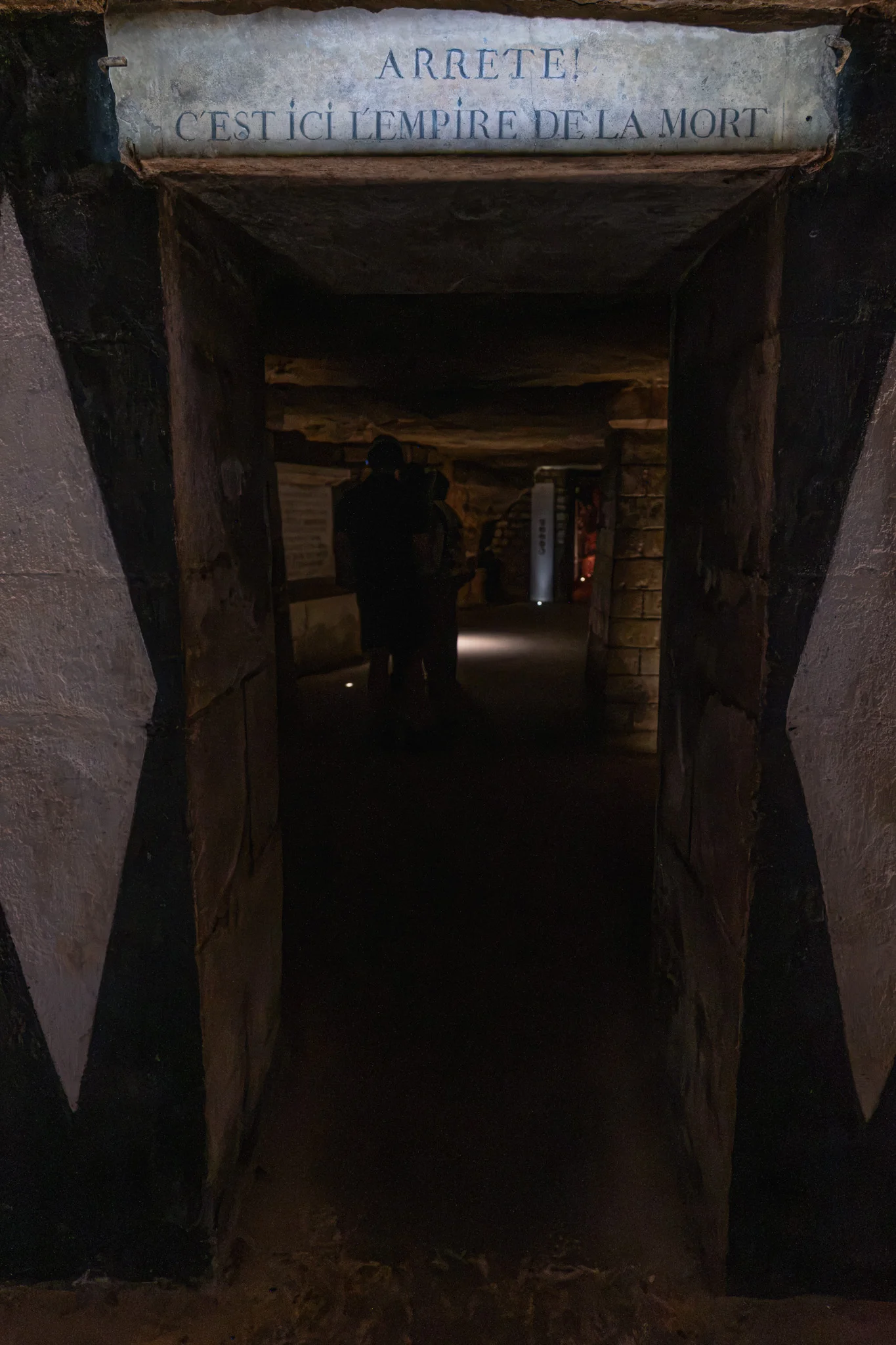
You enter the ossuary beneath a carved warning: Arrête! C'est ici l'empire de la mort. Stop! This is the empire of death. They aren't kidding.
The threshold. Everything before this is a quarry. Everything after it is people. (16 mm, f/3.2, 1/250 s, ISO 2000)
The bones are grouped by the cemetery they came from. Beyond that, nobody is set apart. Rich and poor, powerful and forgotten, all stacked together and arranged for the composition of the wall rather than for who they were. One of the inscriptions along the route describes the place as a kind of temple of equality, and it stayed with me. Every skull was a full life: laughter, tears, all of it lost to time. It's a lot to take in, and then your photographer brain kicks in and you start thinking about the light. That switch felt wild.
Planning Your Visit
The entrance is at 1 avenue du Colonel Henri Rol-Tanguy on place Denfert-Rochereau in the 14th arrondissement, served by the Denfert-Rochereau metro and RER B station. The site is closed Mondays.
To make that a bit more sporting, tickets are only released about a week before your visit date, and they go fast. Watch the website like a hawk. Do not plan to show up and buy a ticket at the door. Also, do not show up too early for your slot; you'll be told to bugger off and come back at the appointed time. As for whether you're first, last or in the middle of your group, none of it matters once you're down there.
📷 Photo Tip
Kill the AF assist lamp. Most bodies fire a small light to help autofocus in the dark. Down here it counts as a flash, and it annoys everyone. Turn it off before you go in.
The route runs 1.5 km, about 20 m below street level. It was renovated in late 2023 and now includes illustrated panels and an audio guide. The official site suggests about an hour. If you're photographing, budget more.
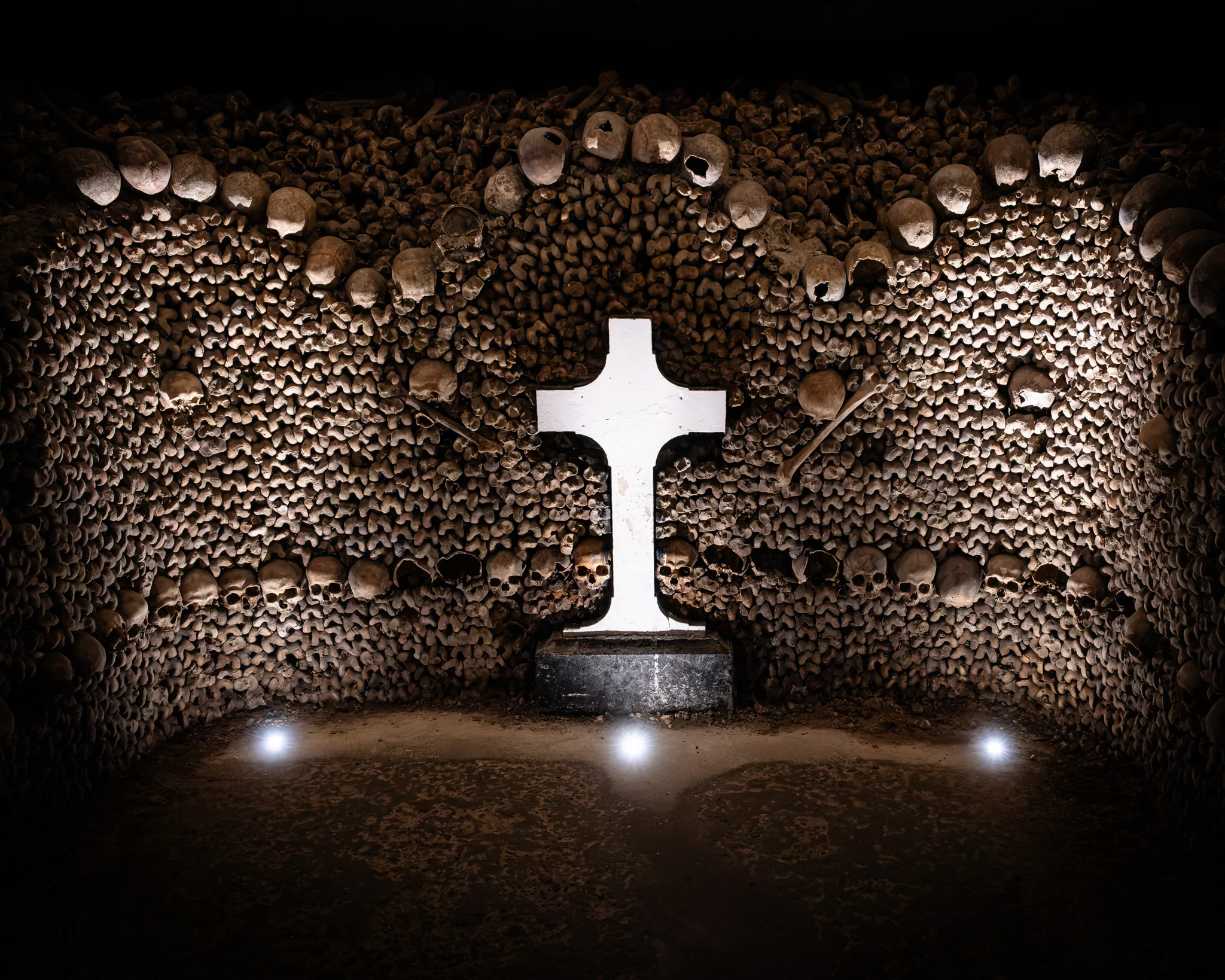
The cross chamber. Skulls in an arc above, a row at the base, and a few thousand femurs doing the masonry. Shoot it straight on and level. (16 mm, f/2.8, 1/30 s, ISO 2000)
It is also chilly underground, about 14 °C year round. You don't need a winter coat, but a long sleeve or a light jacket is a good idea. I toughed it out in a T-shirt, and once I started shooting I didn't feel a thing. My lovely wife, who is a redhead and therefore perpetually cold on account of having no soul, was glad she brought a hoodie.
One more thing: the exit and the entrance are not the same place. You climb 112 steps and come out at 21 bis avenue René-Coty, about 700 m from where you went in, so expect to be a bit disoriented when you emerge blinking into the sun. Don't worry. If you made it down the stairs, through 1.5 km of tunnels and back up again, you can walk to wherever the next part of your Paris trip is.
What's Allowed
No flash. No tripods. Bags are searched on the way in and on the way out, and anything bigger than 40 × 30 × 20 cm won't get in. Above all, do not touch the bones. They are the fragile remains of real Parisians. Not only is it forbidden, but if you do it, rest assured that you are a jerk and will likely remain one for the rest of your life.
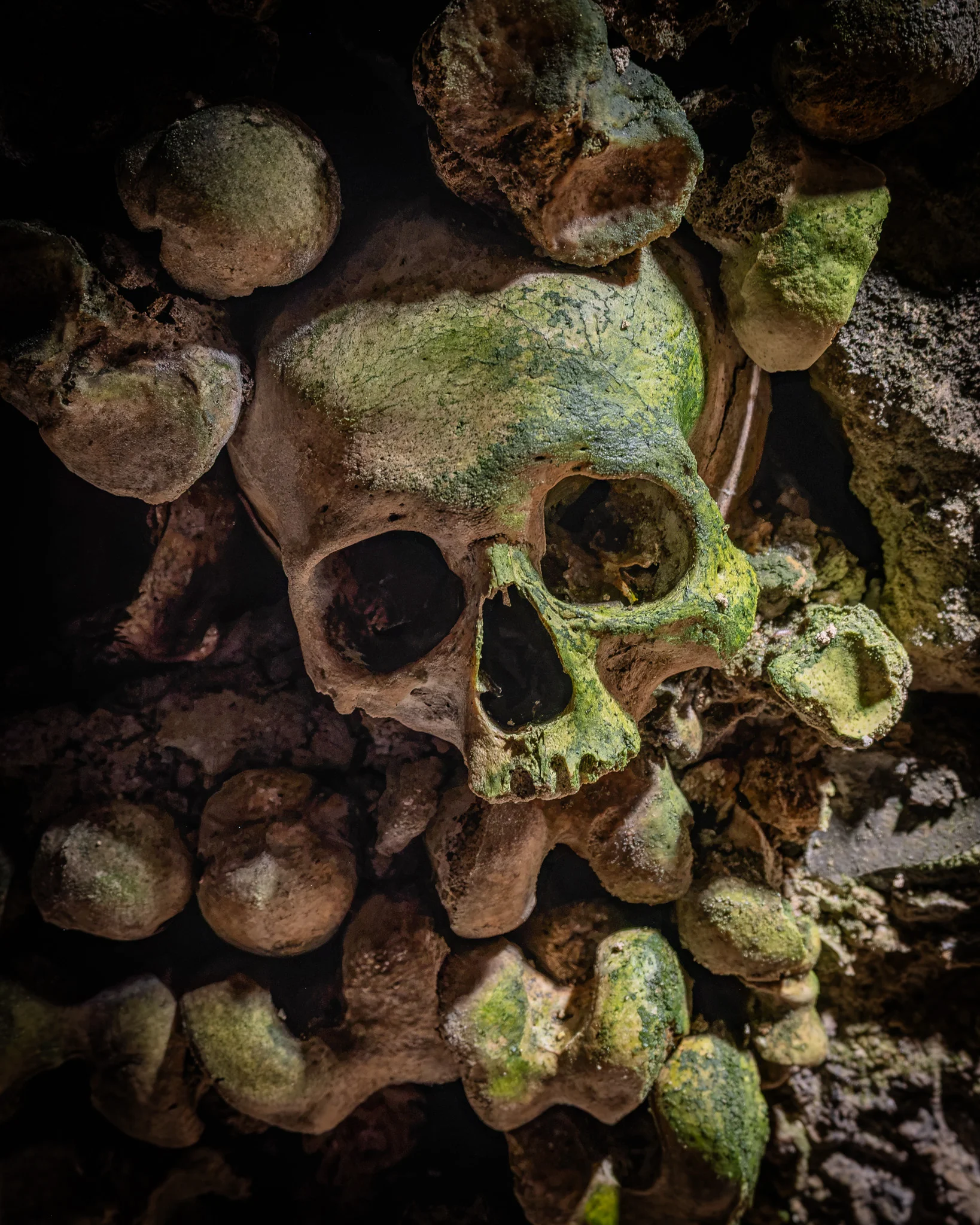
Where the lights shine, things grow. The green is algae, fed by the fixtures, and it only shows up on the bone facing the lamp. Follow it and you've found the light. (16.5 mm, f/2.9, 1/30 s, ISO 400)
Gear
Pack light. I brought one camera, one lens and a belt bag with spare batteries, and it was all I needed.
I shot everything on my Fujifilm X-T30, which is my travel camera. It lives in a weathered brown leather case and is perfect for trips like this. I pretty much only pair it with the XF 16-50mm f/2.8-4.8, which I find ideal for cityscapes and landscapes on the road. It's wide enough for the catacombs, and a long lens will do you no favours down there. Most of the frames in this guide were shot at 16 mm and f/2.8.
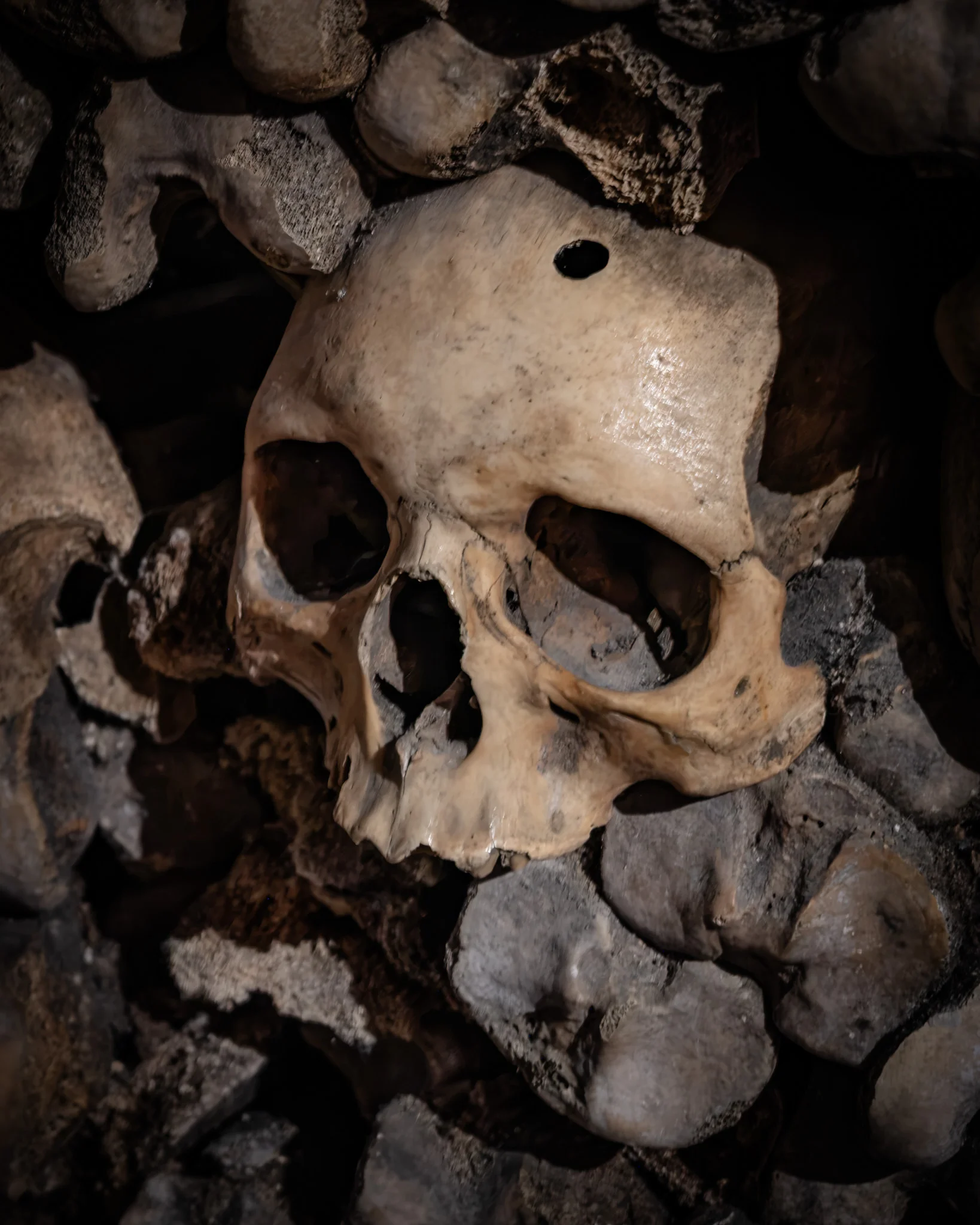
The one frame I shot at 50 mm all day, and only because of the hole. Bullet? Trepanation? Something duller? No idea, but the long end of the 16-50 was enough to ask. (50 mm, f/4.8, 1/30 s, ISO 2000)
So yes, a fast, wide lens is the most useful thing you can bring. Wide lets you get close and still show the pattern of the wall, and a bright aperture buys you shutter speed. A prime at f/1.4 to f/2 would help even more. Leave the long glass at the hotel; the galleries are narrow and you'll be working within a femur's reach of your subjects.
Settings and Technique
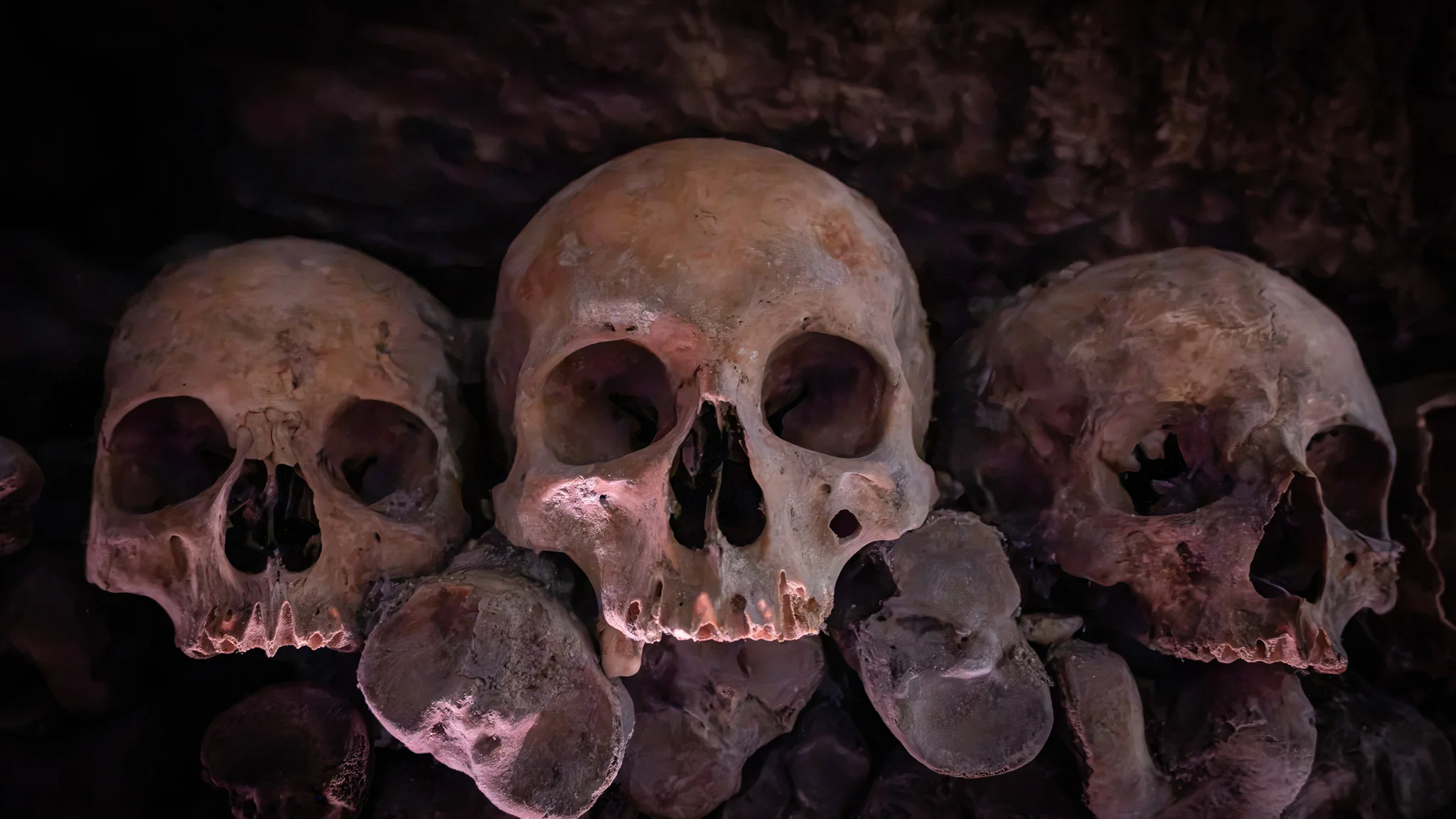
This may come as a surprise, but the catacombs are not lit for photographers. They're lit for the dead. Light comes from a mix of cool LED fixtures spaced along the route and warm accent lights set in the floor, and between them it is dark. In some spots, very dark. My approach was simple.
Three in a row, lit from the floor. The pink is real; the warm accent lights throw it up from below and it reads on camera exactly like this. (18.5 mm, f/3.0, 1/40 s, ISO 3200)
Open wide, get close, protect the shutter speed. I shot at my lens's maximum aperture and kept the shutter no slower than 1/15 s. I'm good at being still, but I'm not that good. My shots ran between 1/60 and 1/15 s.
📷 Photo Tip
Put ISO on a dial or button. You'll be changing it more than anything else. Digging through a menu while a group closes in behind you is how you miss the frame.
Raise ISO last. I aim for ISO 800 as my ceiling, but sometimes the light is so bad and the composition so good that you push past it. In practice, most of the route forced me to ISO 2000 to 3200, and one frame went to 4000. Accept it. A sharp, noisy frame beats a clean, blurry one, and modern noise reduction handles the rest. Go easy on it, though: heavy denoise and upscaling turn bone texture into plastic. With a mid-level body like mine this is hard shooting, so take lots of frames and play with your settings. As the old saying goes, if you can't shoot good shots, shoot lots.
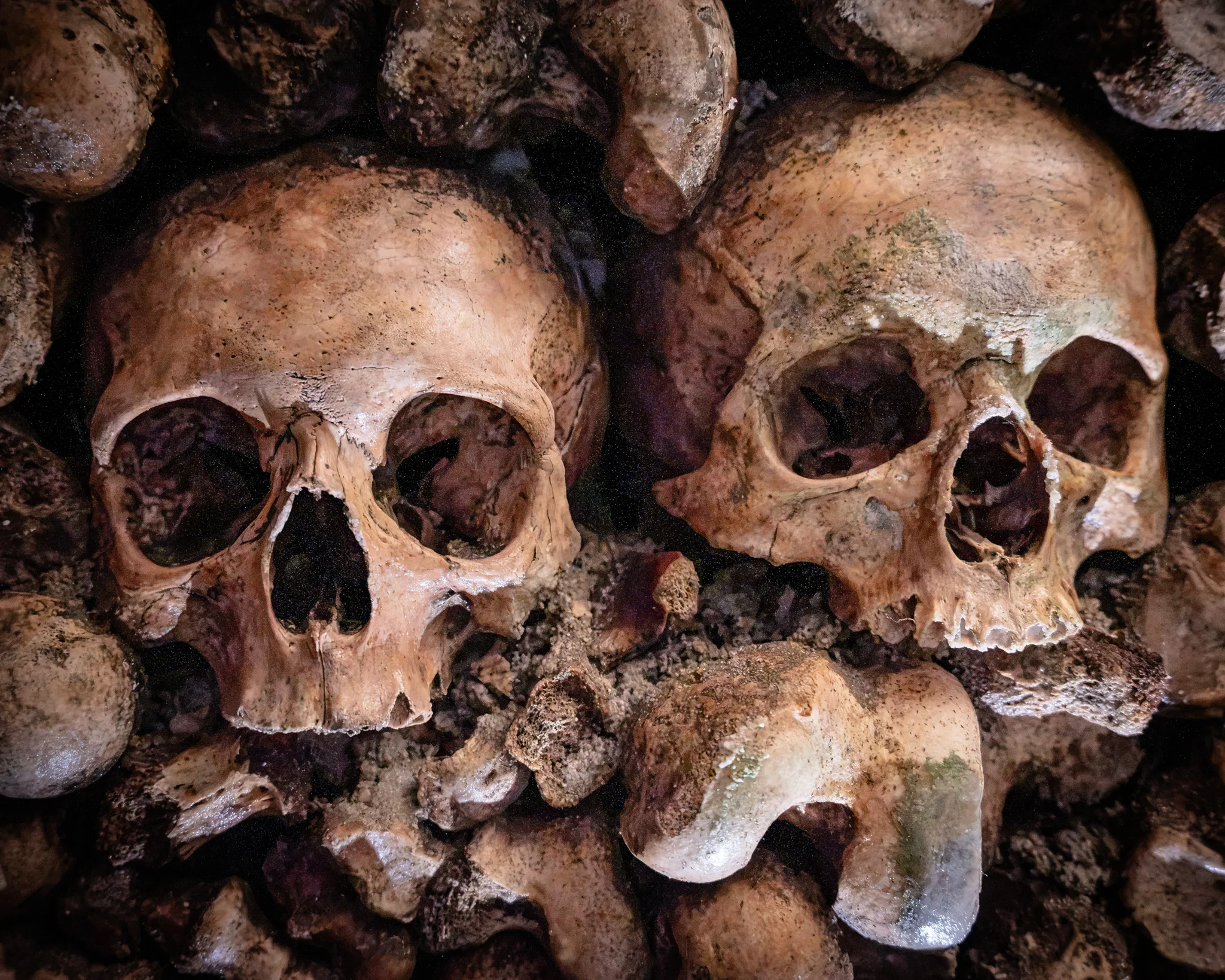
Close enough to count the cracks. That's what 16 mm gets you when you lean in, and it's as close as anyone should get. Hands stay in pockets. (16 mm, f/2.8, 1/40 s, ISO 2500)
Expose for the mood. With a digital camera it's good practice to underexpose by a stop or two and check the histogram. Judge the exposure by eye and pull it down. Deep shadows suit this place, and underexposing protects the highlights on lit bone. Digital recovers shadows far more easily than highlights. Film is the opposite, by the way.
📷 Photo Tip
Shoot RAW and fix white balance later. The route mixes cool LED fixtures with warm floor lights, and auto white balance will flip between them frame to frame. RAW lets you pick one and stick to it.
Brace like a marksman. Tuck your elbows in and lean on any surface that isn't bone. For breathing, I use a technique the military taught me: breathe in deeply, exhale about three quarters, hold, stop your heart beating if you can, and take the shot. Or in this case, release the shutter. It makes a real difference at slow speeds.
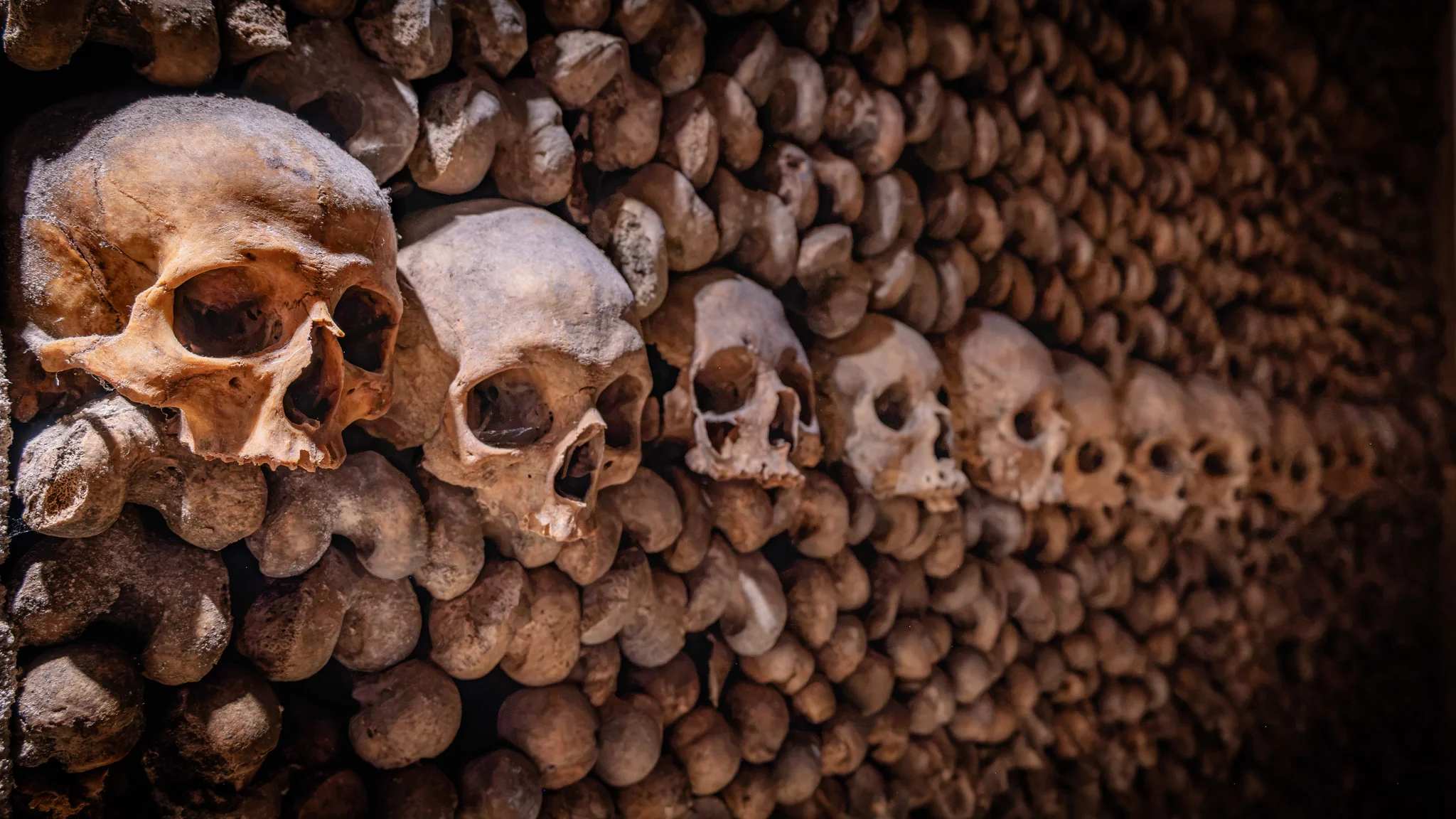
Shoot along the wall, not at it. One skull sharp, the rest falling away into blur, and suddenly the wall has depth instead of just a lot of bones. (16.5 mm, f/2.9, 1/30 s, ISO 400)
Borrow a little light to focus, not to expose. Autofocus struggles in the darkest sections. If you brought a friend, as I did, have them briefly point a phone flashlight at your subject so you can lock focus, then switch it off before you shoot. Keep it low, keep it short, and never point it at other visitors. Manual focus is also your friend here. When it's really dark I bracket my focus, taking a few frames between the near and far points. Again, take lots of shots. The bones aren't going anywhere.
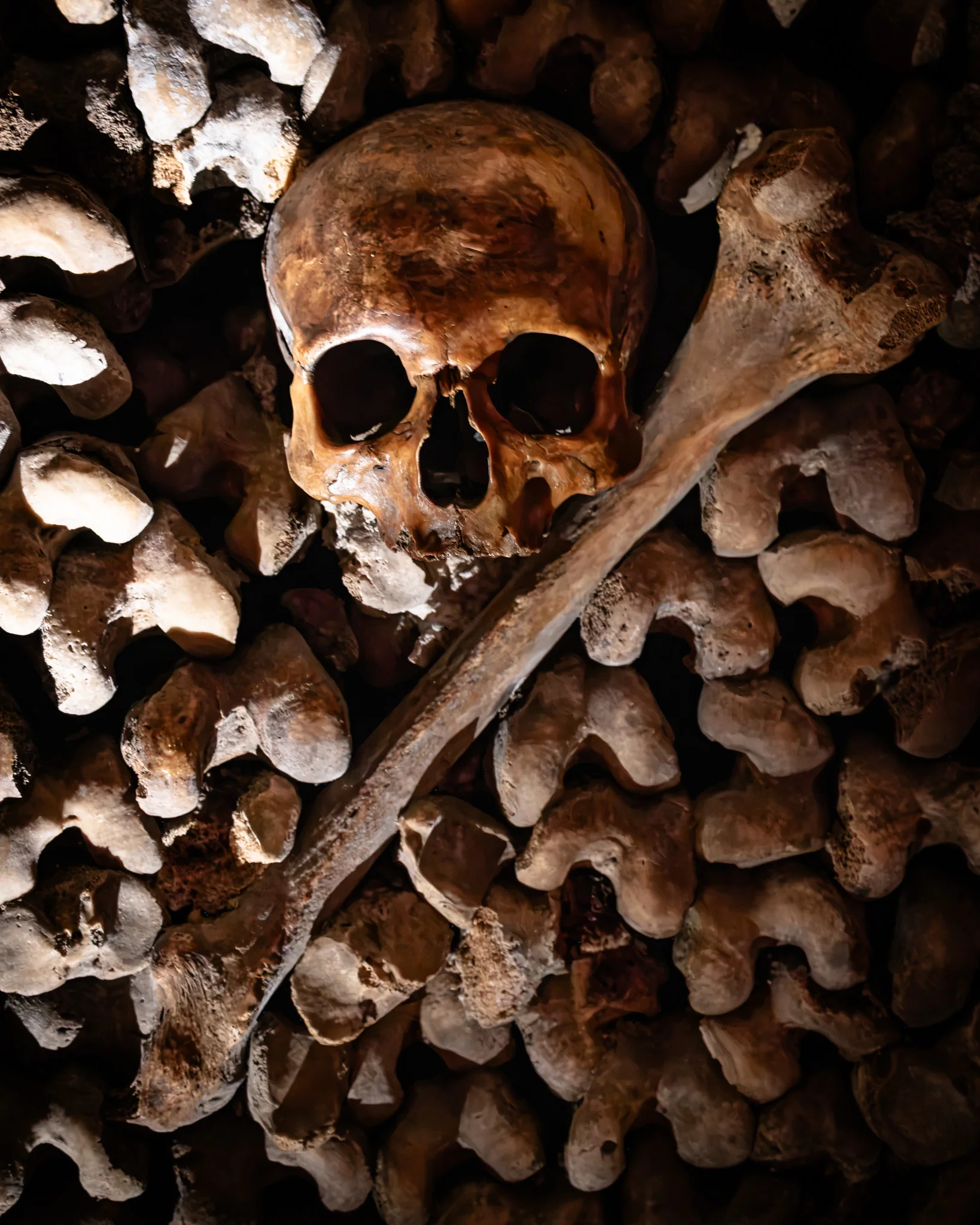
Somebody put that femur there on purpose. You can see faint hints that they once formed a cross. Two hundred years later it's still one of the best composition in the room. (25.5 mm, f/3.5, 1/15 s, ISO 3200)
Work the Light
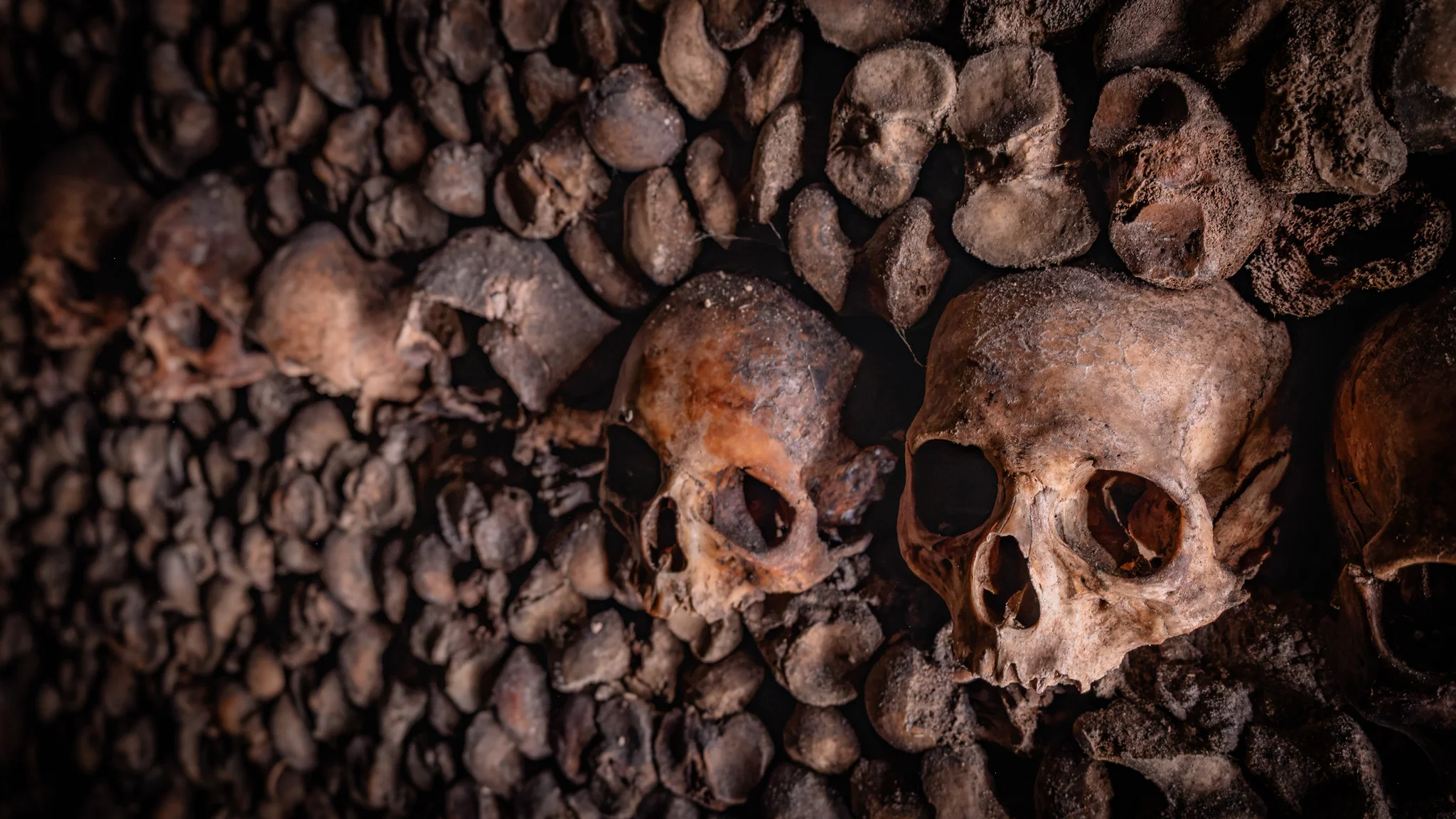
This is the whole game. Walk slowly and look for where the fixed lights fall. The best shots are where the skulls and bones happen to sit near a light source, which gives you a clean exposure, real texture and natural falloff into darkness. The good news is that the skulls that make the strongest images are almost always the ones catching a lamp, and there's no shortage of them.
📷 Photo Tip
Find the lamp, then find the skull. Don't hunt for the best arrangement and hope it's lit. Walk to each light fixture and see what it's falling on.
Light also reveals colour you won't see in the dark sections. Near some fixtures, the bone carries a green film of algae that grows on whatever the lights touch, and it reads beautifully on camera.
For wider frames, look for the set-piece chambers, where skulls are laid in rows or arcs through the femur walls. Shoot these straight on and level, and let the pattern do the work.
The skulls are in a row because someone arranged them that way, and the lamp is where it is because someone arranged that too. Use both. (16 mm, f/2.8, 1/50 s, ISO 640)
A near-to-far angle along a gallery wall also works well. Put one skull sharp in the foreground and let the rows of bone fall away into blur.
Beating the Crowds
Nobody hurries you along. Use that.
Drop to the back of your entry group and let it pull ahead. Groups spread out the deeper you go, and you'll find quiet stretches between one and the next. When the group behind catches up, step aside, let it pass, and keep shooting. We did this through several waves. There are no barriers along the walls, so patience is the only tool you need.
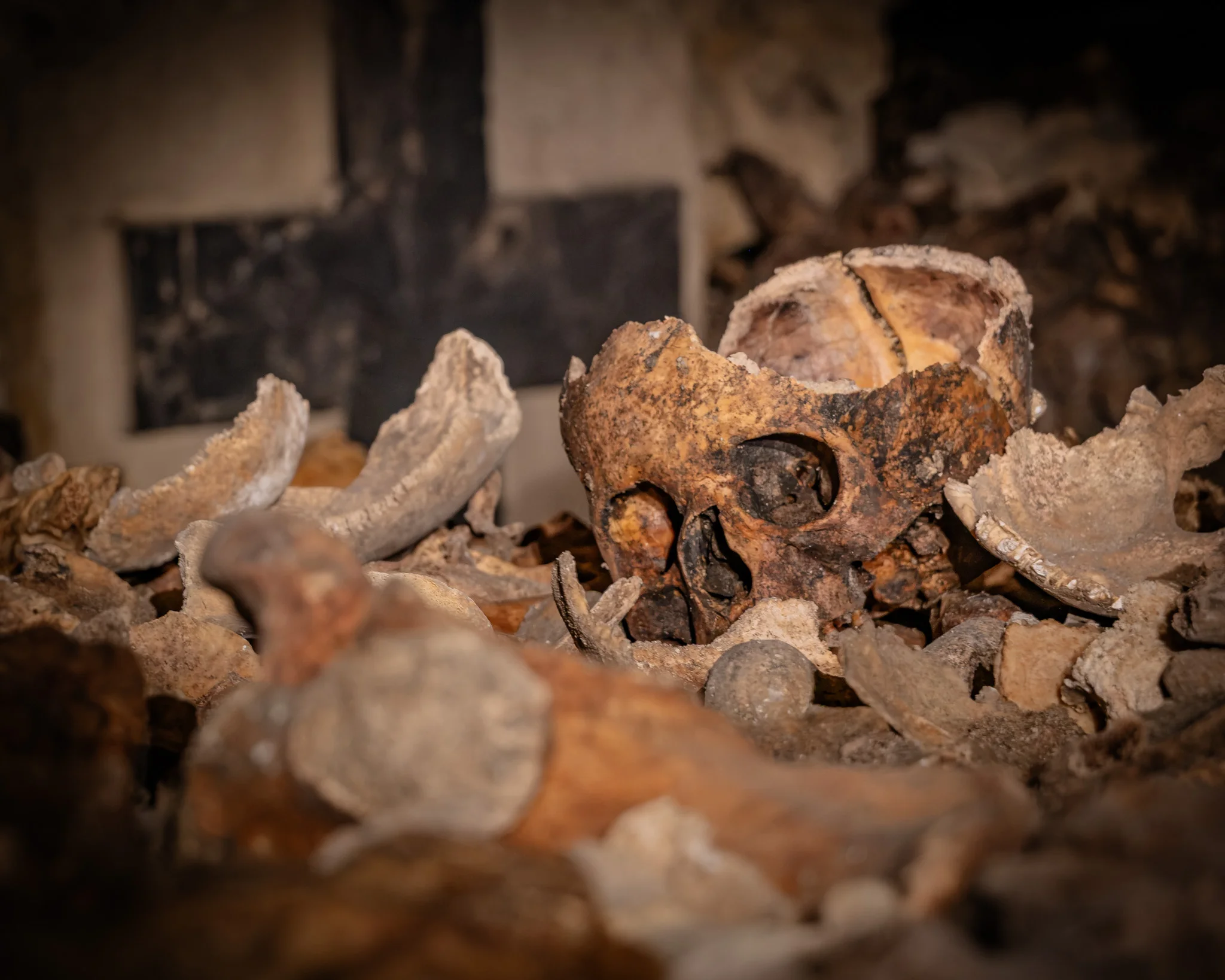
Up top, where the wall stops being tidy. This skull looks like it fell or never fit and got tossed back up. Shot at 47 mm because there was no getting closer, with the cross left soft behind it. (47 mm, f/4.7, 1/30 s, ISO 1600)
Etiquette
Please remember, this is a burial site holding millions of people who each lived a full life. Behave as you would in any cemetery. Keep your voice down, keep lights low and brief, stay out of other visitors' way, and never touch or lean on the remains. Shoot with respect and the images will carry it.
One facing out, two turned away. The arrangers had a sense of composition, and finding the pattern in the pattern is half the fun. (20 mm, f/3.1, 1/15 s, ISO 3200)
Frequently Asked Questions
Can you use a tripod in the Paris Catacombs?
No. Tripods and flash are not permitted.
What camera settings work best?
A wide aperture, a shutter speed of about 1/15 s or faster, and a raised ISO. Expect ISO 2000 to 3200 in most sections. If you own a camera that's a rock star in low light, bring it. If you don't, take lots of pictures.
How long does a photography visit take?
The official estimate is about an hour, but it's up to you. If you're serious about shooting and want to work between groups, plan for more. We took two to three hours.
Can you bring a bag?
Only a small one, under 40 × 30 × 20 cm, and it will be searched at entry and exit. I don't recommend a camera bag.


Comments
Loading comments…